Jump to winners | Jump to methodology
Embracing diversity, equity, and inclusion (DE&I) drives organizations forward, individually and collectively. It improves the work experience by making all team members feel included and supported. Additionally, DE&I programs contribute and play a pivotal role in organizational success.
Some notable cases, highlighted by Forbes, are Unilever maintaining its DE&I-focused hiring strategy in 2024, linking executive bonuses to diversity metrics – a move it attributes to a 10 percent boost in global market penetration. Meanwhile, Delta Airlines expanded its DE&I initiatives by increasing investments in workforce development programs aimed at underrepresented groups. As a result, the company saw a 12 percent rise in employee satisfaction and a 15 percent increase in customer loyalty, according to internal surveys.
Anne-Marie Pham, vice president of engagement at the Canadian Centre for Diversity and Inclusion, underlines the rationale of DE&I. “There’s actually a risk that companies will have to manage if they don’t stay committed, and the risk is to their brand and reputation, their employee engagement and satisfaction.”
She adds, “The risk is not being aligned with what most Canadians value, which is diversity and multiculturalism, as they value difference in Canada. It is part of what makes us strong and part of our identity. Which side of history do employers want to be on?”
The winners of 2025’s Canadian HR Reporter’s 5-Star DE&I Employers were chosen following a rigorous process, with thousands of employees anonymously surveyed on a range of criteria.
Pham states companies should block out DE&I detractors, including those in the US and abroad. “The leading employers are not easily swayed by external pressures that have been growing in Canada and other parts of the world,” she says. “Deep down, these leading employers know that DE&I is about human rights. It’s about deep respect for people on their team.”
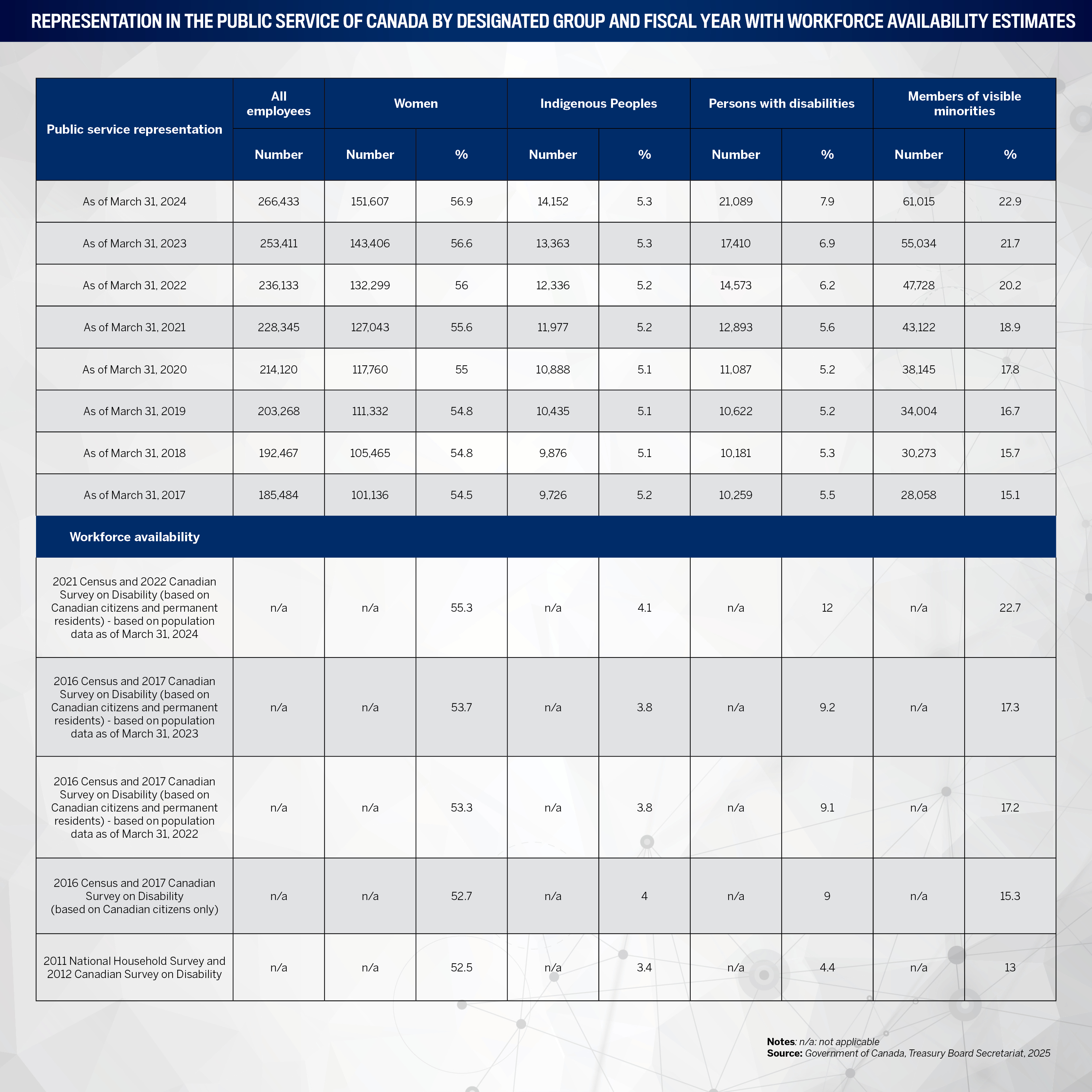
The direction of travel in Canada is clear, as government data from 2017 to 2024 shows there was an increase in the percentage of women, Indigenous people, people with disabilities, and members of visible minorities among public servants.
DE&I is now seen as a foundational lens for all business activities, not just an HR initiative. Leadership buy-in and ongoing professional development are critical, with leaders expected to model inclusive behaviours and champion DE&I at every level.
Regular, mandatory training on unconscious bias, anti-racism, neurodiversity, and Indigenous cultural awareness is standard. Training is ongoing, not a one-off, and is often tailored to address evolving workplace and societal issues.
Clear, accessible mechanisms for reporting inappropriate behaviour or discrimination are prioritized. Companies are transparent about their DE&I metrics, progress, and challenges and regularly solicit employee feedback to refine policies.
Recruitment processes are redesigned to remove bias, such as using skills-based assessments and diverse interview panels. There is a strong focus on equitable advancement and pay parity, with regular audits to ensure fairness across gender, race, disability, and other identities.
ERGs are widely supported and empowered to influence business strategy, not just serve as affinity groups. These groups are increasingly cross-functional and focused on collaboration, intersectionality, and supporting both identity-based and broader inclusion goals.
Employees should feel safe, valued, and able to bring their authentic selves to work. Psychological safety is non-negotiable, with companies fostering open dialogue, feedback, and vulnerability at all levels.
There is a heightened emphasis on Indigenous reconciliation, including consultation with Indigenous peoples, acknowledgment of land, and targeted recruitment and advancement programs. Anti-racism policies are explicit and action-oriented, with accountability for outcomes.
Policies support flexible work arrangements, accessible workplaces, and accommodations for neurodivergent and disabled employees. This includes physical accessibility, alternative work arrangements, and technology to support all abilities.
Leading employers extend their DE&I efforts beyond the workplace, supporting marginalized communities through scholarships, partnerships, and volunteering.
Coast Mental Health (CMH), a Vancouver-based non-profit, has an employee committee to lead its DE&I goals, including members from visible minority backgrounds, those with lived experience, and individuals who are neurodivergent. The aim is to ensure the work environment is as welcoming as possible.
Part of CMH’s strategy extends beyond DE&I to include, more specifically, anti-racism and decolonization. Some of their initiatives include:
employee voice and feedback loops: regular engagement and pulse surveys and a commitment to actioning what is heard. By sharing outcomes transparently and involving staff in solutions, feedback turns into meaningful change.
DE&I-focused initiatives: embedded equity into everything from recruitment practices to succession planning. Also active in province-wide DE&I forums and helping shape frameworks that centre Indigenous-specific initiatives.
peer support and resource networks: staff-led initiatives like wellness committees and affinity groups, so employees can connect over shared experiences and offer mutual support.
recognition and growth opportunities: pathways celebrate a wide range of contributions across departments.
Part of CMH’s effectiveness comes from its frequent employee check-ins and surveys. Deborah Maynard, chief HR officer, explains, “We rely a lot on our committee and allies across the organization, as we’re extremely diverse.”


New employees are given DE&I training as part of their onboarding, giving them the tools needed to thrive in such a diverse workplace. The training principles are:
unconscious bias and cultural competency: workshops help staff recognize and mitigate unconscious bias while deepening their understanding of different cultural perspectives and practices.
trauma-informed practice and cultural safety: emphasizes trauma-informed approaches and cultural safety, especially when working with Indigenous clients and communities.
inclusive leadership development: how to foster psychologically safe spaces, support diverse teams, and interrupt systemic inequities.
onboarding with a DE&I lens: foundational DE&I principles, ensuring all new employees understand the organizational values and expectations around respect and inclusion.
Maynard says, “We view DE&I training as an ongoing journey – not a one-time event – and we’re committed to continuously evolving our approach based on staff feedback, community needs, and emerging best practices.”
Performance is also in part measured by the employee’s dedication to DE&I and completion of training, according to Maynard. This is crucial to creating a team effort in achieving the organization’s end goals. “We’re embedding DE&I into the culture,” she explains. “That makes it so that the training is not performative, and employees know that leadership is committed to it because it’s part of how their performance is managed.”
Some employees are drawn to the mental health field because of lived experiences with family members or have personally faced these struggles. This adds to the need for mental health training, which is integrated into CMH’s DE&I initiatives. Employees can access trauma-informed CBT training and a therapist in addition to the standard service offered by B.C.’s Employee and Family Assistance Services.
CMH has a separate committee for Indigenous reconciliation work, leading the efforts to incorporate Indigenous culture and history through hands-on learning events, like traditional basket weaving and education sessions.
Maynard says, “We bring elders and knowledge keepers onto our sites and talk about the history of basket weaving and why it’s important to the Indigenous culture. We’ve also sent employees to sessions, where they talk about the history of longhouses in reconciliation and the steps toward decolonization.”
Both committees work toward the same goal of creating an equitable workplace.
Jazz Aviation LP, Air Canada’s largest regional partner, has a range of DE&I-related policies such as Accessibility, Gender Affirmation, Flexible Work Arrangements, Workplace Violence, and Harassment Prevention.
The firm holds listening forums with various employee groups and a quarterly virtual Insight Series where senior leaders meet with members from the various ERGs:
2SLGBTQIA+ Group
Indigenous Employee Group
Black Employee Network
Diversity Council
The company-wide newsletter shares DEI&A-related content, and there is an Aspiring Allies program that employees can opt into and receive biweekly Ally Tips to empower employees across the organization to be more inclusive.
President Doug Clarke says, “It’s critical to our success that all employees feel a sense of psychological safety and are empowered to perform at their best. We have been taking action for many years across all levels of our organization to attract and retain the best talent, and our commitment to equity, inclusion, and accessibility is a collaborative and ongoing effort.”
Jazz also organizes and hosts an annual one-day Inclusive Skies conference on DE&I and accessibility in aviation. The airline attends job fairs for underrepresented people and has raised awareness of non-apparent disabilities by highlighting employees’ lived experiences through pre-recorded videos and webinars.
Fiddlehead Technology views DE&I through a value lens, believing that it greatly improves its market competitiveness.
“For us, diversity isn’t just a value. It’s a strategic advantage. In a field built on data, insights, and reducing bias in our models, it would be contradictory to allow bias to go unchallenged in our workplace,” explains CEO Shawn Carver. “The current environment only reinforces our conviction that DE&I is not a trend but a necessity for building resilient teams and delivering stronger outcomes for our clients.”
The company is dedicated to creating an inclusive work environment where all employees physically feel a sense of belonging by:
offering vegetarian and halal meal options at company events
providing a private space for prayer, breastfeeding, and meditation (which can be locked by employees to ensure privacy)

This is part of their greater DE&I strategy, which is spread across a series of initiatives:
inclusive leadership and open communication: anonymous employee surveys and open forums to gather input from all team members
leadership accessibility: regular check-ins and office hours to ensure employees can voice concerns, ideas, and feedback
equitable compensation and pay transparency: structured compensation models to ensure fairness in pay and promotion opportunities
work-life balance: flexible work arrangements, including hybrid work options and additional paid time off (every other Friday) to support employee well-being
professional development and career growth learning culture: dedicated time for professional growth and skill development in emerging areas of AI and data science.
DE&I training and awareness: all employees, including leadership, undergo inclusive workplace training to ensure a respectful and supportive work environment
To make training engaging and meaningful for employees, Fiddlehead simulates realistic instances in employees’ day-to-day work lives. “We take a deeply integrated approach to DE&I, not as a one-off training, but as a continuous thread running through how we hire, lead, and collaborate,” Carver says. “This makes the principles tangible, practical, and consistently reinforced through our daily actions and culture.”
With under 100 employees, a sense of belonging and acceptance is critical to the success of the Moncton-based firm. Carver says that the firm is always working on improving the fundamental goal of celebrating individuality.
He explains, “In a small team, every voice matters, so inclusivity is foundational. From the outset, we’ve cultivated a culture rooted in curiosity, rigour, and mutual respect. Our strength comes not just from our individual capabilities, but from how we bring them together.”
BioTalent Canada has a deep belief that belonging and inclusion are key to its success. This is lived by a commitment to inclusion, diversity, equity, and accessibility (IDEA) practices, with the IDEA Committee, accessible to all staff, gathering feedback via an annual anonymous survey.
Each week, employees recognize cultural, spiritual, and religious days of significance at the company-wide meeting. For 2025, the focus areas include Indigenous ways of knowing. Learning has also been fostered through publicly available material and videos on Two Spirit experiences, Black History in Canada, and neurodiversity.
BioTalent Canada participates in the federal 50–30 Challenge (gender parity and increased representation of equity-deserving groups) and offers multiple listening channels – formal and informal – to ensure every voice is heard. Managers reinforce inclusion by understanding individual work styles, actively listening, and supporting team members beyond their roles.
The People and Culture team manually screens every application – without the use of an Applicant Tracking System (ATS) – to ensure fair opportunity for candidates with diverse experiences, nonlinear career paths, or newcomer status.
This is reinforced through inclusive language in all job postings and by incorporating diversity-related questions into the interview process. By doing so, IDEA values are present from the very first interaction with potential team members.
Make DE&I a core business strategy, not a side project.
Ensure leadership accountability and visible commitment.
Prioritize ongoing education, transparent reporting, and measurable outcomes.
Foster a culture of belonging, psychological safety, and open feedback.
Support ERGs, flexible work, and accessibility for all.
Engage with and support marginalized communities outside the organization.

To determine the companies with the most effective DE&I programs, Canadian HR Reporter first invited organizations to participate by filling out an employer form, which asked them to explain their diversity and inclusion initiatives and practices.
Next, employees from nominated companies were asked to fill out an anonymous form evaluating their workplace on a number of metrics. To be considered, each organization had to reach a minimum number of employee responses based on overall size.
Organizations that achieved a 90 percent or greater average satisfaction rating from employees were named 5-Star Diversity, Equity, and Inclusion Employers for 2025.