
A look at the federal government’s program aimed at streamlining the process to bring talent and new skills from abroad

Background
Since 2017, Canada has implemented the Global Skills Strategy, which creates a faster and more predictable process for attracting top talent and new skills to Canada. It assists Canadian companies in filling in-demand occupations, where there is a demonstrated gap in the Canadian labour market. Immigration lawyer Sergio Karas looks at the features of the strategy as well as how employers and foreign workers can navigate through it.
The Global Skills Strategy tracks employers’ commitment to create jobs, transfer knowledge and train Canadian workers and, according to government claims, this facilitates new investments in Canada; in turn promoting economic growth and creating more middle-class jobs for Canadians.
The strategy provides for an expeditated processing time of two weeks for issuance of a work permit. This faster processing time is not only available to temporary foreign workers being hired but also to their accompanying family members. The strategy further provides work permit exemptions for highly skilled workers and researchers looking to work in Canada for a short time, as well as the creation of a dedicated service channel, which gives employers access to an account manager who assists them in navigating the process.
International Mobility Program
Under the International Mobility Program (IMP), an employer can hire a foreign worker without a Labour Market Impact Assessment (LMIA). Under the strategy, the government maintains a list of occupations that are exempt from an LMIA; if a worker’s occupation is listed, they are eligible to be hired without an LMIA. LMIA-exempt workers can benefit from the strategy if they fall under the National Occupational Classification skill category of a manager or professional (NOC code O or A).
Global Talent Stream
The strategy introduced the Global Talent Stream (GTS) under the Temporary Foreign Worker Program (TFWP). The TFWP allows employers in Canada to hire foreign nationals on a temporary basis if no Canadians or permanent residents are available for the position. Work permits are issued based on the LMIA opinion issued by Employment and Social Development Canada (ESDC). All employers are required to demonstrate that their business and job offer are eligible under the program.
There are two categories of employers who are eligible to hire foreign workers under the GTS:
- Category A: The employer must be referred by one of the designated referral partners. To receive a referral, the company must operate in Canada, focus on innovation, be willing and capable of scaling up, is seeking to fill a unique and specialized position and has identified a qualified foreign worker for potential hire.
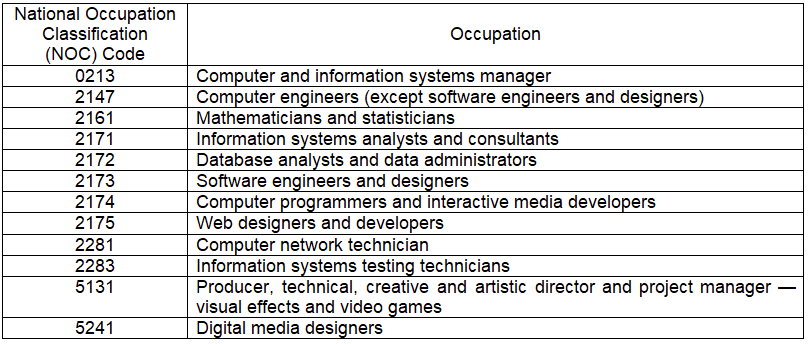
- Category B: An employer hiring a highly skilled foreign worker to fill a position that is found under the Global Talent Occupation List falls under this category. The list is subject to change, but at the moment it includes the following occupations:
An employer must develop a Labour Market Benefits plan with ESDC that demonstrates its commitment to activities that have a lasting and positive impact on the Canadian labour market. This plan helps to identify and track the employer’s overall job creation, skills and training investment.
There are two kinds of benefits that need to be included: mandatory and complementary. If an employer applies under Category A described above, it must commit to creating jobs for Canadians and permanent residents as a mandatory benefit. However, if the employer applies under Category B, then it must commit to increasing skills and training investment for Canadians and permanent residents. Two complementary benefits also need to be listed; these cannot be the same as the mandatory benefits. If an employer is applying under both categories, then it must commit to both the mandatory benefits, as well as two additional complementary benefits.
ESDC conducts an annual progress review to assess how well the employer is meeting the commitments that were outlined in the plan. Even if the foreign worker later becomes a permanent resident, the employer is accountable for the benefits committed to in the plan.
Employer compliance
Employer compliance is separate and distinct from the progress review of the labour market benefits plan. An employer must be aware of its responsibilities and obligations under the Immigration and Refugee Protection Act (IRPA) and the Immigration and Refugee Protection Regulations (IRPR), meeting the requirements and upholding the conditions set out in the regulations. The employer is responsible for meeting all the conditions and requirements of the TFWP, the LMIA application, the decision on the application and its annexes. It also needs to retain all records for six years. ESDC has the authority to review the activities of the employer at any time. If an employer is found to be noncompliant, they will not be eligible to hire another foreign worker under the strategy.
Exemptions
Some exemptions from obtaining a work permit exist under the Global Skills Strategy, such as for highly skilled workers and researchers.
Highly skilled workers. A foreign national can work in Canada without a work permit if they are highly skilled and fall under the position description of manager or professional in the NOC code O or A and their stay is of a short duration — a period of up to 15 consecutive days once every six months or up to 30 consecutive days once every 12 months.
Researchers. A foreign national can work in Canada as a researcher without a work permit if: they will perform research in a Canadian, publicly funded, degree-granting institution or its affiliated institution; they have a significant role to play or value to add to the research project; and they will stay in Canada for a short duration — in the case of a researcher, a period of up to 120 days once every 12 months.
It must be noted that a foreign national can renew their exemption only if the necessary time has elapsed since they were last granted an exemption. This means that they can use the 15-day exemption only after six months have passed since its last use; a 30-day or 120-day exemption can be used again only after 12 months have passed since they last used it.
Processing times
As part of the Global Skills Strategy, highly skilled foreign nationals applying from outside Canada are eligible for a two-week processing time for their work permit application. This expedited time is also available for the workers’ immediate family members (spouse/common-law partner and dependent children) if they apply along with the main applicant. There is no need to apply separately for a visa or electronic travel authorization, as all the necessary permits will be issued with the work permit. The foreign national should ensure that the local visa office requirements have been fulfilled. If the requirements are not met, it can cause delays in the processing of the application.
Enhanced customer service
A Dedicated Customer Channel (DSC) is available to assist universities that support publicly funded research chairs and companies that make a significant job-creating investment in Canada by setting up operations in the country for the first time or significantly expand their business. To be eligible for the DSC, one of the referral partners must identify and refer the employer. A list of the referral partners can be found at https://www.canada.ca/en/immigration-refugees-citizenship/services/work-canada/hire-foreign-worker/temporary/global-skills-strategy/dedicated-service-channel.html. To be eligible for referral, a company must be making high-value investments, be a high-potential or high-growth company or be an innovative company.
If eligible, an employer is given access to an account manager, who will provide services such as information on available immigration programs, explanation of processes, linking investing companies to relevant operational staff in Canada or abroad and serving as a co-ordinating point of contact to ensure smooth processing and communication.
The Global Skills Strategy was introduced as a pilot project for two years; however, its success has made it a permanent program. Since its introduction, 40,000 workers have come to Canada and more than 1,100 Canadian employers have used the Global Talent Stream, according to Immigration, Refugees and Citizenship Canada.
The strategy has been beneficial in many ways. It has increased the specialized work force in Canada. Work permit exemptions allow employers to hire highly skilled workers for a short duration without applying for a work permit. The introduction of the Labour Market Benefit plan ensures that companies hiring a foreign worker create more opportunities for Canadians.
The strategy has many advantages, but it is not devoid of drawbacks. The Labour Market Benefits plan creates a burden on the employer. Many companies that need a specialized foreign worker might not be able to hire one because they lack the resources needed to implement the plan. While the processing time has been significantly reduced, the time needed to meet the documentary requirements can cause significant delays. To be eligible for Category A in the GTS, the employer needs to be referred by one of the designated referral partners; obtaining this referral is not easy. There is no minimum requirement to recruit Canadians or permanent residents, even though the guidelines encourage employers to do so before hiring a foreign national.
The strategy is still in its nascent stage and it is too early to assess its overall impact on the Canadian economy.
 Sergio R. Karas is principal of Karas Immigration Law Professional Corporation in Toronto. He can be reached at (416) 506-1800 or [email protected].


