
Screening practices that may once have been thought to be breaches of privacy will be essential in the post-pandemic workplace
Background
During the COVID-19 pandemic, many employers have had their employees working from home. As the infection numbers decrease and the economy moves toward reopening, these employers must plan to have their employees back in the workplace while keeping in mind the risks that the coronavirus still poses — and this includes safety practices such as providing PPE and temperature screening.
Employment lawyer Christopher Justice discusses how employers can properly implement screening of employees and third parties that are entering the workplace while balancing the interests of privacy and workplace health and safety.
As employers prepare for the reopening of their physical workspaces, it is crucial that they have all of the necessary health and safety measures in place well before the reopening occurs. This includes ensuring that workplace policies are up to date, that all the necessary hygienic and Personal Protective Equipment (PPE) is stocked and that the physical layout of the workspace is modified to allow for appropriate physical distancing.
As more and more workers return to the physical workspace, employers will have to be vigilant in ensuring that they do not allow anyone who is exhibiting COVID-19 symptoms to enter the workspace.
One symptom consistent with COVID-19 is a body temperature above 38˚C. Therefore, and in order to reduce the risk of transmission, employers should have measures in place to detect this symptom when present. This is where the appropriate use of temperature screening can be crucial.
Temperature checks
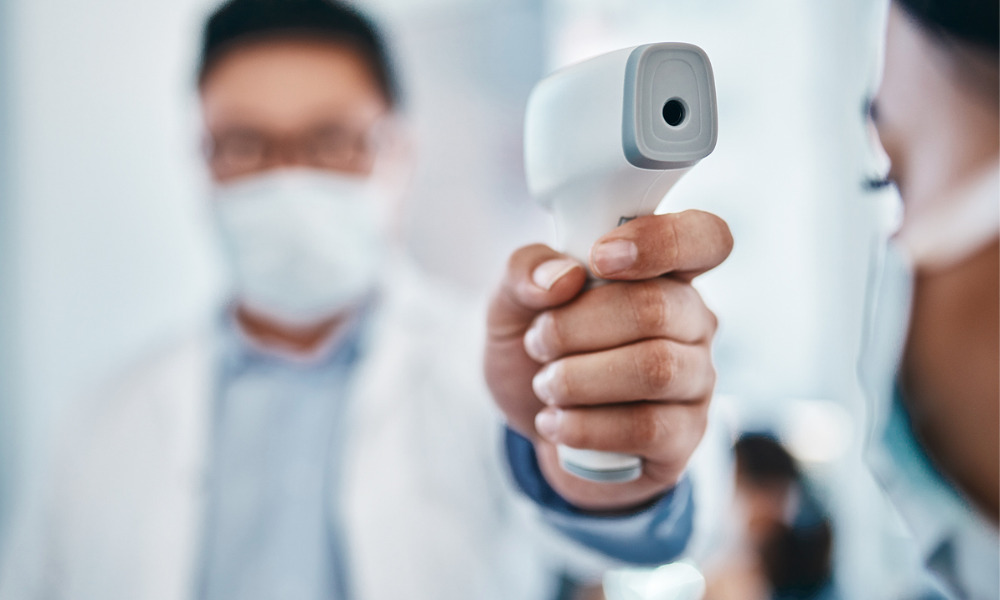
There are two main methods of checking someone’s temperature: by oral thermometer or by infrared digital thermometer.
It is recommended that employers use an infrared digital thermometer as they are less invasive. They are also relatively inexpensive and do not require contact with another individual. A list of infrared thermometers is available for purchase online.
Infrared thermometers are typically placed in front of someone’s forehead and usually require the individual taking the temperature to place the thermometer a few centimetres away from the forehead. For this reason, employers need to be particularly mindful in ensuring that everyone is wearing the necessary equipment. A thermometer with the ability to assess temperature from a further distance, if possible, would be ideal.
While temperature checks are somewhat controversial, given the current climate and provided certain protocols are put in place, they are likely to be deemed reasonable, if not necessary. Furthermore, in Ontario and certain other jurisdictions, there is no specific private sector legislation dealing with privacy that would apply to employees.
It should be noted that such tests generally fall in line with the federal government’s current guidance that every person with a fever should self-isolate out of an abundance of caution that the fever may be attributable to COVID-19.
The Ontario Human Rights Commission has also taken the position that screening processes used to verify or assess for COVID-19 (including temperature screening) may be permissible during the current epidemic. However, such assessments should be reasonable and consistent with the most recent advice from public health officials.
Conducting temperature checks
It is important that employers conduct the temperature checks in a fair and reasonable manner, keeping in mind the important health and safety and privacy concerns. It is ideal if employers are able to hire an external, trained individual to conduct the testing.
That said, and in any event, employers need to ensure the following:
- Is the person taking temperatures trained on how to do so? Ensure the appropriate physical distancing occurs and that both the person taking the temperature and individual having their temperature taken are wearing the necessary PPE (masks/face shields, gloves and a gown).
- Do you have the person’s consent to take their temperature? If not, they should be refused access to the workspace until they are agreeable.
- Is hand sanitizer accessible where the temperature check is conducted?
- Is there a lineup of individuals waiting to have their temperature taken? If so, ensure appropriate physical distancing within the lineup.
- Has the individual conducting the test taken a temperature check of themselves? Before conducting checks, this individual should confirm they do not have a fever themselves.
- The temperature checks should occur in a private or semi-private area, in order to keep the identity of anyone with fevers confidential.
- Ensure that the temperature checks are not collected, used or disclosed for any purpose outside the specific purpose for which they are being conducted (such as whether or not the individual should be permitted to enter the workspace).
- Has the thermometer itself been maintained properly?
- Ensure that the thermometer is wiped down and sanitized on a regular basis and kept in a sealed Ziplock bag when not in use.
- Before taking the temperature of an individual, ensure that their forehead is prepared for measuring (the forehead is clean and not obstructed by hair).
- Do you have a protocol in place in the event that an employee or third party tests positive to or admits to experiencing COVID-19-related symptoms?
Temperature checks alone are not enough
It is important to know that COVID-19 can be spread well before an individual experiences a fever, as there is a host of other symptoms linked to the virus. There are many reasons why someone’s temperature may be high, aside from COVID-19. As such, temperature checks should always be used with other controls, including a questionnaire and attestation.
Questionnaire
A questionnaire should ask the following questions:
- Are you experiencing any of the following issues: severe difficulty breathing; severe chest pain; feeling confused; or losing consciousness?
- Are you experiencing any of the following symptoms: fever; chills; cough that is new or worsening; barking cough; shortness of breath; sore throat; difficulty swallowing; runny nose; stuffy or congested nose; loss of taste or smell; pink eye; headache; digestive issues; muscle aches; or fatigue?
- Are you in any at-risk group (i.e., 70 years or older, weakened immune system or chronic health condition)?
- Have you been in close physical contact with someone who tested positive for COVID-19 within the last 14 days?
- Have you been in close physical contact with a person who either: is currently sick with a new cough, fever or difficulty breathing; or returned from outside of Canada in the last two weeks?
- Have you travelled outside of Canada in the last 14 days?
These questions come directly from the Government of Ontario’s self-assessment tool. It is recommended that employers use this as a guide when implementing their own questionnaire. To the extent that someone answers in the affirmative to any of the above questions, employers can refer to the federal government’s self-assessment tool (https://ca.thrive.health/covid19/en) when deciding the appropriate course of action.
In conjunction with the questionnaire, employers should have those entering the physical workspace sign an attestation every time they wish to enter the workspace, confirming the following:
- They are not exhibiting any symptoms relating to COVID-19
- They have otherwise answered in the negative to the above-noted questions
- They do not have a temperature above 38˚C.
Bottom line for employers
Employers have an obligation to provide a healthy and safe workplace for their employees and any third parties entering their physical offices. By instituting mandatory screening measures, within reason, and by following the above-noted conditions, this will ensure a much safer workplace to return to, while also giving employees the confidence to know that employers are taking all necessary precautions to protect their well-being.
 Christopher Justice is an associate with MacDonald & Associates, a law firm in Toronto specializing in employment law for both employers and employees. He can be reached at (416) 601-2300 or [email protected].


