
'Poaching employees is a business practice, but employers need to be very cautious to put mechanisms in place to protect the company'

When senior executive Moyra Miller was approached by AlayaCare through LinkedIn, the message was clear: the company wanted her on board—and they were willing to go the distance to hire her. A higher salary, bonuses, equity incentives, and even indemnification against potential legal action from her former employer were on the table.
Miller left her long-standing position to join AlayaCare in January 2022. But seven months later, she was terminated without cause. What followed was a wrongful dismissal claim that led to a ruling in her favour, with the Ontario Superior Court awarding 14 months’ reasonable notice and damages totaling over $204,000.
At the heart of the judgment was the court’s finding of inducement—employer conduct that created a reasonable expectation of job stability and led Miller to leave secure employment.
A similar story unfolded on the west coast. In Mercer Celgar Limited Partnership v. Ferweda, the BC Court of Appeal upheld a 12-month notice period for Gerald Ferweda, a chemical engineer with 27 years at Catalyst Paper.
Celgar recruited him in 2018, flying him to Castlegar and making promises of stability and long-term opportunity. He left his secure role, accepted the job — and was terminated just over two years later.
Celgar appealed the original decision, arguing the inducement was modest. The appeal was dismissed.
Figuring out formula for inducement, notice periods
“Poaching employees is a business practice, but employers need to be very cautious to put mechanisms in place to protect the company,” says Thomas Perry, associate lawyer at Hyde HR Law in Toronto, citing the risk that courts will combine two lengths of services together in assessing notice periods.
“That clock keeps ticking, and the employer can be on the hook.”
As explained in Wallace v. United Grain Growers, the role of inducement in determining the relevant notice period is to “protect the employee’s reliance and expectation interests,” said the B.C. Court of Appeal in the Celgar decision.
Unfortunately, there’s no formula to figure out how an inducement will increase the notice period, says Erin Brandt, cofounder of Porta Law in Vancouver.
“Lawyers love formulas and predictability, and both of these cases signal to us that there is no formula and there is no predictability.”
The main risk of inducement is that it increases reasonable common law notice period down the line if that employee eventually gets terminated, says Sharla Johnson, associate lawyer at Singleton Reynolds in Vancouver.
“How much ‘inducement’ is required to add a few more months to the end of a notice period? That's not clear,” she says.
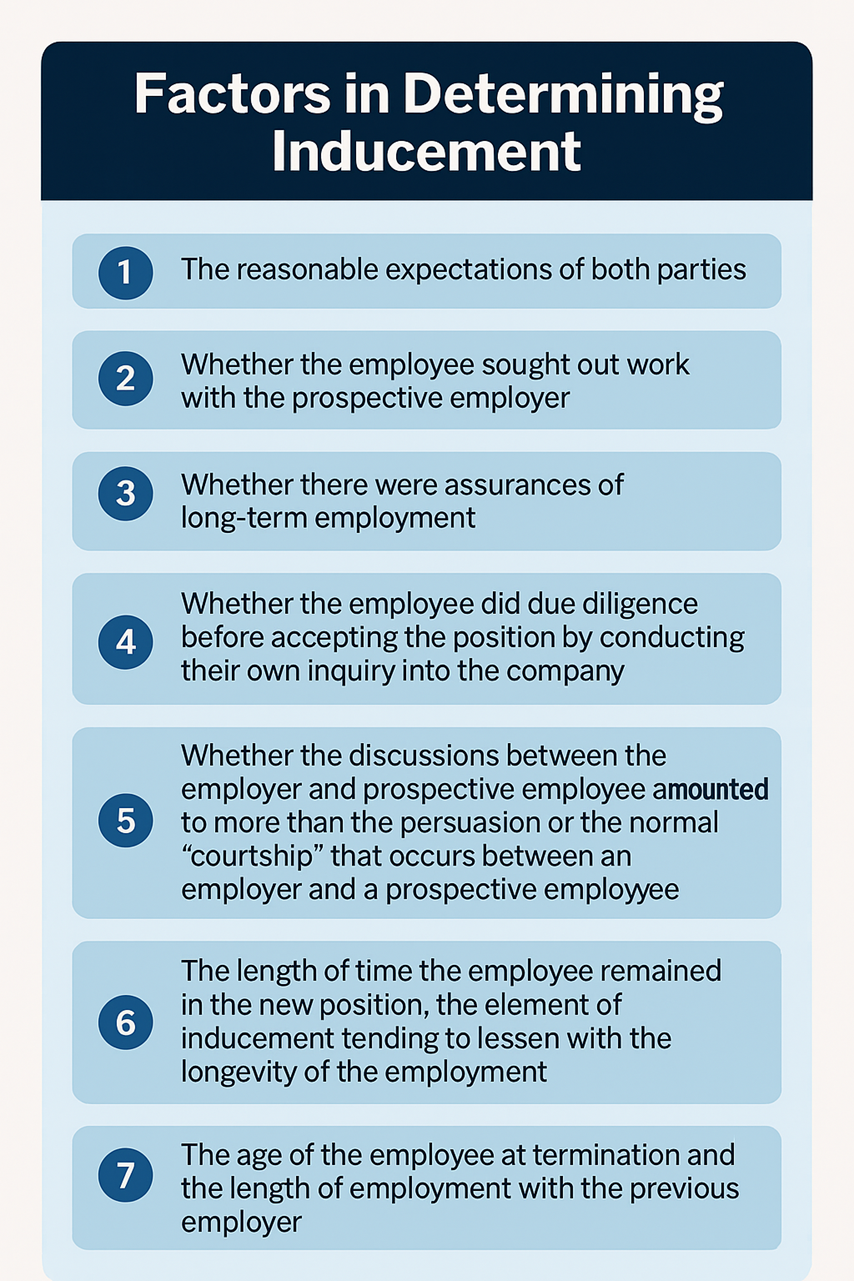
In looking at the issue, the courts in B.C. and Ontario differ slightly, but there are several factors they will look at, including who first initiated the “courtship,” the expectations of both parties, assurances of long-term employment, and how long the individual was in the new role.
Persuasion: the courtship
A key factor is the “courtship”: Was it the the employee or employer who first reached out to initiate conversation about the new role? For example, in these two cases, the individuals were contacted by the employer through LinkedIn.
“If the employer goes directly to the employee and solicits them, then that will be a factor that will be considered in terms of whether inducement will be found,” says Perry.
While AlayaCare said Miller was not “lured” or induced to leave her employment, the co-founder asked about her compensation to determine “what it would take” to persuade her to leave that employment, said the court.
“These discussions initiated by the defendant go beyond the normal ‘courtship’ between an employer and prospective employee and amount to an inducement.”
In addition, in the Ontario case, the employer also promised indemnification against legal costs from the original employer, says Perry: “That is a very strong factor that would indicate inducement.”
‘Reasonable’ expectations and inducement
Another important factor is the “reasonable expectation” of the parties.
“The courts will look at what expectations did the parties have entering into this?” he says. “If you have an employee who is very much ‘courted’… does it go beyond the typical courtship process into outright persuasion and an aggressive pursual of the employee?”
In the B.C. case, Celgar worked hard to make the job attractive to the potential employee by paying for Ferweda to fly out and visit the work site.
“Based on all the circumstances surrounding the creation of the employment contract, Celgar created an expectation on the part of Mr. Ferweda that the opportunity at Celgar was such that it would be advantageous to him to leave his secure long-standing employment and take a job which was expected to be long-term,” said Justice Michael Tammen in the 2024 decision.
Another factor is whether the employee did any due diligence in considering the new role, says Perry.
“Did they investigate the company? Did they research the company, or did they go off of the representations of the employer?”
Careful with promises
One recurring theme across both rulings and lawyer commentary is the role of verbal or informal assurances — particularly those related to job security or long-term opportunity.
Using this kind of language sets expectations, says Brandt.
“When you say to someone: ‘We hire for the long term,’ that's a signal that ‘If you leave where you are now, you're going to be here for a while’ — it's a commitment.”
If the new employer makes assurances of long-term employment or “hypes” themselves up and makes representations that they can offer long-term employment, that can be a problem, says Johnson.
In the B.C. case, for an employer to just ask “How long could you commit to this job?” that was found to implicitly be a representation of long-term employment, she says, “so even asking questions like that could do that.”
Avoiding the risks: language
You want to make it clear to the employee that there are no guarantees of long-term employment, says Perry, to convey: “We're not making any promises to you. You're a regular employee, just like anybody else, and if you don't perform, then we'll get rid of you.”
Johnson adds that even subtle language changes can make a difference — for example, saying “we hope” or “it’s our desire” is less of a commitment to the potential employee.
“It weakens the spectrum of aggressiveness in the recruitment and in what you're promising, the representations that you're making. They're a little less strong, which then can impact, of course, finding about how much an employee was induced.”
But Brandt cautioned against a blanket ban on such language.
“Those assurances can be a critical part of the recruitment process to get the talent that you’re looking for,” she says.
“In balancing business reality with legal principles and legal risk, I'm hesitant to recommend that those assurances not be made… What I would recommend instead is that time and thought be put into negotiating the terms of the contract.”
Contracts key to inducement claims
Despite noteworthy inducement-related cases, lawyers say the most effective protection for employers has not changed: properly drafted employment contracts.
Having an enforceable employment agreement with enforceable termination clauses means the contract is enforced, and whatever is provided for in there is the notice period that then applies, says Johnson.
“Then courts don't have to look into inducement, because the contract is binding and it provides for the notice period… If it's enforceable, then whether you engaged in efforts that could constitute inducement is not really an issue.”
But employers should be careful not to accidentally enter into a binding employment agreement with an employee when they're exchanging job offers or emails beforehand — as seen with a recent case in B.C., she says.
“A key thing is to just make job offers conditional on the employee accepting all the terms that are in the company's written agreement that's going to come.”
There should be clear provisions in the contract, including the fact that termination is possible and outlining what happens on termination, says Brandt.
“Ensure that it's clear enough to everyone that while the hope and desire is a long-term relationship, ultimately, both parties are able to end the relationship early.”
And an employer is well-advised to include a probationary clause in the contract, says Perry.
“It goes to that factor in terms of what promises were made. Because if there's an expectation of the parties of long-term employment, then a probationary period clause… breaks the inducement component of it.”
Source: Firatli v. Kohler Ltd., 2008
Take the pressure off
You also don’t want to pressure the person to sign employment contract, he says: “You want to give them an adequate amount of time to get independent legal advice.”
And one cautionary note: A court can still find inducement, even if both parties had equal interest in this new employment, says Johnson.
“Just because it seems like the employee was very willing and excited about it, that doesn't mean that inducement won't be found,” she says.
“So, it's always good to give an employee an opportunity... to consider the agreement and encourage them to seek legal advice, because it helps the agreement be more likely to be binding.”
Longevity and risk of inducement
Another important consideration when it comes to common law notice and inducement is how long an employee remains in the new role.
The longer the employment lasts in the new role, the less significant a factor the inducement is, says Brandt.
“If you induce someone to leave their job and you fire them after three months, versus you induce someone to leave their job and they stay for two years… there's less of an argument around inducement.”
As a result, the employer may decide to postpone an early dismissal to avoid the extra costs, says Perry.
“It’s not necessarily ideal for an employer, but as a mitigation strategy, they can just keep the person employed and diminish the element of inducement through purely the length of service,” he says.
But Brandt warns against such a move.
“[If] an employer has made a decision to fire someone, I think it's better to do it sooner rather than later, because... the longer somebody is employed for, the higher their common law severance is. So, it's better to pull the plug sooner rather than later.”
Caution in courtship
Ultimately, the message from recent case law is not that employers should stop recruiting from other organizations — it’s that they must proceed with care.
“It's an interesting area of law in the way that it's subtly shifting in different provinces,” says Johnson.
“The good thing is there's an answer to it: an enforceable employment agreement… at least you can really protect yourself with that, which is good.”


