
The legal framework around temporary layoffs has changed during the pandemic
Background
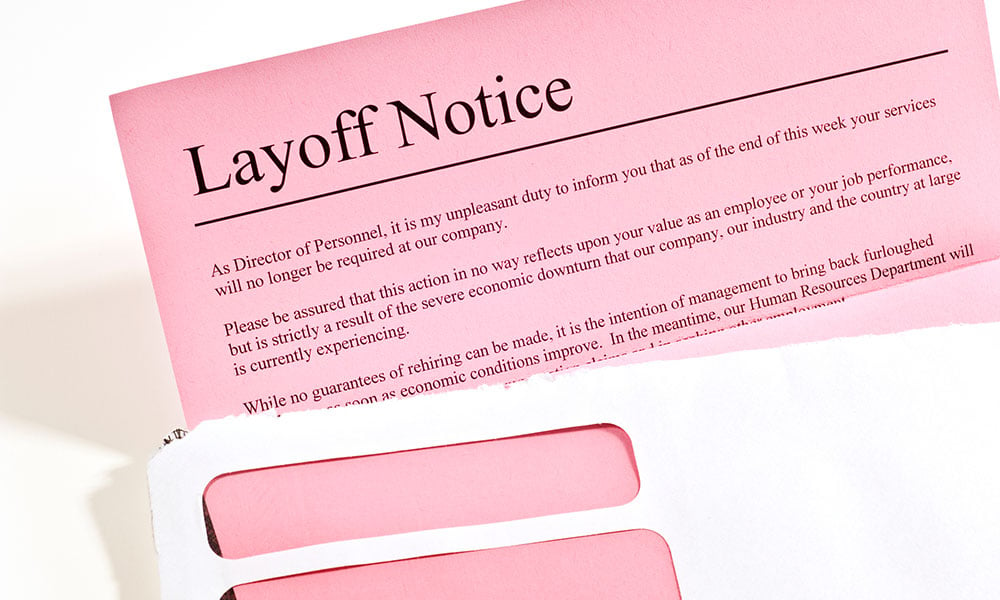
In employment law, certain technical terms tend to be used in informal or colloquial ways. “Layoff” is a good example of such a term insofar as it is used to refer to any cessation of employment, whether temporary or permanent. However, under the law, a layoff always means a temporary pause in the employment relationship with an expectation to resume the relationship in the near future. Employment lawyer Rishi Bandhu looks at the legal requirements around layoffs and how the pandemic-related economic shutdown has changed the legal landscape around them.
COVID-19 has forced many businesses to suspend operations. Work-from-home arrangements are possible for some businesses but unfeasible for others. Temporary layoffs have been the only option for many employers, which has caused a change in how many people view them and how the laws in some jurisdictions treat them.
Legislative requirements create significant obligations for employers in relation to layoffs. Accordingly, employers seeking to lay off employees must understand the applicable minimum standards in the particular jurisdiction in which they operate. In addition, though, the common law concept of constructive dismissal and its application to employee layoffs must be understood in order to manage risk — or at least anticipate it.
Some standards have changed
Every jurisdiction in Canada has minimum standards relating to temporary layoffs, but they vary significantly in terms of the details.
With the exception of Alberta, British Columbia, Manitoba, Ontario and Quebec, all jurisdictions require some form of notice of layoff.
Except for New Brunswick and Prince Edward Island, every Canadian jurisdiction restricts the duration of a temporary layoff. When the maximum temporary layoff period duration lifts, a deemed termination results and termination pay is owed. Severance pay may also be required depending on legislation and the employee’s length of service.
Various provinces have amended their legislation in response to COVID-19, thus altering employer liability in relation to layoffs. The approach in some provinces has been to simply extend the duration of a temporary layoff to delay the trigger for a deemed termination. In British Columbia, the duration of a temporary layoff was extended to 16 from 13 weeks. As the new deadline approaches and unless a further extension is legislated or extensions granted on a case-by-case basis, employers in that province are likely bracing for significant termination and severance pay liabilities.
Ontario’s approach was unique, deeming all layoffs — including reduced-hour arrangements — to be protected leaves of absence until six weeks after the provincial emergency order in relation to COVID-19 lifts. Ontario thus avoids having to revisit the duration of a temporary layoff but indefinitely suspends the right of employees to collect their entitlement to termination pay and severance pay.
Courts have consistently held that employers do not have an implied right to lay off employees. Failing evidence of such a right, a laid-off employee may claim that they have been constructively dismissed and thus entitled to compensation in lieu of notice of termination.
No statutory right to layoff
There is some case law in Ontario (Trites v. Renin Corp.) and Alberta (Vrana v. Procor Ltd.) to suggest that the existence of a statutory regime with detailed provisions regarding the timing and manner of layoffs forecloses court actions for constructive dismissal.
The reasoning in those cases was rejected in later decisions (Chea v. CIMA Canada Inc. and Turner v. Uniglobe Custom Travel Ltd.), but the argument is likely to arise again, particularly in Ontario. Ontario’s newly implemented regulation deeming all layoffs and hour reductions to be protected leaves of absence also provides that a temporary reduction or elimination of hours (a layoff) does not constitute a constructive dismissal. Some will undoubtedly argue that the provision removes the right to sue for constructive dismissal in court, but the amendments do not appear to go that far.
The consensus appears to be that employment standards rules concerning layoffs do not afford employers the right to lay off. That right must, therefore, be found directly in the contract of employment, but it may also be established in the policies and practices of the employer.
Courts have found the right to lay off where the employer has established clear workplace policies reflecting a right to layoff (Greene v. Chrysler Canada Ltd.), where layoffs are common in the industry (Petras v. Construction and General Workers’ Union, Local 602) and where the employee knows that employment is cyclical and subject to slowdowns (Hefkey v. Blanchfield).
Frustration of contract
For many employers, operating at full or even limited capacity was impossible given the mandatory closure of operations. There was, therefore, no choice but to lay off. Given the unprecedented nature of the situation, employers will undoubtedly argue that it would be unfair to find them liable for constructive dismissal.
Employers may raise the defence of “frustration of contract” in response to claims of constructive dismissal. As a principle of contract law, frustration applies where an unforeseen event prevents an employment relationship from continuing or renders the relationship radically different from expectations. Changes in laws, natural disasters and, most frequently, disability can result in frustration.
A frustration defence has never been applied in the context of a temporary cessation of work. It has always been applied where the relationship cannot continue at all or where it transforms the relationship into something radically different from what the parties anticipated. Nevertheless, given the exceptional nature of the pandemic and the historic economic damage it has caused, courts are likely to be receptive to arguments of frustration, although acceptance of it is far from certain.
Changing reasonable expectations
The employer’s best defence may lie directly in the analytical framework identified by the Supreme Court of Canada for assessing constructive dismissal claims.
Potter v. New Brunswick Legal Aid Services requires all constructive dismissal cases to be analyzed in two distinct branches. Cases addressing an employer’s unilateral changes to the contract of employment represent the “first branch” and those where the employer’s overall conduct reveals that it no longer intends to be bound by the contract of employment are covered under the “second branch.”
The employer’s decision to lay off in the absence of a contractual right to do so would be assessed under the first branch. The second branch is typically reserved for situations involving employer harassment or abuse.
In analyzing whether a layoff meets the test for constructive dismissal under the first branch, a two-step test is applied.
First, it must be determined if the layoff was imposed “unilaterally” by the employer and, therefore, without contractual authority. Employee consent, agreement or condonation of a layoff decision would confer contractual authority and dispose of the employee’s claim.
Second, the court must be satisfied that the breach was “substantial” from the perspective of a reasonable person in the same situation as the employee at the time of the breach.
As noted, the case law predominantly demonstrates that a layoff without contractual authority is a substantial alteration of the contract of employment. In an uncertain economy that is fundamentally altered by an unprecedented global pandemic, the expectations of a reasonable person may be radically different. A reasonable person may not view an unavoidable temporary cessation of employment as substantial in nature.
COVID-19 has dramatically altered how we function as a society. For the foreseeable future we cannot interact, shop or work in the same way that we did prior to the pandemic. Clearly, our reasonable expectations have changed and the courts will undoubtedly follow suit by applying a more flexible perspective toward layoffs and other employment changes that may not be expressly contemplated.
Practicality and good faith
Constructive dismissal claims, in the best of times, are risky endeavours for employees. In most cases, employees must resign from the employment relationship to pursue the claim. Abandoning recall rights will permit employers to argue that the employee failed to take reasonable steps to mitigate the claimed loss. The inability to prove the claim leaves the employee with a resignation and a potentially oppressive costs order.
Further, employees expect to be recalled to work. There appears to be little incentive for employees to abandon an inactive employment relationship in search of opportunities in an uncertain economy.
While COVID-19 has undoubtedly raised important questions about an employer’s right to manage its business, good faith as an organizing principle in all contractual relationships will not change. The employer’s best defence to avoid and mitigate liability may simply be to manage its employees in the spirit of good faith, honesty and transparency. Employees will respect it and courts will note it.
For more information, see:
- Trites v. Renin Corp., 2013 ONSC 2715 (Ont. S.C.J.).
- Vrana v. Procor Ltd., 2004 ABCA 126 (Alta. C.A.).
- Chea v. CIMA Canada Inc. 2016 ONSC 1937 (Ont. S.C.J.).
- Turner v. Uniglobe Custom Travel Ltd. 2005 ABQB 513 (Alta. Q.B.).
- Greene v. Chrysler Canada Ltd. 1982 CarswellBC 205 (B.C. S.C.).
- Petras v. Construction and General Workers’ Union, Local 602, 1986 CarswellBC 2524 (B.C. S.C.).
- Hefkey v. Blanchfield, 2020 ONSC 2438 (Ont. S.C.J.).
- Potter v. New Brunswick Legal Aid Services, 2015 SCC 10 (S.C.C.).
 Rishi Bandhu is an employment lawyer in Oakville, Ont., advising employers and employees on all aspects of employment and labour law. He can be reached at (905) 849-0025 or [email protected].


