Both managers, jobseekers have concerns about impact of AI

Canadian employers are increasingly using artificial intelligence to boost productivity and close stubborn skills gaps, but a new survey suggests the same technology is fuelling worker anxiety that HR professionals will need to manage.
Half of hiring managers (50%) say AI could help address the shortage of skilled workers, and 63% say AI tools could be essential to bridging the skills gap in new hires.
On operations, 67% expect generative AI to improve efficiency, and 65% say it will free up employee time.
The gains are registering. Hiring managers most often credit AI with higher company productivity (24%), more resources for employees to build skills (23%), and stronger creativity (22%). Among companies using AI, 79% say the employee-client connection is unaffected.
The rise of worker unease
The gains are arriving with apprehension, according to the Express Employment Professionals report based on two surveys: one of 504 Canadian hiring decision-makers conducted Nov. 3 to 19, 2025, and the other of 502 Canadian adults conducted Nov. 7 to 21, 2025.
Almost all job seekers (94%) say they have concerns about AI’s growing use, and 55% of hiring managers say automation threatens to dilute their company’s brand personality.
Among job seekers, the worries centre on lost effort and skill. Some 49% worry about overdependence on technology, while 45% expect employees to put in less effort. Many also fear workers will lose the ability to think creatively (49%) or problem-solve (42%).
The unease extends to leadership: 66% of hiring managers believe their employees fear generative AI will make them obsolete, the survey found.
Concern is turning into workforce plans
The tension sharpens around jobs. Nearly half of hiring managers (49%) say AI could allow them to shrink their workforce, while 78% of job seekers fear employers will hire less. Among job seekers whose company uses AI, 75% fear their own workforce could be cut.
Those fears are showing up in plans: 23% of hiring managers planning to cut or freeze headcount in 2026 cite AI as the reason, up from 14% a year earlier.
Entry-level roles face the earliest pressure: 44% of job seekers know of companies using AI to automate entry-level tasks, and 41% say it is more efficient than hiring and training a candidate.
Optimism persists, but confidence uneven
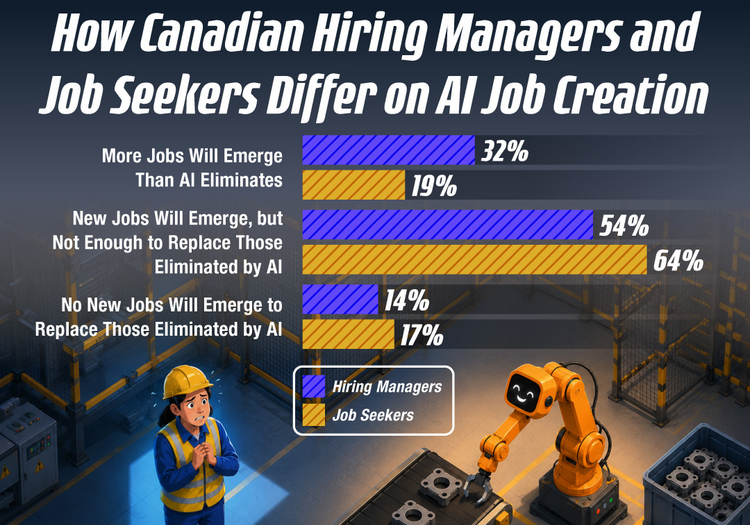
Despite this, most respondents still expect new work to emerge: 76% of hiring managers and 74% of job seekers believe new jobs will offset those lost to AI.
However, job seekers are less convinced. Only 13% believe more new jobs will emerge than are eliminated, while 37% expect some but not enough, and 26% expect none. Hiring managers favour preparation, with 38% urging on-the-job training to work alongside AI and another 38% calling for training in skills AI cannot replace.
“The future of work will be shaped by how businesses empower people to work alongside AI,” says Bob Funk Jr., CEO, president and chairman of Express Employment International. “In an economy as incredibly diverse as Canada’s, the real opportunity is to pair innovation with training, adaptability, and human potential so the workforce becomes stronger, more prepared, and more confident about what comes next.”
Leaders’ 'behavioural gap' with AI
A separate study from leadership consultancy The Positive Group — in collaboration with researchers from Harvard Business School, RSGI, and Hubel Labs — found that 62% of workers believe their leaders encourage employees to take ownership of AI innovation.
“The fact this number is not higher could be linked to inadequate AI training programs,” the company says in a report emailed to HRD.
Only six out of 10 (59%) of those who took part in the survey say their organisations have structured AI training in place for all; 28% say it is for senior leaders or specific teams only; 10% say training is managed on a case-by-case basis; and 4% say training is not prioritised at all.
“In partnerships, you can’t simply tell people what to do. Change has to come through influence and example,” says Perry Burton, head of partner learning and development at Grant Thornton UK, in the same report.
“That’s challenging when people are moving fast, feel pressure to deliver, and are understandably anxious about how their roles might evolve.”
The report also notes that only 33% of executives see their leaders demonstrate adaptability, and just 45% of workers say leadership keeps their teams regularly informed about actual AI developments.
“The gap is not primarily technical, but behavioural,” the report concludes.
Will Marien, CEO of the Positive Group, notes: “Strengthening these capabilities may be the highest-leverage move organisations can make as AI reshapes how work is done.”