Effective recognition is ‘a daily practice that strengthens relationships, connects employees to what matters, and reinforces what great work looks like’

Employee recognition is moving from transactional gestures – such as generic e‑cards, automated points or one‑size‑fits‑all gifts – towards human‑centred recognition that feels personal and sincere, according to a new report.
Sixty per cent of recognition moments now include an in‑person element, compared with 42 per cent a year earlier.
Encouragingly, 61 per cent of employees received recognition in the last 30 days, up from 58 per cent in 2025. And 70 per cent of employees say their organisation does a good job promoting recognition programs, up from 66 per cent, finds O.C. Tanner, adding these shifts suggest recognition is “becoming more embedded in how organizations are trying to support engagement and high performance, not just offered as a standalone program.”
Despite increased awareness of the importance of employee engagement, most employers are still missing the mark when it comes to effective rewards and recognition programs, according to a previous report.
Global links between recognition, trust and tenure
The O.C. Tanner report is based on a survey of 4,243 employees across 10 countries, including Canada, all working in organisations with more than 500 staff.
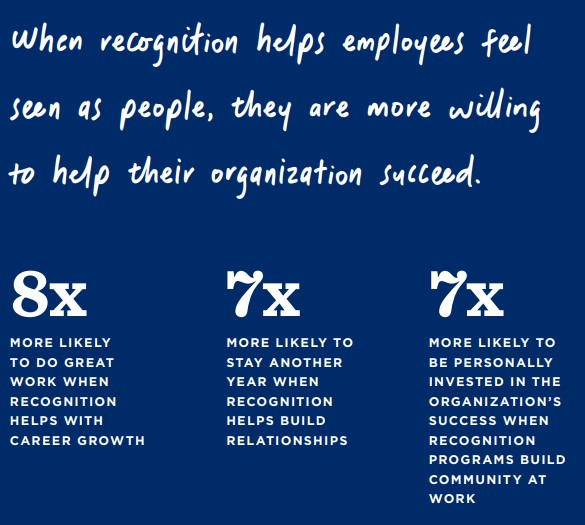
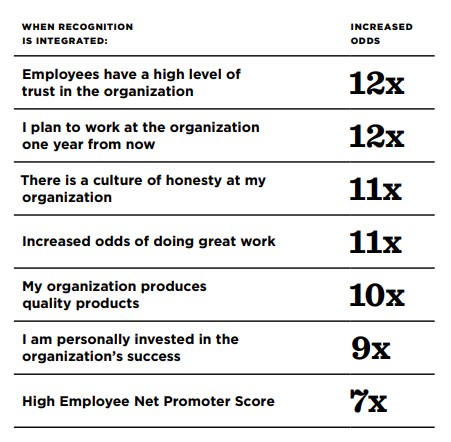
When recognition is integrated into everyday work and designed to strengthen relationships, the survey finds 43‑times higher odds that employees have a high level of trust in their organisation. In the same conditions, the odds of employees doing great work are 25 times higher, and the odds they plan to stay at least another year are 26 times higher.
The Institute characterises effective recognition as “cultural infrastructure: a daily practice that strengthens relationships, connects employees to what matters, and reinforces what great work looks like.” It adds that “employees don’t just feel better, they perform better” when recognition is intentionally designed and embedded into daily work.
Matching awards to achievements
However, awards are also under scrutiny. While 72 per cent of employees say their most recent recognition experience involved an award, 34 per cent believe their leaders do not know how they want to be recognised. The Institute notes that “when the award does not match the achievement or the person, the message changes. It stops saying ‘we see you’ and starts saying ‘we checked a box.’”
That finding suggests catalogues and points schemes need to be curated, not merely extensive.Nearly 9 in 10 employers (87%) agree recognition is a competitive advantage, with benefits that include boosting loyalty and reducing turnover, according to a previous study.
Finally, O.C. Tanner points to the growth of recognition champions – employees and leaders who model and advocate for recognition – as a way to embed new habits. Only 41 per cent of employees say their organisation has such a program, but where it exists, most view it as effective and culture‑building.
Here are some ways HR can maximise employee recognition in 2026, as shared by Achievers’ Rebecca Mattina on the employee engagement platform’s website:
- Provide frequent employee recognition
- Make recognition personal and “purposeful”
- Integrate recognition into tech stacks
- Offer scalable, personalised rewards
- Promote peer‑to‑peer recognition
- Promote the company’s employee recognition programme
- Use recognition data to drive decisions
Few employers measure the ROI of their employee recognition programs, according to a previous report.