Unemployment ticks higher even as overall employment holds steady and more Canadians enter the labour force in April

Canada’s unemployment rate rose to 6.9 per cent in April as more people entered the labour market and looked for work, even as overall employment was little changed, according to the latest Labour Force Survey.
The unemployment rate rose 0.2 percentage points, as more people searched for work (+51,000; +3.4 per cent), while employment was little changed (-18,000; -0.1 per cent).
The employment rate — the proportion of the population aged 15 and older who are employed — decreased by 0.1 percentage points to 60.5 per cent in April, matching a recent low observed in August 2025.
On a year-over-year basis, employment in April was up by 67,000 (+0.3 per cent), but recorded a net decline of 112,000 (-0.5 per cent) over the first four months of 2026, according to Ottawa.
The employment rate was down 0.3 percentage points on a year-over-year basis in April, and this marked the second consecutive month of little variation following the monthly decline of 84,000 (-0.4 per cent) in February. In April, full-time employment fell by 47,000 (-0.3 per cent), while part-time employment edged up (+29,000; +0.8 per cent).
"The labour market’s weak start to 2026 continued in April," says Brendon Bernard, senior economist at Indeed Canada.
"Employment slipped, for the third time in four months, while hours worked were flat. Meanwhile the unemployment rate ticked up, from 6.7% to 6.9%, returning to where it stood in October, after a temporary dip. Flat population growth means the sluggish pace of job growth doesn't have the same negative implications that they would in other periods. Still, there’s no spark getting conditions back in the right direction, particularly for job seekers struggling to land work."
Core-aged workers drive gains
The participation rate — the proportion of the population aged 15 and older who were employed or looking for work — rose by 0.1 percentage points to 65.0 per cent in April as more people were in the labour force searching for work, according to Statistics Canada. The increase was concentrated among core-aged people, whose labour force participation rate rose 0.3 percentage points to 88.5 per cent.
On a year-over-year basis, the overall labour force participation rate was down 0.3 percentage points in April, mostly reflecting population aging which has put downward pressure on the labour supply as more individuals have transitioned into retirement, says Ottawa. Among core-aged people, the labour force participation rate was up 0.3 percentage points year over year, while for youth aged 15 to 24 it was little changed.
There was little change in the number of private and public sector employees as well as in the number of self-employed workers in April. Compared with 12 months earlier, the number of private sector employees was up by 91,000 (+0.7 per cent), while self-employment was down by 55,000 (-2.0 per cent), and public sector employment was little changed over the period.
Youth unemployment rises
Employment varied little across major age groups in April, but the unemployment rate increased among youth aged 15 to 24 and among core-aged men, according to the Labour Force Survey. The youth (15 to 24 years) unemployment rate rose by 0.5 percentage points to 14.3 per cent in April, as employment varied little and the number of young people searching for work edged up (+14,000; +3.3 per cent).
The youth unemployment rate was virtually unchanged on a year-over-year basis but remained markedly above the pre-pandemic average of 10.8 per cent. In April, the youth unemployment rate for students was 16.0 per cent, 2.5 percentage points higher than the corresponding rate for non-students (13.5 per cent) and both rates were little changed on a year-over-year basis (not seasonally adjusted), says Ottawa.
"These struggles likely reflect weak hiring appetite in many of the sectors where teenagers frequently work, namely retail trade, and accommodation and food services," says Bernard.
"However the situation is aggravated by greater competition from older job seekers, in earlier years, the surging number of non-permanent residents, and more recently, recent grads in their early 20s finding work in lower-paying services, as previously strong areas like professional services stagnate."
In addition to the elevated unemployment rate, the overall youth labour force participation rate was 62.9 per cent in April, virtually unchanged from a year earlier but below the pre-pandemic average of 65.4 per cent.
Among people of core working age (25 to 54 years), both men and women saw little variation in employment in April. For core-aged men, the unemployment rate rose 0.3 percentage points to 6.1 per cent as more men in this age group searched for work, while the unemployment rate for core-aged women was 5.9 per cent in April, virtually unchanged in the month and from 12 months earlier.
Wage growth stays elevated
Average hourly wages among employees in April were up 4.5 per cent year over year, following growth of 4.7 per cent in March (not seasonally adjusted), according to Ottawa. Average hourly wages among employees were up 4.5 per cent (+$1.64 to $37.77) on a year-over-year basis in April, compared with year-over-year wage increases that averaged 3.4 per cent in 2025.
Wage growth was stronger for employees with higher wages on a year-over-year basis in April. For employees in the bottom 25 per cent of the wage distribution, wages rose 3.5 per cent (to $19.05) on a year-over-year basis in April, while average hourly wages grew more rapidly among employees in the second-lowest 25 per cent of the wage distribution (+4.4 per cent to $27.52), as well as the third (+4.9 per cent to $39.06) and the top (+4.8 per cent to $66.30) quartiles.
The recent acceleration in overall hourly wage growth largely reflected changes in the composition of employment, including a lower proportion of employees with shorter job tenure, according to Statistics Canada.
Employment shifts by industry
On a month-over-month basis, employment decreases in April were concentrated in information, culture and recreation (-25,000; -2.8 per cent), construction (-16,000; -1.0 per cent), and in “other services” (-13,000; -1.6 per cent).
On the other hand, employment increased in business, building and other support services (+22,000; +3.2 per cent), health care and social assistance (+18,000; +0.6 per cent) and in accommodation and food services (+13,000; +1.1 per cent),.
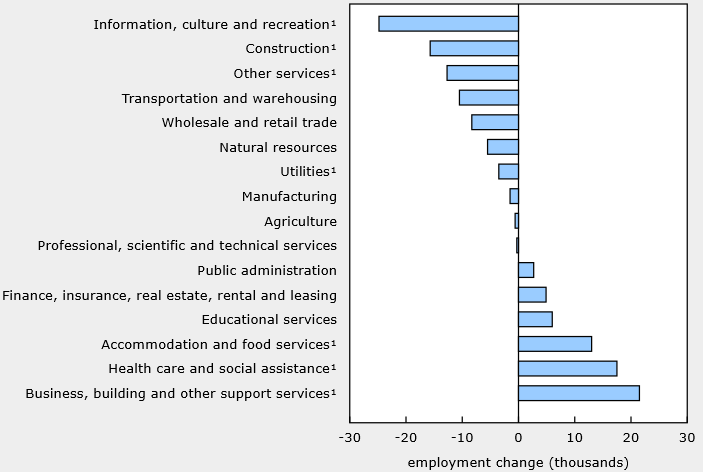
On a year-over-year basis, employment was little changed across most industries in April, with the notable exception of health care and social assistance, which was up 119,000 (+4.1 per cent) over the period.
Quebec sees losses; Ontario posts gains
Fewer people were employed in Quebec, Newfoundland and Labrador, Saskatchewan and New Brunswick, while Ontario recorded a gain and employment was little changed in the other provinces, according to Ottawa.
In Quebec, employment fell in April (-43,000; -0.9 per cent), the second significant monthly decline in the past three months, and from January to April employment in Quebec recorded a net decline of 91,000 (-1.9 per cent), primarily concentrated in the Montréal census metropolitan area (CMA), where employment fell by 56,000 (-2.3 per cent) over the same period. The unemployment rate in Quebec rose by 0.8 percentage points to 6.2 per cent in April as fewer people were employed and more people searched for work, matching the recent peak observed in June 2025, while in the Montréal CMA the unemployment rate rose 1.3 percentage points to 7.7 per cent in April, its highest rate since July 2016 (excluding 2020 and 2021).
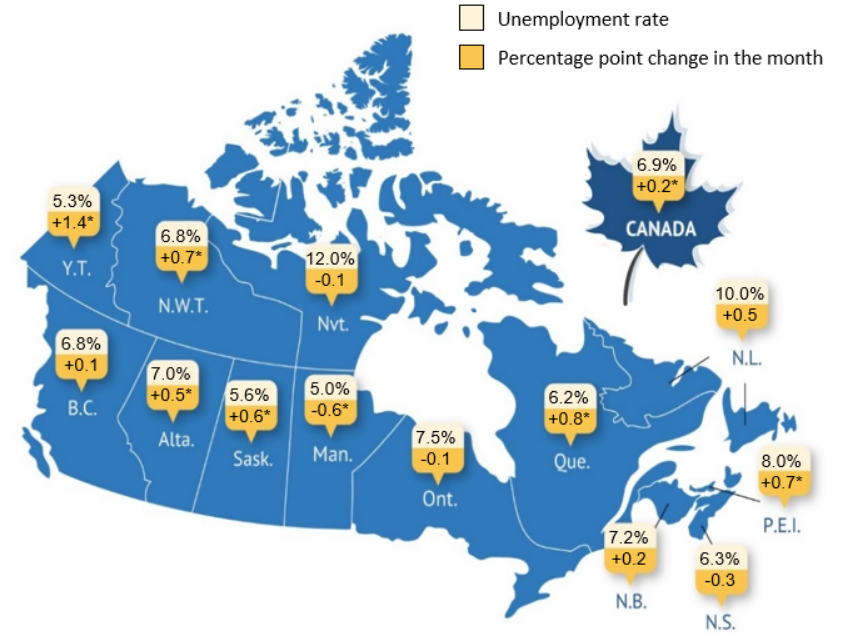
Employment also declined in Newfoundland and Labrador (-5,200; -2.1 per cent), Saskatchewan (-4,000; -0.6 per cent), and New Brunswick (-2,700; -0.7 per cent) in April, according to Ottawa. The unemployment rate increased in Saskatchewan (+0.6 percentage points to 5.6 per cent) and was little changed in Newfoundland and Labrador (10.0 per cent) and New Brunswick (7.2 per cent), while despite little variation in employment the unemployment rate declined by 0.6 percentage points to 5.0 per cent in Manitoba, the lowest rate across the provinces.
Employment rose in Ontario (+42,000; +0.5 per cent) in April, following two consecutive months of little variation, and the gain in April partially offsets the decline recorded in January (-67,000; -0.8 per cent), according to the report. The unemployment rate in Ontario edged down 0.1 percentage points to 7.5 per cent in April.