Nominated physicians will receive expedited 14‑day work permit processing, allowing them to work while awaiting permanent residence

The federal government will introduce targeted immigration measures to fast‑track permanent residence for international doctors already working in Canada, in an effort to ease health labour shortages and stabilise physician supply.
This directly impacts physician recruitment pipelines, retention strategies and long‑term workforce planning across hospitals, clinics and health systems.
Under the plan, Immigration, Refugees and Citizenship Canada (IRCC) will create a new Express Entry category for international doctors who have at least one year of Canadian work experience in an eligible occupation within the last three years. These physicians are already in Canada on temporary status, “helping patients and contributing to our health care system,” IRCC says. Invitations to apply through the new category are expected to begin in early 2026.
Reserved spaces and faster work permits
The federal government will reserve 5,000 federal admission spaces for provinces and territories to nominate licensed doctors with job offers. These spaces are in addition to the annual Provincial Nominee Program allocations, notes Ottawa.
Doctors who are nominated will receive expedited 14‑day work permit processing, allowing them to work while awaiting permanent residence.
“Canada’s new government has a mandate to build a strong economy by attracting top global talent and filling critical labour shortages,” says Lena Metlege Diab, Minister of Immigration, Refugees and Citizenship. “This dedicated Express Entry category, along with the reserved federal admission spaces for provinces and territories will help bring in and keep practice-ready doctors, so people across Canada can get the care they need.”
The changes support the federal government’s Budget 2025 commitment to fill critical labour gaps with high‑skilled talent, notes IRCC.
Several provinces have also been working to fast-track the recruitment of international doctors.
The new program out of Ottawa is a welcome development, according to the Canadian Medical Association (CMA).
“By creating a pathway to permanent residence for doctors here on temporary visas, we create a stronger health workforce, staffing gaps begin to close, and patient care benefits from diverse voices and experiences,” says Dr. Margot Burnell, president of the group. “Today’s announcement is a step in the right direction.”
Shortage of doctors in Canada
According to IRCC, in 2024, about 17 per cent of Canadian adults and 11 per cent of children and youth reported not having a regular health care provider, underscoring ongoing demand for qualified physicians across the country.
Compared with before the COVID-19 pandemic, in 2019, the number of physicians (+7.2%) and the number of nurse aides, orderlies and patient service associates (+3.7%) grew, according to Statistics Canada (StatCan).
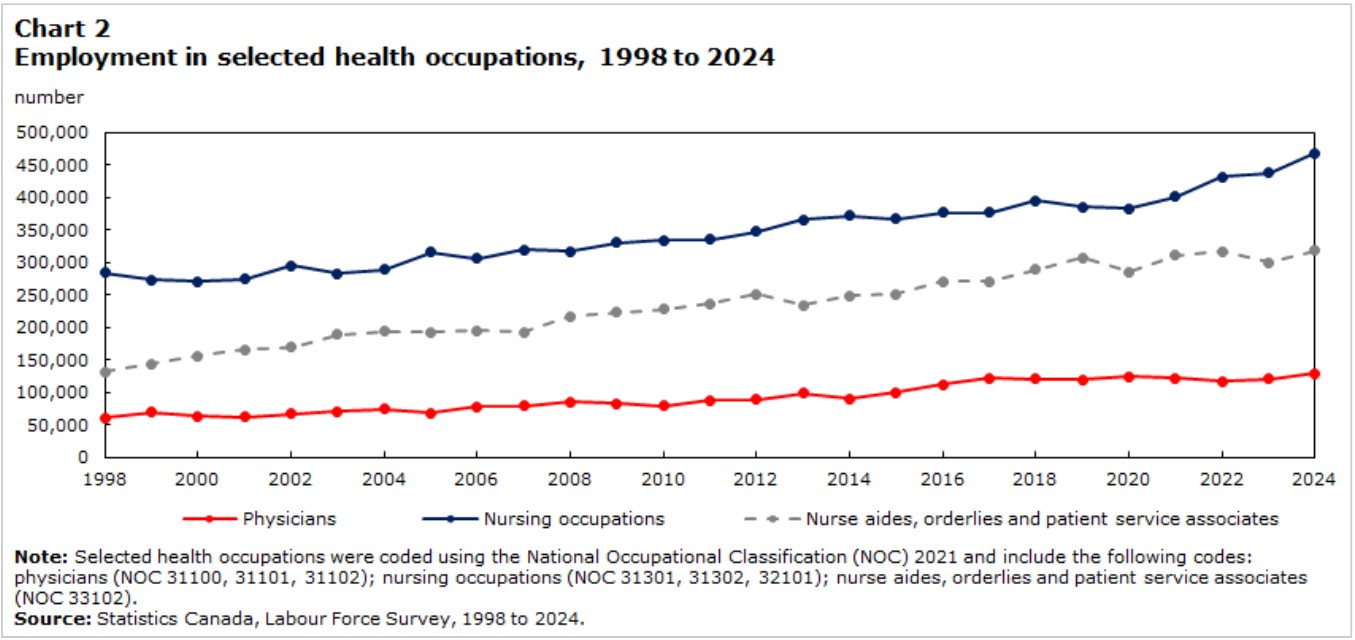
StatCan also recently noted that between the fourth quarter of 2019 and the fourth quarter of 2023, employment in health care occupations (excluding management) grew by 121,100 (+8.4%), reflecting continued expansion of the health workforce.
“However, this growth has not kept pace with the needs of the health care system,” according to the government agency. “During the same period, the job vacancy rate—the number of vacant positions as a proportion of all positions—in the health care industry increased from 3.0% to 5.5% (not seasonally adjusted) with the number of vacancies for health occupations more than doubling.”
Shortfall of family physicians
Canada faces a 22,823‑family physician shortfall, with only 1,300 new graduates annually, making it impossible to close the gap at the current rate, especially in rural areas, according to Luis Francisco Leiva Tobelem, with the Department of Anesthesiology and Pain Medicine at the University of Toronto, and his colleagues.
They note that 21.5 per cent of residents in Quebec are without access to a primary care provider. The same is true for 17.7 per cent of British Columbia residents. And the number goes up to about half in some regions, particularly the territories.
“Canada's healthcare system is facing a severe shortage of doctors, leaving millions of Canadians struggling to access essential primary and specialist care,” they say in a paper posted in Science Direct. “Despite substantial investment in healthcare, Canada still falls behind other OECD countries in having enough physicians to meet patient needs. This crisis, fueled by inadequate workforce planning, an aging population, and increasing physician burnout, has forced more patients to rely on emergency departments for basic care, driving up costs and reducing quality of service.”
Quebec could be facing an exodus of healthcare professionals after passing legislation that imposes a new compensation system on the province’s doctors, introducing performance-based pay and severe penalties for collective resistance, according to a previous report.