After fatal runway collision, unions warn real danger zone is the tarmac, not the sky
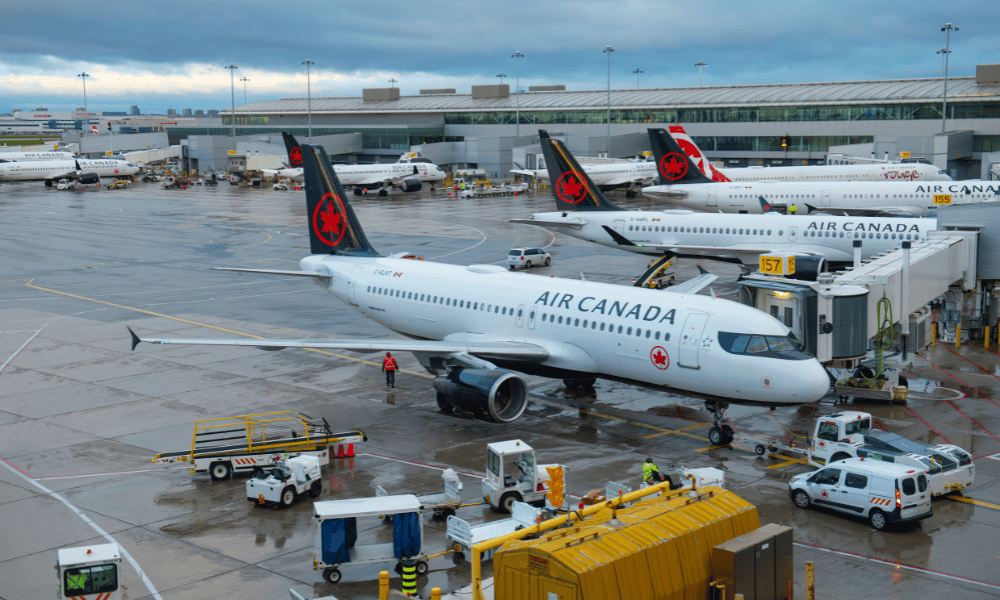
A fatal runway collision involving an Air Canada Express jet at New York’s LaGuardia Airport is raising urgent questions about how safely airports protect the workers who guide planes, drive emergency vehicles and manage the airfield in real time.
Flight AC8646, a Jazz Aviation‑operated Mitsubishi CRJ‑900 flying under the Air Canada Express banner, was arriving from Montreal late Sunday when it struck an Airport Rescue and Firefighting (ARFF) vehicle on the runway shortly after landing. Both the captain and first officer were killed; dozens of other people, including emergency personnel, were injured.
Air Canada, in its own update, confirmed that the captain and the first officer were killed in this accident: “We are deeply saddened by the loss of two Jazz employees, and our deepest condolences go out to the entire Jazz community and their families.”
There were 72 passengers and four crew members on board the Jazz CRJ900 aircraft, said Unifor Local 2002 in a message to members: “Tragically, both the pilot and co-pilot lost their lives in the collision.”
Complex emergency on runway
The crash occurred at about 11:30 p.m. on March 22, when the regional jet touched down after its flight from Montréal–Trudeau International Airport and then slammed into a Port Authority fire truck moving across the runway.
The vehicle was not responding to a problem with the Air Canada jet, but to a separate incident. Garcia confirmed that the firefighting truck had been dispatched to a United Airlines flight that reported an issue with odour during takeoff, according to CBC.
Port Authority executive director Kathryn Garcia told reporters that 41 people were transported to hospitals in Queens, with 32 later released and nine still in care, including some in serious condition, reported CTV and CBC. Two Port Authority employees in the ARFF truck suffered non‑life‑threatening injuries, Garcia said.
Air Canada said that “emergency services are on site taking care of injured passengers, and some have been transported to local hospitals,” and that its teams and those from Jazz “are preparing to make their way to the site” while cooperating with both the Transportation Safety Board of Canada and the U.S. National Transportation Safety Board.
LaGuardia Airport has been closed to passenger traffic while investigators document the scene.
‘Stop, Truck 1. Stop’: split‑second decisions under pressure
Publicly available air traffic control recordings suggest controllers were juggling multiple emergencies just before the impact.
According to CBC’s account of the audio, one controller can be heard clearing a vehicle to cross part of the airfield, then urgently trying to reverse that instruction as the Air Canada jet approached: “Stop, Truck 1. Stop,” the transmission says. CBC also reports that in the aftermath, a staffer on the recording can be heard saying, “I messed up,” as colleagues try to console each other.
Harvey Scolnick, a retired U.S. air traffic controller and now aviation consultant, told CBC he is struggling to understand how such a collision could occur given existing procedures.
“This kind of thing doesn't happen very often, because of the specific phraseology and procedure that controllers are taught,” he said, adding that there are detailed FAA handbook sections on runway crossings.
Scolnick explained that ground controllers typically manage aircraft and vehicles on taxiways, while tower controllers oversee active runways; both must stay in close coordination. He also noted, in comments to CBC, that not all communications between controllers and vehicles are necessarily captured on the same recorded radio frequencies, a detail likely to be central to the NTSB investigation.
‘Extremely busy’ airfield at LaGuardia
Pilots familiar with LaGuardia say the airport’s intensity is a critical part of the story. Denis Lepage, a retired Air Canada pilot who flew between Montreal and LaGuardia for 29 years, told Radio‑Canada’s Tout un matin program that the New York hub is uniquely demanding.
“LaGuardia is an extremely busy airport, both in terms of air traffic and ground traffic. So, there are a lot of vehicles on the move,” he said, in comments reported by CBC. “Air traffic controllers must be extremely vigilant when issuing clearances.”
Lepage also pointed to chronic staffing issues affecting those workers, telling CBC that controller shortages restrict how many takeoffs and landings the system can safely handle, particularly in the New York area.
From the perspective of the cockpit, Lepage underlined how exposed pilots are in any ground collision. He told CBC there is “very little” protection on the front fuselage of an aircraft against this kind of contact, adding: “It really doesn’t take much contact between a vehicle on the ground and an aircraft to cause damage.”
News images show the wrecked CRJ‑900 resting on its tail, its crumpled nose pointed upward, with the cockpit area torn back to the side windows and internal wiring and controls exposed. A heavily damaged neon‑yellow ARFF truck lies on its side nearby, encircled by floodlights and emergency crews.
CBC journalist David Common reported that NBC News, citing sources at the scene, said a flight attendant was found outside the aircraft still strapped into a jumpseat – a detail he described as “remarkable” and emblematic of the sheer force of the crash.
Union frames it as occupational tragedy
In a message posted Monday morning, Unifor Local 2002 – which represents many Jazz employees – explicitly connected the LaGuardia crash to the everyday risks aviation workers face.
“It is with deep sadness that we share news of the tragic air accident that occurred late Sunday night at LaGuardia Airport in New York,” the union wrote. “On behalf of Unifor Local 2002, I extend my heartfelt condolences to the families, friends, and co-workers of the pilots who lost their lives in this devastating incident. Their loss is felt deeply across the aviation community, and we stand in solidarity with all those affected.”
The union emphasized that runway disasters are workplace events as well as public tragedies. “Every day, our members uphold the highest standards of safety and care, often under challenging and demanding conditions,” the statement said. “This heartbreaking loss is a stark reminder of the responsibilities carried by aviation workers and the risks they navigate to ensure the safety of others.”
Acknowledging the emotional toll on colleagues, Unifor urged members to seek help if needed: “If you are feeling impacted and need support, please do not hesitate to reach out. Employee Assistance Program (EAP) volunteers and coordinators, union representatives, and colleagues are all available to provide assistance.”
The message also called on aviation workers to look out for one another: “In moments like these, we are reminded of the importance of compassion, solidarity, and care for one another. Please take the time you need and support those around you.”
Company pledges cooperation; families seek answers
In its corporate update, Air Canada said it “cannot confirm the exact number of injuries or if there are other fatalities at this time” and stressed that “no further details are available at this time; however, Air Canada and Jazz will continue to issue regular updates as information becomes known.”
The airline said Air Canada and Jazz teams “are preparing to make their way to the site and details will be provided through additional statements as soon as possible,” and that both companies “are cooperating with the Transportation Safety Board of Canada and the National Transportation Safety Board in the United States in the investigation of the cause of this incident.”
Earlier Monday, Jazz Aviation president Doug Clarke called it “an incredibly difficult day for our airline, our employees, and most importantly, the families and loved ones of those affected,” according to statements reported by CBC. “We extend our deepest condolences to the family and friends of our two pilots and our unwavering support to those who have been injured,” he said.
Canadian Transport Minister Steven MacKinnon wrote on social media that he is “deeply saddened by the tragic accident at LaGuardia Airport involving an Air Canada Express aircraft arriving from Montreal,” adding, “My thoughts are with the families, loved ones, and colleagues of those who lost their lives, as well as all those who were injured,” CBC and CTV reported.
Runway systems under microscope
Beyond individual decisions, investigators will also be looking at the technology and procedures meant to protect workers and passengers on the ground.
CBC, citing The Associated Press, notes that LaGuardia is one of 35 major U.S. airports equipped with an advanced surface‑surveillance system that combines radar and data from locator systems on aircraft to alert controllers to potential runway conflicts. Whether that system was fully functional, and how its alerts were handled Sunday night, will be key questions for the NTSB.
The Transportation Safety Board of Canada has dispatched a team to support the U.S. probe, CBC reports, while the FAA is sending experts from its own ranks, according to a statement from U.S. Transportation Secretary Sean Duffy referenced by CBC.
As Unifor told its members, “This heartbreaking loss is a stark reminder of the responsibilities carried by aviation workers and the risks they navigate to ensure the safety of others.” The challenge now for regulators, employers and unions will be to turn that reminder into concrete changes that better protect the people whose jobs unfold at the edge of the runway.