Other changes include lower immigration levels, measures to recruit international talent, major AI investments

Canada’s newly released federal budget is placing people and productivity at the heart of its strategy to “Build Canada Strong.”
More than 75% of the government’s actions this year are to respond to “significant global economic shifts” while 42% of Budget 2025 is to strengthen Canadian sovereignty and 36% is to bring down costs for Canadians.
“Just as Canadians mobilised in the 1940s to defend freedom and rebuild the global economy, and just as we restored fiscal sustainability in the 1990s to secure future growth, today we stand at another crossroads. A new era of disruption demands a new era of leadership—and a new economic foundation built on resilience, sovereignty, and innovation.
“Canada is ready. Because Canada is strong,” said François-Philippe Champagne, Minister of Finance and National Revenue.
Federal public service to shrink by 10 per cent
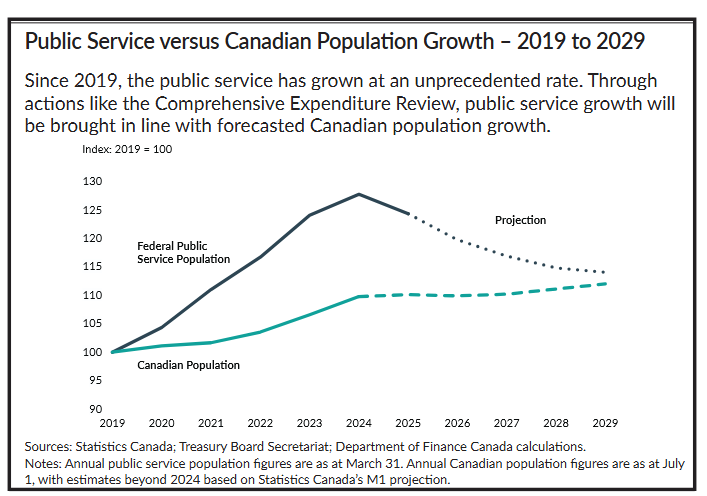
Budget 2025 marks a significant shift in the federal government’s approach to public sector management, with plans to reduce the size of the federal public service by about 40,000 positions—or 10 per cent—by 2028-29.
This reduction, which will bring the workforce down from a peak of almost 368,000 in 2023-24 to roughly 330,000, will be achieved through normal attrition, voluntary departures, and targeted workforce adjustments.
“A leaner public service is a more empowered and productive public service,” the government stated.
To facilitate this transition, the budget proposes a voluntary Early Retirement Incentive program for eligible public servants, allowing retirement with immediate pension and no penalty for early departure.
The government will also cut the executive cadre by 1,000 positions over two years and reduce spending on management and consulting services by 20 per cent within three years.
“By spending less, we can make the generational investments that grow our economy and protect the essential programs that keep your costs down,” the budget notes.
Immigration levels to stabilize amid system overhaul
Canada’s approach to immigration is also undergoing a major recalibration. The 2026-2028 Immigration Levels Plan will stabilize permanent resident admissions at 380,000 per year for three years, down from 395,000 in 2025.
The share of economic migrants will rise from 59 per cent to 64 per cent. Meanwhile, temporary resident admissions will be reduced from 673,650 in 2025 to 385,000 in 2026, and 370,000 in 2027 and 2028.
“Our immigration system was built to standardise and evaluate newcomers so that admission was based on a person’s merits. Over time, this system has evolved—its complexity has grown and its efficiency has waned,” the government said.
“We are taking back control over the immigration system and putting Canada on a trajectory to bring immigration back to sustainable levels.”
The government highlighted early results: “Asylum claims are down by a third, and new temporary foreign worker arrivals are down by approximately 50 per cent this year. New international student arrivals have also declined by approximately 60 per cent compared to 2024. This is a start, but we recognise there is more work to do.”
Special initiatives will recognize eligible Protected Persons as permanent residents and accelerate the transition of up to 33,000 work permit holders to permanent residency over the next two years.
Recruiting international talent, credential recognition
To address critical labour shortages and drive innovation, Budget 2025 introduces a suite of measures to recruit international talent. Up to $1.7 billion will be invested in recruitment, including $1 billion over 13 years for an accelerated research Chairs initiative, $400 million for research infrastructure, $133.6 million for top international doctoral students and post-doctoral fellows, and up to $120 million to recruit international assistant professors.
The budget also proposes $97 million over five years for the Foreign Credential Recognition Action Fund, focused on improving the fairness and timeliness of recognizing foreign credentials, particularly in health and construction sectors.
“Improvements to foreign credential recognition are essential to ensure that immigration can effectively help address labour shortages and support the Canadians that rely on goods and services from those sectors,” the government stated.
Major AI investments and digital transformation
Budget 2025 includes a major commitment to artificial intelligence, with $925.6 million over five years to develop a large-scale sovereign public AI infrastructure and a Sovereign Canadian Cloud. Of this, $800 million comes from previously provisioned funds. The investment aims to boost AI compute availability and ensure secure, sovereign access for public and private research.
“This will help businesses seize the opportunities from AI, creating new jobs and economic growth,” the budget states. The Minister of Artificial Intelligence and Digital Innovation will work with industry to identify promising projects, while the Canada Infrastructure Bank will be enabled to invest in AI infrastructure.
To measure AI’s impact, $25 million over six years and $4.5 million ongoing will go to Statistics Canada for the Artificial Intelligence and Technology Measurement Program (TechStat). The government also plans to establish an Office of Digital Transformation to scale technology solutions across the federal government and accelerate AI adoption.
Labour market and economic outlook
The budget acknowledges ongoing challenges for Canada’s labour market: “Unemployment has increased, driven by weak hiring and layoffs in trade-exposed sectors such as manufacturing,” says Ottawa, and “productivity remains weak, limiting wage gains for workers.”
The government’s response is to invest in infrastructure, innovation, and skills to drive growth and create high-paying careers.
As Budget 2025 puts it: “A government that spends less, invests more, and delivers better: that’s how we build Canada Strong.”
Budget 2025 is anchored on four objectives:
- Harnessing Canada’s strengths: Investments in clean and conventional energy, critical minerals, artificial intelligence, and a highly educated workforce will spur industry growth and help businesses thrive.
- Building the nation: Major nation-building projects, including the Build Canada Homes initiative, aim to double the pace of home construction and support industries such as steel, aluminum, and softwood lumber. The Buy Canadian Policy will prioritize domestic suppliers.
- Unifying the economy: The One Canadian Economy Act will break down internal trade and labour barriers, expediting major projects and fostering Indigenous partnerships and inclusion.
- Diversifying trade: A new Trade Diversification Strategy will strengthen existing relationships and open new markets, particularly in Asia, while investments in trade infrastructure will expand Canada’s export capacity.