
'Hiring teams that fail to communicate may lose the chance to reconnect with these candidates in the future'

Employers who fail to notify candidates of their status risk permanently losing them as future applicants, based on the findings of a recent study.
Forty-eight per cent of respondents said they would not apply to a company again after being ghosted, according to LiveCareer. A further 42 per cent said the experience would make them trust the company less, while 37 per cent said they would share the experience with others.
Only 17 per cent said being ghosted would not affect their perception of, or future behaviour toward, the employer, the report found.
"Hiring teams that fail to communicate may lose the chance to reconnect with these candidates in the future," the report states.
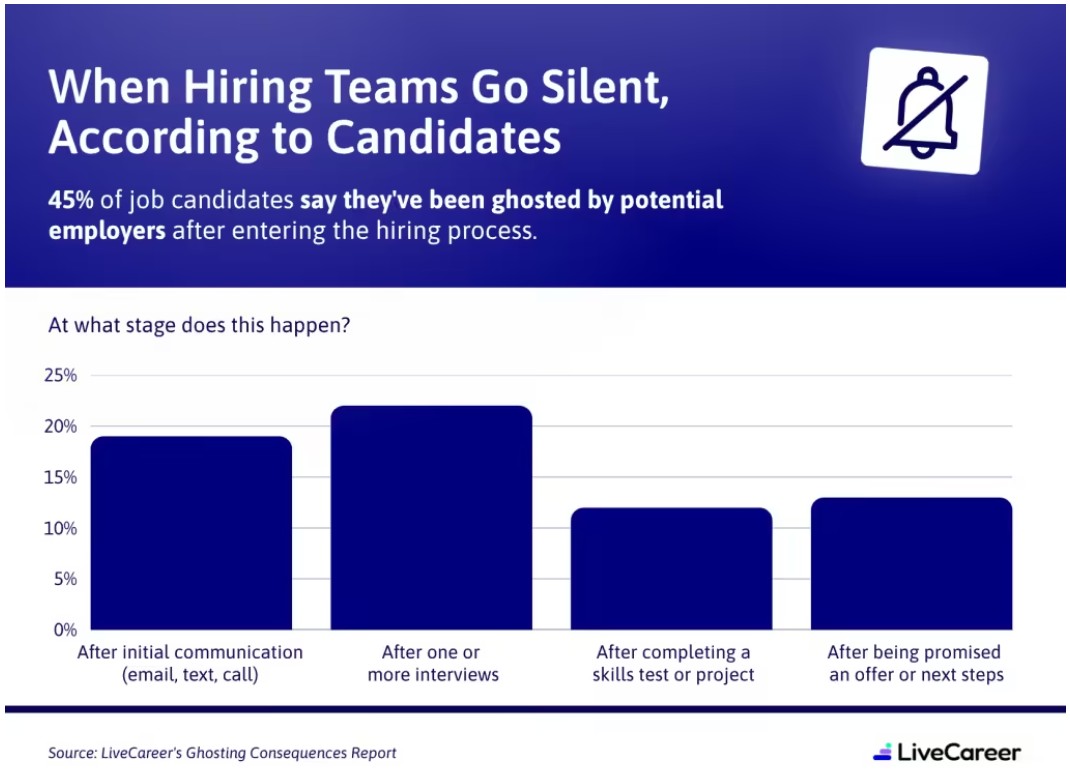
Ghosting occurs throughout the hiring process
Nineteen per cent of workers said they were ghosted after an initial email, text or phone call, while 22 per cent said they were ghosted after one or more interviews, according to LiveCareer. Twelve per cent were ghosted after a skills test, and 13 per cent after being told an offer was coming.
Candidates also gave employers considerable time before assuming they had been ghosted, with 26 per cent waiting one to two weeks and 24 per cent saying they would continue following up until they received a response.
"Many candidates are willing to wait an extended period for a response, giving employers ample opportunity to maintain communication," the report states.
A previous reported noted that employment scams have surged. Canadians reported losing over $49 million to job and employment scams in 2024 — a quadrupling of losses since 2022, when the total was closer to $7 million, according to the Canadian Anti-Fraud Centre (CAFC).
Workers blame employers over candidates
Forty-five per cent of respondents said employers ghost candidates more often than candidates ghost employers, according to the LiveCareer survey of over 1,000 U.S. workers conducted on April 14, 2026. Thirty-three per cent said both sides ghost about equally, while 21 per cent said job seekers are the more frequent offenders.
Most workers do not attribute employer silence to recruiting challenges such as high applicant volume. Fifty-seven per cent said they believe employers stop communicating after choosing another candidate, and 33 per cent believe employers avoid formally rejecting a poor-fit candidate.
Only 10 per cent believe employers ghost candidates because they rely too heavily on automation or artificial intelligence, according to the report.
“Candidates invest significant time and energy researching companies, preparing for interviews, completing assessments, and following up on opportunities,” says Jasmine Escalera, career expert for LiveCareer. “When a potential employer suddenly stops communicating, many workers see it as a sign of how the organization treats its people. As our findings show, ghosting can damage trust and discourage qualified candidates from considering future opportunities with the company.”
A previous LiveCareer report noted job seekers can also ghost employers. Most job seekers (70 per cent) say ghosting is unacceptable, but poor or unfair hiring experiences can quickly change that sentiment. And nearly 2 in 5 (39 per cent) say they would consider ghosting a potential employer after a bad or unfair hiring experience.
“Today’s job hunt is exhausting, with job seekers often submitting hundreds of applications to land a new role,” said Jasmine Escalera, career expert at LiveCareer. “When candidates encounter long periods of silence, unclear timelines, misleading job descriptions, or overly automated processes, they naturally shift their attention to more promising opportunities. Applying to a high volume of roles also increases the likelihood that a candidate could vanish once they receive an offer elsewhere.”



