
Critics claim 'huge level of overreach' by government, lack of appeal process will lead to departure of health-care workers

Human resources leaders in health and related sectors in British Columbia will face new legal duties, reporting expectations and cultural safety standards when the province’s Health Professions and Occupations Act (HPOA) comes into force next month.
The HPOA will come into force on April 1, 2026, reshaping how regulated health professionals and certain occupations are governed.
The HPOA received Royal Assent in the B.C. Legislative Assembly on Nov. 24, 2022. It will replace the Health Professions Act and introduce new structures for oversight, discipline and governance of regulated health professions and certain health occupations.
On July 16, 2025, Cabinet approved regulations to bring the HPOA into force on April 1, 2026. Through ministerial orders, the Minister of Health approved new profession regulations for all currently regulated health professions, effective the same date, and for psychotherapy, clinical perfusion, respiratory therapy, radiation therapy and medical laboratory technology, effective Nov. 29, 2027.
The regulations include a Regulated Health Practitioners Regulation that sets out restricted activities and supports interpretation of the profession‑specific regulations.
The B.C. government has said the legislation is intended to improve public protection and safety by creating a new oversight body, strengthening disciplinary processes, embedding anti‑discrimination requirements and simplifying how health professions are regulated.
New law replaces Health Professions Act in 2026
Patient safety, cultural safety and regulatory oversight in B.C.’s health system will undergo major changes when the HPOA takes effect, replacing the decades‑old Health Professions Act. Until then, the existing Act continues to govern health professionals and regulatory colleges.
The HPOA is designed to improve public protection by creating a new oversight body, strengthening disciplinary processes, embedding anti‑discrimination requirements and simplifying how health professions are regulated, according to the B.C. government.
Health Minister Adrian Dix called the reforms unprecedented in scope. “Our government is making the most significant changes to oversight of regulated health professions in British Columbia’s history,” he said. “These changes will streamline the process to regulate new health professions, provide stronger oversight, provide more consistent discipline across the professions, act in the public interest and protect patient care in the province, while also laying the groundwork to further reduce the total number of regulatory colleges.”
New oversight body, discipline model and HR’s role
Under the HPOA, the Health Professions and Occupations Regulatory Oversight Office (HPOROO) will provide system‑wide oversight of regulatory colleges. Certain sections of the Act came into force on Oct. 18, 2023, to allow the office to be established.
The B.C. government says the oversight body will audit colleges, set standards on policy and practice, investigate colleges when necessary, and process complaints about colleges’ actions and policies. It will also recommend to the Minister which professions or occupations should be regulated.
The Act creates an independent discipline tribunal and separates the investigation and discipline stages of complaints. Investigations will remain with colleges, while the oversight body will support the discipline stage, and all agreements between colleges and registrants will be made public.
Colleges must fund counselling for victims of sexual abuse and sexual misconduct, and victims will be able to recover costs from registrants who harmed them. HR teams will have to coordinate internal investigations, safety planning, leave and benefits with more formal, transparent external processes, and prepare managers for dual employer–regulator scrutiny on serious cases.
Amalgamated colleges and shared scopes of practice
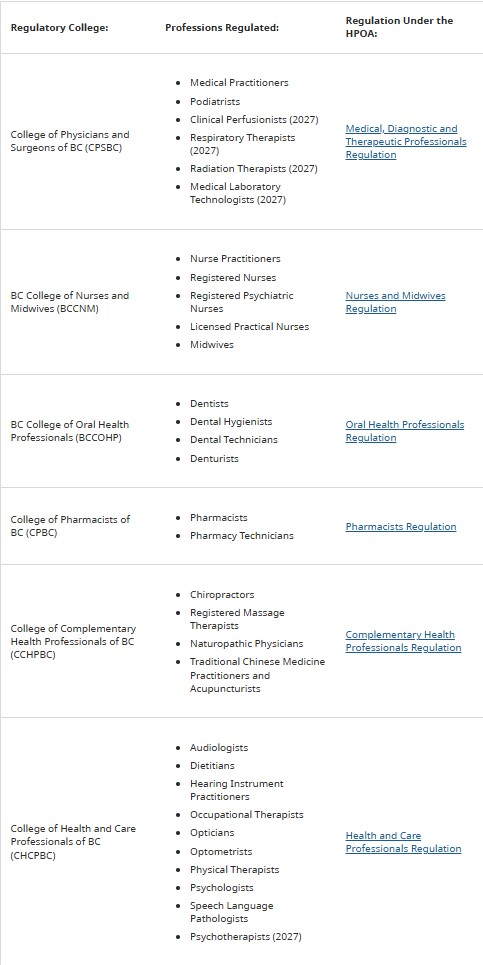
The HPOA formalises an ongoing push to amalgamate B.C.’s health regulatory colleges to reduce their number and standardise regulation. Recent mergers have combined nursing and midwifery regulators, joined the College of Physicians and Surgeons with the College of Podiatrists, and consolidated four oral‑health colleges into the BC College of Oral Health Professionals.
Under the new regime, professions are grouped by college through consolidated regulations instead of separate rules for each profession. For example, the College of Physicians and Surgeons of BC will regulate medical practitioners, podiatrists and, from 2027, several diagnostic and therapeutic professions under one regulation, while the BC College of Nurses and Midwives will continue to regulate nurse practitioners, registered nurses, registered psychiatric nurses, licensed practical nurses and midwives.
The HPOA maintains B.C.’s shared scope‑of‑practice and restricted‑activities model, which the government says is designed to support inter‑professional practice and team‑based care while balancing public safety and consumer choice. For HR, role descriptions, delegation practices and supervision structures in multi‑disciplinary teams may need to be reviewed against the new regulatory groupings and scopes.
Concerns over recruitment, retention and burnout
In 2022, the BC Association of Clinical Counsellors (BCACC) said positive words about the HPOA.
"BCACC welcomes the news from the BC Provincial Government that the regulation of clinical counsellors is on the immediate horizon," said Michael Radano, BCACC Chief Executive Officer. "BCACC has been working steadfastly to support its members for this eventuality. With a newly announced Entry to Practice Competency Framework for clinical counsellors, a public registry being launched by the end of 2022, and updated standards of practice with more planned to address the need for improved public protection, BCACC feels confident in its ability to prepare members for professional regulation."
However, Doctors of B.C. expressed their concerns about the legislation:
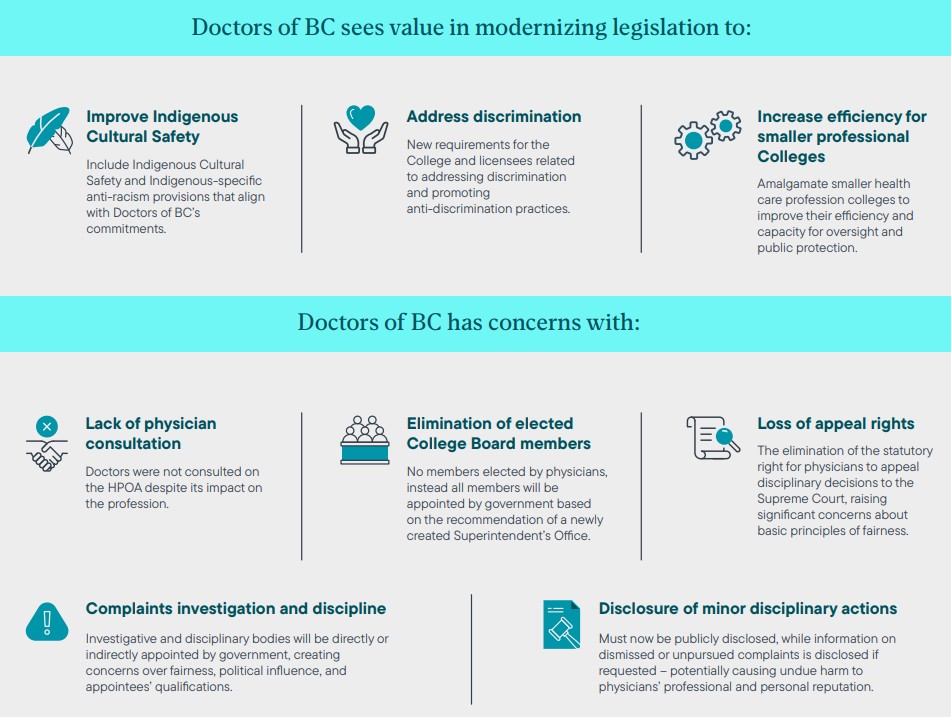
Adam Thompson, president of Doctors of B.C., told the Vancouver Sun the association has been raising concerns with the government for the past four years, particularly over the lack of an appeal process and the loss of control over appointments to the College of Physicians and Surgeons’ board.
“The key thing at the moment is that we want to recruit and retain doctors in British Columbia, and we need to realize that this will reduce the physicians’ desire to live and provide care in B.C.,” Thompson said. Citing another province’s experience, he added: “We saw in Quebec when they put in some changes to legislation around physicians that physicians in Quebec started to leave. There is a significant concern that (the bill) could have the same impact on physicians in B.C.”
B.C. has hired hundreds of healthcare professionals from the United States.
Opposition politicians are also seeking to halt the reforms. The B.C. Conservatives are calling for Bill 36 to be repealed. Party health critic Anna Kindy told the Vancouver Sun the changes represent “a huge level of government overreach in how health-care workers are regulated” and said she introduced a private member’s bill on 9 March to scrap the legislation. “It’s going to break down the … collegiality of sort of working together with government,” she said.
A report published earlier this year noted that 36 health‑care workers across three B.C. health authorities improperly accessed the medical records of Lapu Lapu Day Festival victims 71 times, in what the province’s privacy watchdog called an “egregious and intentional invasion” of privacy.



