
‘To be effective, a rewards experience must feel consumer‑grade: mobile, rich with choice, and personalised’
While rewards and recognition are crucial tools in HR’s toolbox, the structure and experience of employee rewards – not just recognition itself – have a direct, measurable impact on engagement, belonging and retention, according to a recent report.
Specifically, when people have a very positive rewards experience, they’re 2x more likely to feel motivated and 19x more likely to recommend their organisation as a great place to work, reports Workhuman.
When rewards carry real monetary value, engagement rises by 21 per cent and belonging by 28 per cent.
Employees are more motivated when they can use rewards for indulgences rather than everyday spending, says the report. Specifically, employees who use rewards for splurges are 25 per cent more likely to feel motivated to perform than those who use rewards for routine purchases.
And the vast majority (95 per cent) of employees who used rewards for “splurge” items they wouldn’t buy otherwise say they’re motivated to perform.
“Tangible value signals fairness and substance,” says the report. “Workers were more likely to say they love their program when they have the opportunity to choose splurges or items they wouldn’t otherwise buy with their own cash. To make rewards as sticky and meaningful as possible, ensure they have some tangible value.”
Social connections and employee rewards
The study also links reward design to social connection at work. It reports that 70 per cent of respondents have redeemed points as a gift for someone else, while 56 per cent “redeem their points for something that benefits the wellbeing of their family or friends.”
Employees who redeem for others’ well-being are 19 per cent more likely to say they are motivated to perform and 16 per cent more likely to feel connected to colleagues at work.
The report states that “when rewards are linked to shared moments, they can extend the emotional impact of recognition and strengthen social bonds that drive collaboration.”
Memorable redemptions tied to loved ones also correlate with stronger program sentiment. The report finds that employees who redeem rewards to create memories with loved ones are 5× more likely to love their recognition program (79 per cent vs. 15 per cent), and that 95 per cent of those who always redeem for memory‑making experiences report feeling connected to colleagues +20 percentage points more often than those who never do (95 per cent vs. 75 per cent).
Two in five (40 per cent) North American organizations are actively conducting formal ROI analyses of their employee recognition, according to a previous report.
Personalization tied to program ‘love’
The Workhuman study – based on a survey of more than 2,500 workers in the U.S., U.K., Ireland, Canada and Australia – also highlights personalisation as a key factor in program performance. It describes choice as “one of the clearest signals of respect,” and says personalisation is “what turns a generic gift into a meaningful one that lasts.”
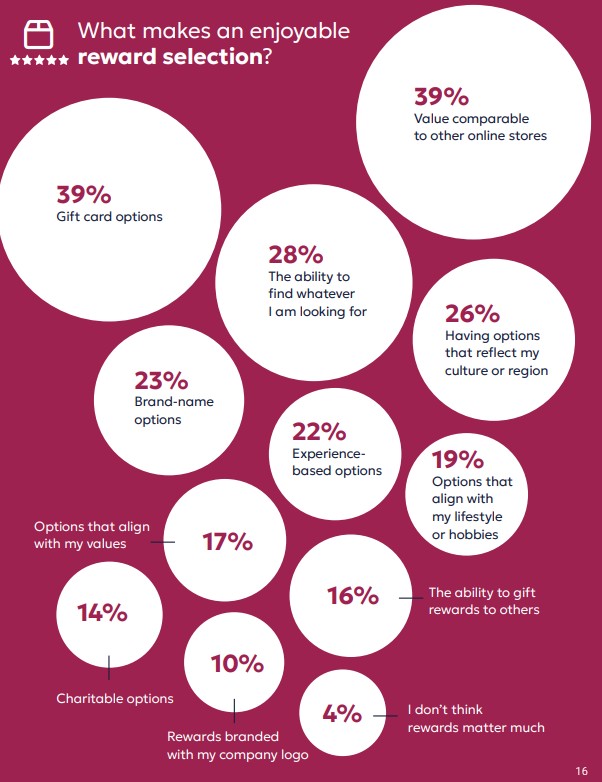
Employees who say their reward options reflect their culture, values and interests are 3x more likely to love their recognition program, says the report, which notes that “1 in 5 say they find options that align with their lifestyle or hobbies most personally meaningful” and “1 in 6 find rewards that align with their personal values most personally meaningful.”
“To be effective, a rewards experience must feel consumer‑grade: mobile, rich with choice, and personalised,” says Sarah Whitman, SVP of e‑commerce at Workhuman. “This research shows just how significant it can be when employees are able to turn recognition awards into a high-quality, global reward experience that reflects their values, interests, and culture.”
How can companies improve their employee recognition programs?
Despite increased awareness of the importance of employee engagement, most employers are still missing the mark when it comes to effective rewards and recognition programs, according to a previous report.
Here’s how HR professionals can effectively use employee recognition in the workplace, according to Robert Half:
Embed recognition into your team’s everyday culture.
- Build recognition into your team’s rhythm.
- Tie employee recognition to retention goals.
- Customise recognition for your team.
- Measure and evolve your efforts.
“Employee recognition isn’t a soft skill. It is a strategic lever for building stronger, more resilient teams,” says Robert Half. “By celebrating success consistently and authentically, Canadian employers can improve morale, reduce turnover, and create a workplace where people want to stay and grow.”



