
No evidence of link between workers' actions or omissions and incident to justify testing
A railway company did not have justification to require two workers to submit to substance testing following a minor incident with railway equipment, an arbitrator from the Canadian Railway Office of Arbitration and Dispute Resolution has found.
The two workers were employed with Canadian Pacific Kansas City Railway (CPR) since 2011. One was an extra gang foreman and the other was a special group machine operator.’
CPR had an alcohol and drug policy that permitted substance testing for a “significant work related incident, a safety related incident or a near miss or as part of an investigation.” The policy also stated that an employee should not be tested if “the act or omission of the individual(s) could not have been a contributing factor to the incident.”
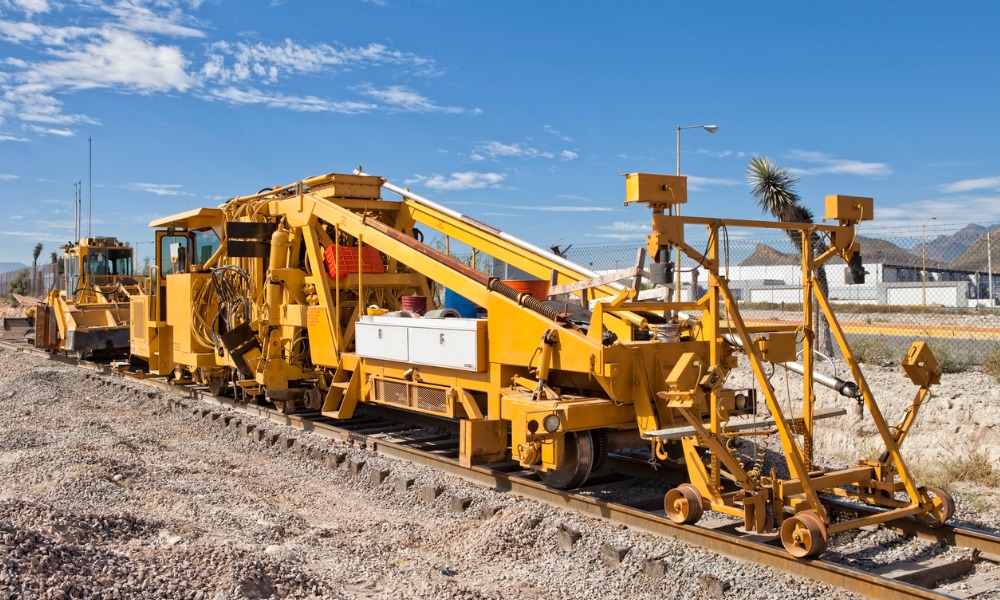
On April 26, 2019, the two workers were working together, with the machine operator running a Pandrol Jackson Tamper – a machine used for railway track maintenance - at the back of the work area. The extra gang foreman was working at the front end of the area.
At one point, the machine operator broadcast the switch position to the extra gang foreman, who was walking towards the tail end of the work area. He indicated that the switch was lined, locked, and checked for the reverse position and the foreman acknowledged the broadcast.
Minor incident
Shortly thereafter, the machine operator directed the tamper into a back track over a derailer that wasn’t properly aligned, which caused the tamper to derail. The tamper was placed back on the rails by jacks and work continued as normal.
CPR chose not to investigate the incident and had the machine operator sign an “admission of responsibility,” which was the lowest level of discipline for CPR employees.
However, the company required both workers to submit to substance testing under its alcohol and drug policy and procedures. It felt that it was both a safety related incident and a near miss, as the derail that the tamper rolled over was in place to prevent the movement of equipment onto the main line.
The machine operator’s test came back negative, while the extra gang foreman’s was positive for marijuana. He was dismissed and later reinstated.
Union challenged post-incident testing
The union filed a grievance alleging that CPR didn’t have cause to require the two workers to submit to substance testing. It argued that none of the conditions for testing outlined in the policy were present – the incident was treated as minor without an investigation; there was no injury or damage; it wasn’t significant, a near miss, or safety related; and it didn’t have the potential to cause injury, damage, or a serious safety concern.
CPR maintained that the machine operator’s actions or omissions caused the incident, as he had failed to place the derail in the non-derailing position before moving over it. This was a breach of a Canadian Railway Operating Rule, the company said. CPR also argued that the extra gang foreman was in charge of employees assigned to him and was required to be familiar with the location of the derail. He was also in radio communication with the machine operator right before the incident, establishing a “clear link” between the incident and his actions or omissions as foreman, said the company.
The arbitrator noted that the Supreme Court of Canada established that requiring an employee to submit to any type of substance testing was an invasion of privacy. There were limited circumstances when testing is allowed, with after an incident being one of them, said the arbitrator.
Link to employee’s actions required
However, the mere fact that an incident occurred wasn’t cause for testing – the employer must investigate whether acts or omissions by the employee contributed to the accident. This requirement was reflected in CPR’s own policy, the arbitrator said.
In this case, CPR didn’t investigate the incident, nor did it try to assess the extra gang foreman’s involvement other than he had a radio communication with the machine operator prior to the incident. The foreman wasn’t required to verify the information in the machine operator’s broadcast and it wasn’t his responsibility to view the switch to ensure it was lined properly. Had CPR investigated, it would have found that the radio communication was not to provide any directions but was an acknowledgement of the broadcast, said the arbitrator.
In addition, the foreman had overall responsibility for the work, but this didn’t support a testing requirement, the arbitrator said.
As for testing the machine operator, the arbitrator agreed with the union’s argument that the incident didn’t involve damage or risk of injury to justify testing – the evidence showed that CPR considered it minor and there was no risk of more than trivial damage. The failure of CPR to investigate meant that it couldn’t assess whether there was a link between the machine operator’s actions or omissions and the incident, said the arbitrator.
The arbitrator determined that CPR didn’t follow its own alcohol and drug policy and it didn’t have justification to test the two workers. CPR was ordered to make the foreman whole for any losses suffered. The machine operator didn’t suffer any financial loss in the matter. See Canadian Pacific Kansas City Railway and Teamsters Canada Rail Conference (Brown), Re, 2023 CarswellNat 6489.


