
Flawed investigation, inaccurate assessment of incident lead to inappropriate post-incident testing
A federally regulated employer in British Columbia breached a worker’s privacy rights and its own policy when it conducted a flawed post-incident investigation and ordered the worker to submit to substance testing, an arbitrator has ruled.
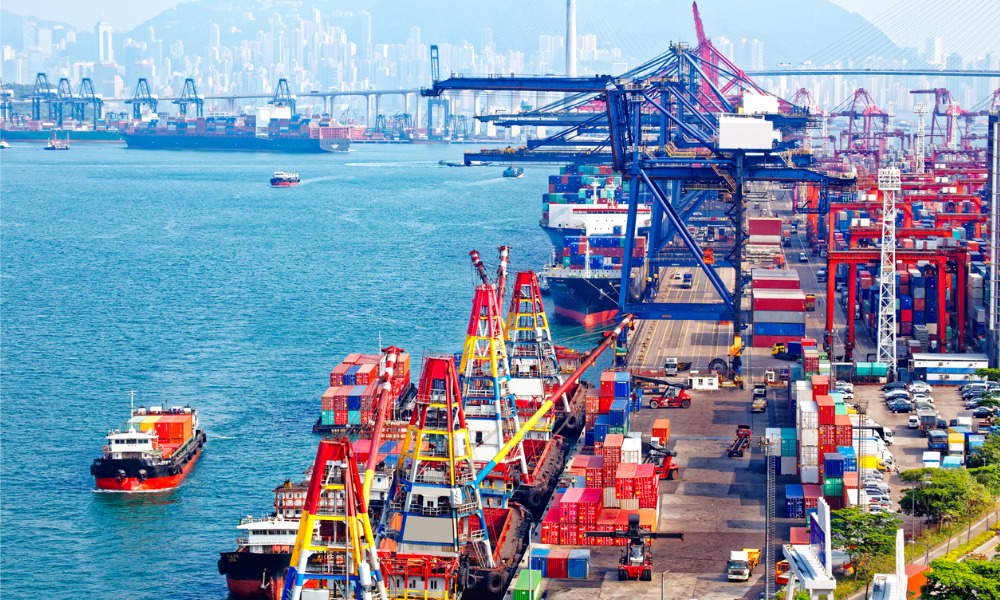
The worker was a longshore worker in Vancouver. He started longshore work in 1994 and became a gantry operator in 2011 with no incidents. A gantry operator runs a gantry crane, a large crane on rails that loads and unloads cargo vessels berthed at docks.
The worker was employed at DP World Canada Fraser Surrey Docks in Surrey, BC. The company was part of the BC Maritime Employers’ Association (BCMEA), which had joint drug and alcohol policy that applied to all workers in the BCMEA. The policy stated that an employee may be required to undergo substance testing following a significant event in order to rule out substance use as a potential cause of the significant event.
The policy defined “significant event” as an accident or near-miss that results in a fatality, a significant injury, significant damage to property, a reportable environmental event such as a spill, or a near miss that could have resulted in any of these events. Following such an event, the determination of whether an employee should submit to substance testing required a preliminary investigation that indicated a connection between the employee and the significant event, whether the employee’s actions or omissions may have contributed to the event, consideration of other factors, and whether testing would help with the investigation.
BCMEA also had procedures for gantry operation, including when a gantry must move past a vessel’s bridge with its boom raised and the operator’s cab at the back of the crane. When this happens, the operator can’t see the boom and relies on radio communication from the dock foreman and ship foreman. Clearance between the gantry and the vessel varied depending on the vessel.
Workplace accident
On Aug. 28, 2020, the worker was operating a gantry on a vessel with lights on a tower on its starboard side, closest to the dock. A couple of hours into his shift, he finished working in the rear of the vessel and had to move the gantry past the bridge. The dock foreman was on the dock and the ship foreman was on the bridge.
With the gantry’s cab at the rear of the crane, the worker slowly moved the gantry past the bridge. According to the worker, the foreman confirmed there was clearance but not much, so he should go slowly. The ship foreman said “stop, stop, stop,” so the worker let go of the joystick. However, the gantry always took a few seconds to stop, so it made contact with the vessel’s top navigational light, which fell and dangled on a cord. He was then told to move the gantry forward to a different bay and come down from the cab.
According to the ship foreman, the vessel had started to list towards the gantry and closed the clearance, perhaps because another gantry was working on the other side. His instructions to stop were given in a matter of seconds.
BCMEA conducted a preliminary investigation at the scene and the worker explained verbally and in a written statement that he had released the joystick immediately upon hearing the direction to stop, but the gantry continued to move for a few seconds as was normal. It was determined that the worker immediately followed the instructions to stop, but there wasn’t enough time before contact was made with the vessel’s light. However, the ship foreman reported that he had a good view of the clearance, there was clear communication, and he told the worker to stop multiple times but he didn’t. A video of the incident was also reviewed.
Management raised other concerns, such as a lack of awareness of the safe work procedure for gantries and hazards as contributing factors outside the worker’s control. It was determined that the incident was a significant event because the vessel’s light was damaged – about $4,000 to repair - the gantry had to be inspected before being put back in service – costing about $800 - and downtime.
Post-incident test
The worker was directed to submit to a post-incident substance test under the drug and alcohol policy. The worker complied and the result was negative, so there was no discipline and he was returned to work.
The union filed a grievance over the post-incident testing, arguing that there was no significant event, the investigation was flawed, and the decision to test was a breach of the policy.
The arbitrator noted that costs beyond physical damage – such as inspection of equipment – could be factored in whether an incident is a significant event, but costs on their own were not determinative. In this case, the arbitrator found that the damage to a single light was relatively minor and there was little safety risk, given that the gantry was moving slowly and no one was at risk. The arbitrator also found that the preliminary investigation was more concerned with “hypothetical concerns of delay” without the “actual gravity” of the incident. As a result, there was no basis to conclude that the incident was “special, remarkable, consequential, important” to justify invading the worker’s privacy rights, said the arbitrator.
The arbitrator also noted that the drug and alcohol policy stated that the purpose of a post-incident test was to “rule out substance abuse as a potential cause” and the investigation must genuinely assess whether there was an objective, reasonable basis for looking into impairment as a cause.
The arbitrator found that BCMEA had a significant amount of information immediately following the incident, including the video, the statements of the worker and the foremen, and the fact that another gantry was working on the other side of the vessel that could have caused the vessel to list. There was some discrepancy between the worker and the ship foreman on whether the worker stopped immediately, but there was no attempt to resolve that discrepancy, the arbitrator said, adding that the ship foreman had control of the gantry’s movement because the worker couldn’t see.
The arbitrator determined that the preliminary investigation leading to the order to test was flawed due to a lack of follow-up and objectively assess the available information.
BCMEA was ordered to pay the worker $1,500 in damages as compensation for the invasion of privacy and the employer’s failure to follow the drug and alcohol policy. See BCMEA and ILWU, Local 502 (Chauhan), Re, 2023 CarswellNat 6658.


