
Incident caused by carelessness, not malice following labour dispute
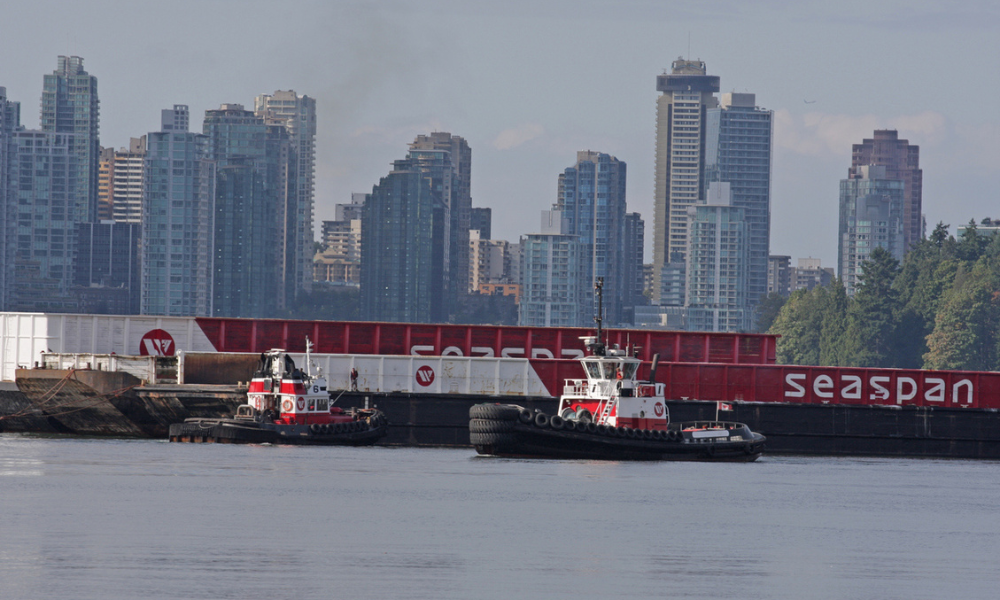
A BC tugboat captain’s actions in steering his vessel too close to another one was careless but not malicious, an arbitrator has ruled in reducing the captain’s suspension from 60 days to one day.
The worker was a tugboat captain for Seaspan with no discipline on his record. In late 2022, he participated in strike activity against Seaspan. During the labour dispute, another tugboat called the Trident Shield helped Seaspan.
On Nov. 10, 2022, the worker captained a Seaspan tugboat, the Falcon, out of the company’s Vancouver basin to a job in Port Moody, BC. After exiting the basin, turned towards a barge tie-up area and a navy buoy past the barge tie-up where other Seaspan vessels were tied up. He did not know which vessels were tied up, although it was reasonable to assume that there would be some.
He steered the Falcon out of the basin and increased his speed toward another tugboat, the Trident Shield, that was tied up and passed next to it about 20 feet away. Because of the Falcon’s proximity and speed, the tugboat’s wake rocked the Shield with enough force to disrupt the crew on board, although no one was injured.
After passing the Shield, the Falcon slowed down as it headed towards other vessels tied to the navy buoy. According to the worker, he reduced the throttles to more easily pass around the navy buoys.
Safety breach
The Shield’s crew didn’t immediately complain to authorities, but a short time later they reported it to the Shield’s owner. The owner then made a report to the federal authority and Seaspan.
Seaspan conducted an investigation, including a review of video taken from the mast of the Shield and GPS data that recorded the speed and path of the Falcon.
Seaspan believed that the worker intentionally steered his tugboat towards the Shield at an unsafe speed and distance in order to rock the other boat because it assisted Seaspan in the recent labour dispute. It asked the worker for an explanation and the worker said he was sorry if anyone was hurt.
It suspended the worker for 60 days and imposed return-to work conditions on him, including psychometric testing. The worker refused to complete the psychometric testing as he felt humiliated by it and some of the other requirements.
Suspension excessive: union
The union filed a grievance, claiming that the suspension and return-to-work conditions were without cause. In addition, the union argued that Seaspan’s actions were motivated in part because the worker participated in a strike, which was a breach of the Canada Labour Code.
The worker insisted that he believed that he was passing the Shield at a safe distance and speed, although he acknowledged that he could have given the other boat a wider berth. He said there was “no chance” of a collision.
The arbitrator found that the evidence proved that the worker travelled at a speed and proximity to the Shield so that the Falcon’s wake “presented an avoidable risk to those aboard the Shield,” noting that the worker was a skilled captain who could navigate his boat near other vessels and was responsible for his boat’s wake in close quarters.
However, the arbitrator also found that the worker did not intentionally aim the Falcon at the Shield. The worker’s explanation for slowing down after passing the Shield was credible, as reducing the throttles to ease passage around the navy buoys made sense, not necessarily because he didn’t want the same wake for other vessels as he had made for the Shield, said the arbitrator.
In addition, the video depicted a puff of smoke from the Falcon’s exhaust before it reached the Shield, which could be attributed to the engine throttle transitioning to a slower speed, but it would take time to slow down, the arbitrator said.
Misconduct unintentional but careless
Although the worker’s actions weren’t intentional, the wake was avoidable with reasonable care, the arbitrator said. As a result, it was reasonable for Seaspan to investigate and issue discipline.
The arbitrator also found that the worker’s carelessness was a serious employment offence, as his job involved independently captaining his boat safely and Seaspan’s interests were tied to securing its property and safety of its employees and others. The video provided enough evidence to prove the misconduct, but not Seaspan’s theory that the worker acted maliciously, the arbitrator said.
The arbitrator noted that the incident was an isolated event and the worker had no prior discipline, and he offered an apology if he hurt anyone. However, he didn’t acknowledge that it was in Seaspan’s interest that he travel more slowly around other vessels and the company needed to ensure that its message in that regard was received, the arbitrator said.
The arbitrator determined that the 60-day suspension and return-to-work conditions were based on Seaspan’s erroneous assumption that the worker’s misconduct was based on revenge for the Shield’s helping Seaspan during the labour dispute.
No bad faith
The union’s claim for aggravated damages was denied, as the arbitrator found that Seaspan did not act in bad faith. Although the company “overreacted” by concluding that the worker intentionally used the Falcon’s wake to rock the Shield, there was some basis for it to make that inference based on the video evidence and the timing, coming shortly after the labour dispute.
The suspension was reduced to one day and the return-to-work conditions were rescinded. In addition, Seaspan was ordered to compensate the worker for lost pay during the 60-day suspension plus $5,000 in general damages for the “unjustified intrusion of his privacy” from the psychometric testing.
See Seaspan ULC and CMSG (Jordan), Re, 2023 CarswellNat 5556.


