‘The anticipation of a very rapid change didn’t really appreciate how hard it is to integrate new technology into processes’: academic explains why AI workplace transformation will take time

A new report from MIT paints a sobering picture for Canadian employers and HR leaders: despite billions of dollars invested in generative AI (GenAI), only a small fraction of organizations is seeing real returns.
The study, based on over 300 public AI initiatives and interviews with 52 organizations, found that 95% of organizations “are getting zero return” from their GenAI investments.
Avi Goldfarb, professor of marketing and chair in artificial intelligence at the Rotman School of Business, isn’t surprised.
“I think this is exactly what we should have expected, which is that technological change takes time, and we’ve seen that in history over and over again,” he says.
“Whenever a major technology comes along, what we call a general-purpose technology, the long-run impact on productivity and the way we live and work is extraordinary, but the short run impact is a lot slower than we might expect.”
The reality behind the ‘GenAI Divide’
The MIT report — The GenAI Divide: State of AI in Business 2025 — highlights a gap between organizations that achieve business value from GenAI adoption and the vast majority that see little to no measurable impact, despite significant investment.
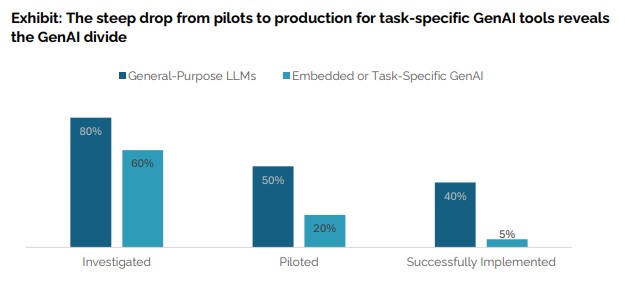
While over 80 percent of organizations have explored or piloted GenAI tools, and nearly 40 percent report deployment, most of these efforts fail to deliver measurable business impacts, the report said, further detailing that the divide is not due to poor technology or regulatory hurdles, but rather “seems to be determined by approach.”
Goldfarb draws a historical parallel to the adoption of electricity, noting that even when a new technology has clear wide-reaching uses and benefits, implementation depends on the systems into which they are being integrated – basically, whether they are ready.
“Electricity in the 1880s was clearly going to transform how we lived and how we worked… but in the US, which was the leading country in terms of electricity adoption, half of US workplaces and half of US homes were only electrified in the 1920s,” he says.
“It took 40 years from recognizing the potential to it making a difference for most people, at home and at work, and a big part of that was houses and workplaces were not designed for electricity.”
This is reflected in the current uptake of AI technology in workplaces, he says, as many organizations focus on immediate cost or time savings rather than long term improvements.
Source: MIT "The GenAI Divide: State of AI in Business 2025"
Point solutions and minimal impact
The MIT study found that most organizations are stuck in what it calls “point solutions” – using AI to replace a human in an existing workflow without changing the underlying process: “Most fail due to brittle workflows, lack of contextual learning, and misalignment with day-to-day operations.”
Goldfarb explains that the problem lies in narrow thinking or “point solutions” being implemented without accounting for wider impacts.
“You take your existing workflow, you figure out something an AI can do, you take out the human, you drop in a machine, you leave the workflow the same, and that’s almost by definition only going to have a minimal impact, because you can’t do any better than you’re already doing. All you’re doing is saving some costs,” he says.
“The anticipation of a very rapid change didn’t really appreciate how hard it is to integrate exciting new technology into processes.”
Certain sectors see little change with GenAI transformation
While the promise of generative AI has captured headlines, the MIT report finds that true transformation is limited to only a handful of industries: “Only two industries (tech and media) show clear signs of structural disruption, while seven others remain on the wrong side of transformation.”
In sectors such as healthcare, consumer and retail and financial services, GenAI has been relatively successfully embedded in support, content creation, and analytics use cases, it says – structural and systemic shifts have yet to be seen.
Rather, most sectors are experiencing “widespread experimentation without transformation,” it states.
Goldfarb explains this gap as a necessary “in-between” stage, as organizations are still in the early phases of figuring out how to redesign their systems and workflows to fully realize AI’s benefits.
“Major technological change doesn’t happen by you doing what you always did, but a little bit better,” he says.
“It requires a change in how you operate, and that kind of change is really complicated, and so it takes time for society to figure out what the new system looks like.”
Rethinking workflows for real value
The study found that 60 percent of organizations explored enterprise-grade AI systems, whether custom-built or plug-and-play, but only 20 percent of those reached the pilot stage. Only five percent made it to production.
“The core barrier to scaling is not infrastructure, regulation, or talent. It is learning,” the report states.
“Most GenAI systems do not retain feedback, adapt to context, or improve over time.”
Goldfarb agrees that simply automating existing processes is not enough, explaining that aiming for cost savings does not equal meaningful ROI, especially when every other aspect of a process remains status quo.
“Where the payoff tends to be is when you go a step further and say, ‘Okay, how can this new tool… allow me to better serve my stakeholders?’ And if that’s the framework, then your adoption of that tool is going to be more effective,” he says.
“A practical step for Canadian employers today is to first identify where AI might fit in their current workflows, and then only invest in that if it’s also going to be a step toward some kind of transformation, to allow them to not just do things more cheaply, but to do things more effectively and better.”