Crown corporation handed out average of $13,000 per manager and executive despite record losses
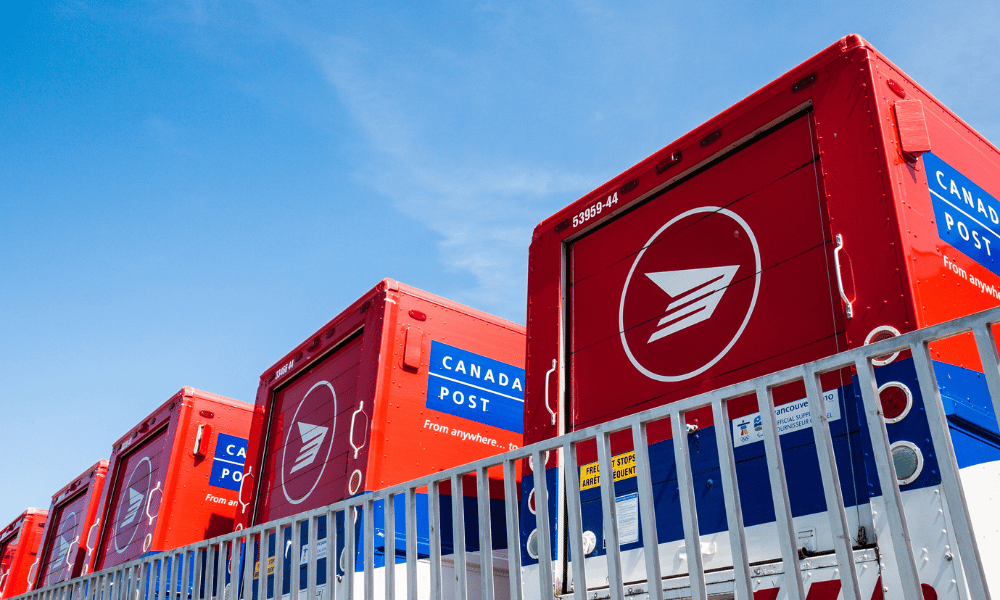
Canada Post approved $30.8 million in bonuses for its managers and executives in 2025, the same year it recorded its largest pre-tax loss ever and accepted a $1.03-billion taxpayer-funded bailout, according to government records obtained by the Canadian Taxpayers Federation (CTF).
The corporation has 2,377 management employees, including 417 at the executive level, putting the average payment at about $13,000, according to the CTF. Canada Post declined to break out executive bonuses separately from the management total, and did not disclose what percentage of executives received a bonus or what bonuses cost for non-management staff.
"It's absolutely unacceptable that Canada Post is handing out bonuses while taking a taxpayer-funded bailout," says Franco Terrazzano, CTF federal director.
"If Canada Post is taking taxpayer-funded bailouts, then there's no way its managers and executives should be showering themselves with bonuses."
Canada Post defends payments
Canada Post pushed back on the characterization. In a statement to CTV News, a company spokesperson said the $30.8 million is part of an existing compensation program funded from the corporation's own revenues — not the federal bridge funding it has received.
"This amount represents less than one per cent of our total annual labour expenses," the spokesperson said. "With our financial situation, we understand the optics and the concerns this decision will raise."
The corporation refers to the payments internally as "at-risk payments" rather than bonuses, describing them as tied to retention and performance and re-earned annually, according to CTV News. A separate bonus program covering all 55,000-plus Canada Post employees has not paid out since 2011.
The spokesperson also pointed to the corporation's ongoing restructuring — which includes closing some post offices and ending home mail delivery for four million Canadian households — as justification for retaining management talent, CTV News reported.
"Canada Post is facing significant financial pressures after two decades of declining mail and millions more addresses to serve," the spokesperson said. "Our objective is to re-establish a sustainable, reliable postal service for all Canadians that can pay back those loans as quickly as possible."
Record loss and 2 rounds of federal funding
Canada Post reported a loss of nearly $1.6 billion in 2025 — described by the corporation itself as the largest loss before tax on record, according to the CTF. It was the eighth consecutive year the Crown corporation lost money, bringing its cumulative losses over that period to roughly $5.4 billion.
The federal government provided Canada Post with a $1.03-billion bailout in 2025, intended to carry the corporation through the fiscal year ending March 31, 2026. But Canada Post said the funding proved insufficient "due to the severity of the corporation's financial situation."
The government announced a second tranche of up to $1.01 billion in February 2026 as a short-term financial bridge. Both rounds of funding are to be repaid "in so far as [Canada Post's] revenues are sufficient," according to the CTF.
Union calls bonuses 'unacceptable'
The Canadian Union of Postal Workers (CUPW) issued a statement July 14 drawing a direct line between the management payments and the concessions postal workers faced at the bargaining table.
"Canada Post says it is facing an unprecedented financial crisis," CUPW said. "It is demanding concessions from postal workers, warning of service cuts, seeking more than $2 billion in public loans, and telling Canadians that the corporation is 'on the brink.'"
The union said it was unacceptable to demand concessions from workers, cut door-to-door delivery, and close post offices "while executives continue paying themselves millions in bonuses." Canada Post and CUPW spent more than two years in contentious negotiations that resulted in strikes in 2024 and 2025, with postal workers voting to ratify a new contract in June 2026, according to CTV News.
"The future of Canada Post must be built through investment, innovation, accountability and public service — not secret executive bonuses, service cuts and worker concessions," CUPW said.
Other Crown corporations giving bonuses
The CTF said Canada Post is not alone, citing other Crown corporations giving out bonuses:
- The Canada Mortgage and Housing Corporation (CMHC) paid out $31.7 million in bonuses last year despite its CEO acknowledging that housing supply and affordability "remained one of Canada's greatest challenges."
- VIA Rail handed out $10.3 million in bonuses, with every executive receiving one and the average executive bonus coming to $115,293 — even as the rail corporation continues to lose hundreds of millions of dollars annually.
- Alto, the Crown corporation overseeing the federal high-speed rail project, paid out $2.8 million in bonuses with an average executive bonus of roughly $68,500. The organization noted that construction on the project has not begun and the route has not been finalized.
Across the federal government, about 98 per cent of all government executives received a bonus in 2024-25, the most recent year for which data is available, according to the CTF. Federal departments met just 54 per cent of their performance targets that same year.