'More people in Canada are using their drug plans and they’re accessing treatments that were unattainable a few years ago'

Canada’s private drug plans are facing mounting cost pressure from high‑priced therapies, according to a recent report.
Overall, 61.8 per cent of insured individuals made at least one claim in 2025, up from 58.7 per cent in 2023, reports TELUS Health.
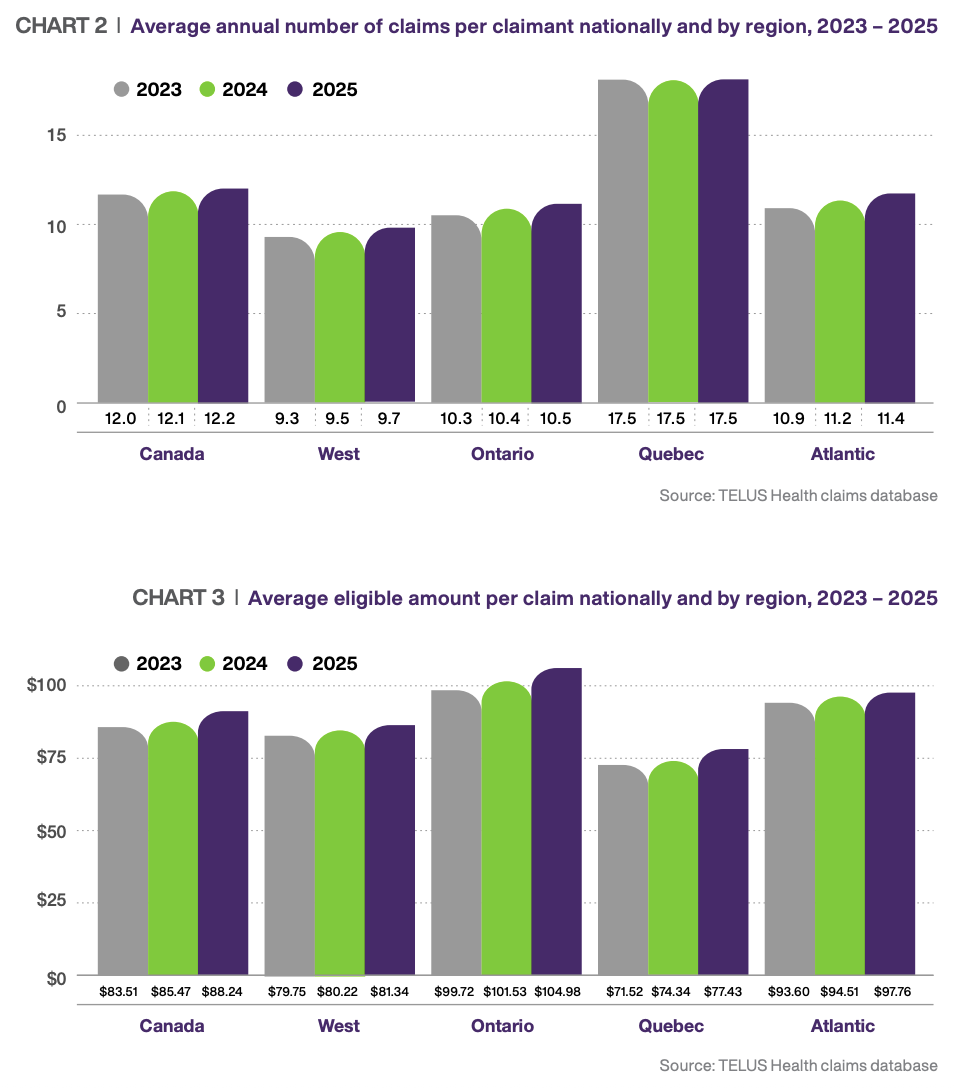
While the average number of claims per claimant held steady at 12.2, the average eligible amount per claim rose to $88.24 and the average annual eligible amount per claimant increased to $1,079.04, the company concludes, based on claims data for more than 15 million insured people in Canada.
“More people in Canada are using their drug plans and they’re accessing treatments that were unattainable a few years ago,” says Vicky Lee, pharmacist and director, pharmacy consulting & professional services at TELUS Health.
The company notes that growth in eligible amounts continues to outpace growth in utilisation because of the impact of high‑cost drugs on the overall price point.
In 2024, the average eligible amount per claim rose to $85.52 from $83.53 in 2023, the company previously reported.
Specialty, weight‑management and diabetes drugs
Specialty medicines remained the main driver of spending in 2025, accounting for 33.9 per cent of total eligible drug costs while being used by only 2.1 per cent of claimants. Within that group, ultra‑high‑cost drugs—defined as having annual treatment costs of at least $100,000—represented 5.2 per cent of total eligible spend and were used by 0.03 per cent of claimants, at an average annual eligible amount of $190,446.32 each.
Trikafta, a therapy for cystic fibrosis, accounted for 47.7 per cent of spending on ultra‑high‑cost drugs at an estimated $300,000 per year, while Ultomiris, for rare blood disorders and neuromuscular diseases, can cost up to $600,000 annually. TELUS Health notes that even a single ultra‑high‑cost claim can be “catastrophic for a drug plan,” underscoring the need for robust risk‑management arrangements.
The weight‑management category climbed six places in 2025 to rank 11th among all drug categories, representing 2.5 per cent of total eligible spend after growth of 61.0 per cent in one year and 104.0 per cent in 2024. Wegovy, a semaglutide formulation for weight loss, held 68.7 per cent of category spending by year‑end, while TELUS Health expects new entrant Zepbound and eventual Wegovy generics to further expand the market.
Diabetes, including devices, remained the largest category at 13.2 per cent of total spend, but eligible amounts declined 6.8 per cent in 2024 and 1.8 per cent in 2025. TELUS Health links the drop partly to reduced off‑label Ozempic use following Wegovy’s launch and says Health Canada is reviewing eight generic versions of Ozempic expected to be priced at 35 per cent of the brand’s list price.

Generics, pharmacare and regional gaps
Generics and biosimilars continued to support cost containment. Generic medicines captured 70.8 per cent of all claims in 2025, up from 67.5 per cent in 2023, while 67.4 per cent of claimants using one of 18 tracked biologics received a biosimilar, compared with 44.6 per cent in 2023. TELUS Health highlights the ADHD category, where the launch of generic Vyvanse helped push eligible costs down 13.2 per cent in 2025 despite higher utilisation.
Public pharmacare initiatives are beginning to shift costs from private plans. The federal Pharmacare Act for diabetes drugs and contraceptives took effect in October 2024, with Manitoba and Prince Edward Island launching programmes in 2025 and British Columbia following in March 2026. TELUS Health reports sharp declines in private contraception claims in these provinces and expects some diabetes spending to migrate as more jurisdictions join.
Regional disparities remain pronounced. Quebec’s 30‑day dispensing practices drove the highest claim frequency in 2025 at 17.5 claims per person and the highest annual eligible amount per claimant at $1,355.25, despite the lowest cost per claim at $77.43. Western Canada, supported by universal or pharmacare‑style public plans, recorded the lowest annual eligible amount per claimant at $787.41, while Atlantic Canada saw the fastest growth at 5.5 per cent, reflecting its higher mix of specialty drugs.
“An evidence‑based plan design is critical,” Lee says. “The convergence of ultra‑high‑cost therapies, a maturing weight‑management market and the availability of generics means a thoughtful approach that balances costs, medical innovations and regional policies is required to continue supporting the evolving healthcare needs of people in Canada.”
How can employers contain drug plan costs?
Here’s how employers can maximise their drug plans amid rising costs, according to insurance company HUB International:
Assess employee impact first:
- Instant cost‑saving solutions can create stress, friction and long‑term coverage issues for employees.
- Understand how heavily staff rely on the drug plan and how much they value it relative to other benefits.
- Prioritise a strong “quality employee experience” (QEX) for pharmacy coverage before implementing aggressive cost cuts.
Use robust data analytics:
- Analyse utilisation patterns, prevalent conditions and high‑cost medical issues in the workforce.
- Work with an experienced broker to access broader, deeper data sets than traditional reports.
- Model the impact of any drug‑strategy change to predict disruption and support long‑term cost sustainability.
Adopt formulary management:
- Consider managed formularies that use evidence‑based drug coverage to support long‑term sustainability.
- Aim to control costs while minimising disruption for employees.
- Rely on an experienced broker to explain options and help choose the right formulary strategy.
Benchmark against competitors, with caution:
- Compare your pharmacy benefit with peers to see if it is too lean or too costly.
- Recognise that benchmarking assumes similar strategies and demographics, and that competitors are acting proactively, which may not always be true.
“Managing pharmacy benefit costs may seem overwhelming, but organisations that take an active role can achieve a more affordable, effective and sustainable plan for the long term,” the company says.
Canada faces a “multiprong threat” to prescription drug affordability, driven by domestic regulatory changes, international trade dynamics and political resistance to comprehensive pharmacare, according to a previous report.
And only 55 per cent of Canadian employers feel successful in containing healthcare costs, while 40 per cent remain neutral, highlighting ongoing difficulties, according to another previous study.