Which province has the longest wait times? Delays impact people with heart conditions, mental health issues

Three months or more—that’s how long many Canadian adults wait just to get an initial appointment with a medical specialist, according to a recent Statistics Canada (StatCan) report.
This is true for 36 per cent of all Canadians who sought an initial specialist appointment in 2024.
Meanwhile, two-thirds of Canadians waited less than three months for an initial consultation with a specialist: 35 per cent waited less than a month and 30 per cent waited one to less than three months.
What are the effects of medical long wait times?
Overall, 35 per cent of Canadians aged 18 and older—or 10.8 million people—consulted a medical specialist for an initial appointment in the past year.
The impact of wait times is significant, noted StatCan. Sixty-four per cent of Canadians who saw a specialist reported that the wait affected their lives. The most common effects were increased worry, anxiety and stress (66 per cent), pain (36 per cent), and difficulties with daily activities (32 per cent).
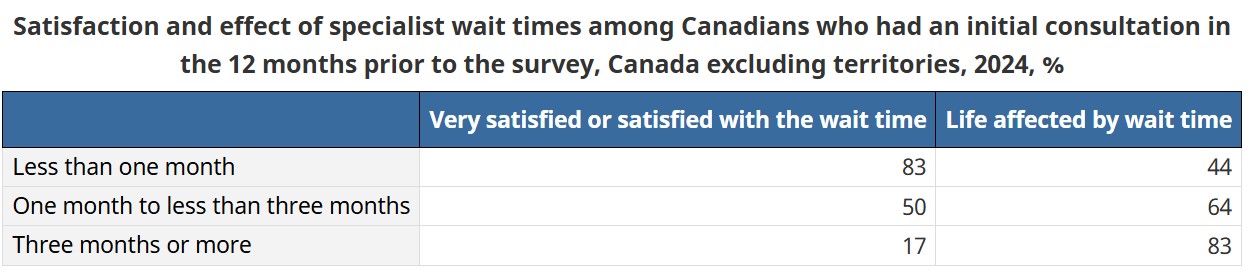
The likelihood of negative effects increased with longer waits: 44 per cent of those seen within a month reported an impact, compared to 83 per cent of those who waited more than three months.
This affected many who already suffer from the following health conditions:
- Heart condition or stroke (55.3 per cent)
- Cancer (63.3 per cent)
- Asthma or other breathing condition (63.5 per cent)
- Mental health condition (63.2 per cent)
- Diabetes (60.0 per cent)
Delayed medical treatment is linked to worsened outcomes, including disease progression, chronic complications, or even death, as was discussed in a previous report from The Times.
And nearly two-thirds of Canadian women delay, skip healthcare due to long wait times, according to a previous report.
On top of that, many Canadians across different provinces are dissatisfied with their experience, according to StatCan’s report.
|
Province |
Percentage of those saying they are dissatisfied or very dissatisfied |
|---|---|
|
Ontario |
34.2 per cent |
|
Alberta |
33.4 per cent |
|
British Columbia |
33.3 per cent |
|
Saskatchewan |
31.0 per cent |
|
Manitoba |
30.5 per cent |
|
Nova Scotia |
29.7 per cent |
|
Prince Edward Island |
29.3 per cent |
|
Newfoundland and Labrador |
28.2 per cent |
|
New Brunswick |
25.6 per cent |
|
Quebec |
22.9 per cent |
People waiting for medically necessary treatment lost an estimated $5.2 billion in productivity in 2024, reported the Fraser Institute.
"Waiting for medically necessary treatment remains a hallmark of the Canadian health-care system, and in addition to increased pain and suffering—and potentially worse medical outcomes—these long waits also cost Canadians time at work and with family and friends," said Nadeem Esmail, a senior fellow with the Fraser Institute.
Mackenzie Moir, senior policy analyst at the Fraser Institute, added “These findings point to the growing burden of long wait times not only on individual well-being but on the broader economy.”