
Waterloo North Hydro, Niagara Casinos among 30 winners
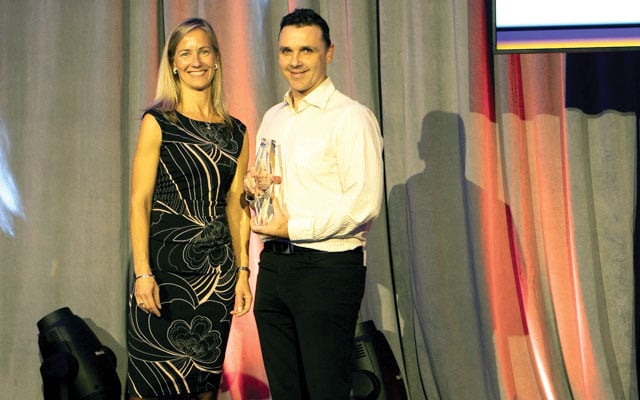
Thirty companies were recognized for health and safety excellence recently at the ninth annual Canada’s Safest Employers awards, presented by Canadian Occupational Safety (a sister publication to Canadian HR Reporter).
The awards boast 10 industry-specific categories, ranging from services and health care to mining and manufacturing. Companies are judged on a wide range of occupational health and safety elements including leadership commitment, employee training, OHS management systems, incident investigation, emergency preparedness and innovative health and safety initiatives.
Two of the awards of particular interest to HR included the Wellness Award (for employee overall well-being) and the Psychological Safety Award (for employee mental health):
Psychological Safety – Gold: Waterloo North Hydro
Waterloo North Hydro’s management team need only look at its employee history to realize why psychological safety is of upmost importance.
An employee suicide in the 1980s — and a second one in 2012 — were eye-opening experiences for the 123-worker hydro company in Waterloo, Ont., says Will Stratford, manager of health, safety, environment and sustainability.
“That definitely made us realize that this is not an isolated thing,” he says. “Caring about the psychological safety and the mental health of our employees is an obligation; it’s not a nice-to-have.”
The day following the 2012 suicide, Waterloo North Hydro implemented a psychological health and safety management program.
“There was huge potential for us to create an environment that brought out the best in people,” says Stratford. “We tried to take a concept that is definitely not comfortable for a lot of people — and definitely theoretical — and we tried to make it practical.”
Psychological safety concerns were added to tailboard meetings at the company. The programming targeted stigma associated with mental health issues and coaxed workers to become more comfortable discussing the subject.
And while some hydro workers are exposed to highly stressful scenes such as motor vehicle crashes, the programming is intended to benefit all staff, says Stratford.
Seven years later, management’s efforts appear to be paying off.
“People here are now used to talking about how they’re feeling and when they’re not feeling well and whether they’re fit to do what they’ve been asked to do,” he says. “It’s very much part of their vocabulary now.”
Commitment from senior leadership helped steer workplace culture toward an environment where civility and respect are expected, says Statford, and mental health is embedded into business methodology.
“The early adoption is significant,” he says. “Safety needs to be embedded so it becomes part of the everyday discussion. And now, psychological safety is taking the next step in that way, too.”
Senior leadership’s commitment to psychological health and safety alongside training for employees stems from the foundational belief that an employer needs to support staff in all aspects of their lives, says Stratford.
In terms of programming options, Waterloo North Hydro’s efforts in mental health are tiered in three categories: minimal, medium and high investment.
Minimum investment includes promoting opportunities within the employee assistance program (EAP) and tapping into local resources whenever possible.
“We’re very aware of our local resources and we leverage them as much as we can,” says Stratford.
Medium investments include paying for lunch-and-learns and financial health seminars, as well as promoting a healthy work-life balance that allows employees the opportunity to use their lunch hour to work out or meal prep for their families.
And a recent high-investment initiative saw the hydro company offer a Ways to Mental Wellbeing program for five weeks for interested staff.
“It’s building the skills of your employees to become more self-aware of their own needs and give them a pathway to become more mentally resilient,” says Statford.
Reworking corporate policies to include care for mental health alongside physical safety has also benefited Waterloo North Hydro. Altering the language used in the workplace has provided assurance to employees that psychological safety is worthy of consideration.
“It’s a slightly different approach to a traditional process,” he says. “We’ve tried to connect people in a way that makes them realize that we don’t just care about their work, we care about them.”
The company twice circulated the Guarding Minds at Work survey to employees — in 2012 and 2017. The aggregated data helped management direct programming toward areas that scored lowest, with results from the latter survey showing that efforts to alleviate concerns had been successful.
Also in 2017, Waterloo North Hydro offered a comprehensive mental health awareness program for all employees.
Further, the hydro company augmented its return-to-work process in 2017 to include cognitive demands to create a more inclusive environment that supports mental health. The policy applies to both work-related and non-work-related situations.
Wellness – Gold: Niagara Casinos
Niagara Casinos’ wellness initiative brought about a major life change for one employee, according to Lindsay Daw, disability services manager at the gaming and entertainment company that runs two casinos in downtown Niagara Falls, Ont.
“There was one woman who actually was able to go off of her diabetes medication because she was able to get it under control.”
This past year, Niagara Casinos implemented a new digital wellness effort using the Praktice Health app, which became “the best challenge we’ve ever done,” she says. The 30-day event enabled the 4,224-employee workforce to keep a close eye on everything they do, from eating to exercise to mindfulness.
“Each day for those 30 days, you tracked your nutrition, your hydration, exercise or activity; [it was] linked to your phone or your Fitbit to track your steps,” says Adam Palmer, safety prevention supervisor at Niagara Casinos. “Also, there was a moment of mindfulness where there was a guided meditation three times a day that you would complete.”
The participating employees accumulated a total of more than 49.2 million steps, ate 8,650 healthy meals and drank 9,600 litres of water. Collectively, they inhaled 14,000 mindful breaths and 3,750 physical activity actions over the 30 days.
For the roughly 300 workers who took up the challenge, it was well received.
“We have one [employee] who was 71 years old [and she] did every single activity and she was a real champion for the challenge,” says Palmer.
All the information went into a social feed that all participants could see.
“It wasn’t a huge change; it was these daily micro-habits that you’re focusing on and changing,” he says. “For someone to have more water intake or manage their meals, it really helped.”
Niagara Casinos also put a big emphasis on financial wellness with a pop-up event entitled “Small Amount Equals Big Savings.”
“We had a little coffee stand pop-up and we gave out coffee and cookies. The idea was to show how cutting back on small amounts — like buying a coffee or cookie every day — can make a big impact on people’s savings over time,” says Daw. “We were giving out information on what that daily coffee could save you for your retirement over 10 years, 25 years.”
The company also highlighted the importance of handwashing prior to cold and flu season with another pop-up initiative.
“You basically washed your hands with Glo Germ [and] you put your hands underneath the blue light, and it’ll show if you’ve cleaned your hands well enough,” says Daw. “It creates quite a buzz.”
Niagara Casinos’ employees are generally enthusiastic about all the company’s wellness initiatives, says Daw.
“When they’re chatting with their friends and talking about some of the things we do — like stand-up paddle-boarding or goat yoga that we just did recently — I think they become very proud of those things and the resources and the intent that we put into these programs.”
The company is far from finished with its wellness efforts and Niagara Casinos plans on introducing new initiatives to address the challenges for workers at the 24-7, 365-days-per-year operation. The wellness committee is currently working on creating a resource guide for new employees on shift work.
“We recognize that fatigue and sleep is an important part of health and wellness,” says Palmer. “It’s looking at providing tips for sleep hygiene and routine; even things like how to manage social relationships, family relationships, when working with shift work and different hours.”
Niagara Casinos will always be investing in employee wellness because wellness is one of its key business objectives, says Daw.
“Our associate well-being is part of our strategic objectives: We want to make sure that our associates are in a good mindset financially, physically, mentally; they’re a contributor to our success and we directly link it to our culture and our business performance,” she says. “We know that a healthy employee will perform better.”



