Unemployment falls to 6.6% as construction, transportation and summer hiring lead rebound: StatCan

Canada's labour market rebounded sharply in May, adding 88,000 jobs and pushing the unemployment rate down to 6.6%, according to Statistics Canada's latest Labour Force Survey released Friday.
The gain marks the first significant employment increase since November 2025, and comes after a net loss of 112,000 jobs over the first four months of the year.
On a year-over-year basis, employment was up 147,000, or 0.7%. The employment rate — the share of the population aged 15 and older who are employed — rose 0.2 percentage points to 60.7%, also the first increase since November.
The employment situation showed a nice rebound in May, reversing a weak start to the year, says Brendon Bernard, senior economist at Indeed Canada.
"Not only did full-time employment and hours worked jump, but gains were encouragingly broad-based across industries," he says.
The strong numbers are a good reminder of how a "brewing trend" in the Labour Force Survey can reverse with just one data release, according to Bernard.
"The slide in full-time job growth that started in February has reversed, and the 0.3-point drop in the unemployment rate to 6.6% almost brings it back to where it started the year. This isn’t particularly good news — the challenges facing Canadian job seekers persist. But the weak momentum that began the year was probably overstated, in part because the fourth quarter of 2025 was surprisingly strong. We’re now back to baseline."
Full-time work in Canada
The recovery was driven almost entirely by full-time work, which surged by 154,000 in the month, effectively reversing a similar-sized decline of 156,000 full-time positions recorded between January and April. Part-time employment fell by 66,000. Both the private sector and the public sector contributed to the gains, adding 56,000 and 20,000 jobs respectively, while self-employment was little changed.
The unemployment rate, which had climbed from a recent low of 6.5% in January to 6.9% in April, pulled back in May but remains above its pre-pandemic average of 6.0% observed between 2017 and 2019. The rate peaked at 7.1% in August and September of last year, said the Labour Force Survey.
As conditions improved, the job-finding rate — the share of unemployed Canadians who found work — rose to 26.3%, up 3.7 percentage points from the same period last year, though still below the pre-pandemic benchmark of 31.5% for the same months.
Employment by sector
Job gains were spread across several sectors, with construction leading the way at 27,000 new positions, a 1.7% monthly increase. Information, culture and recreation gained 19,000 jobs, as did transportation and warehousing — up 2.3% — while accommodation and food services added 17,000.
Manufacturing also posted a modest gain of 15,000, though the sector remains down 44,000 positions compared with January 2025, a period of heightened uncertainty tied to U.S. tariff policies, said Statistics Canada.
Transportation and warehousing and accommodation and food services were standouts on a year-over-year basis as well, up 36,000 and 34,000 positions respectively compared with May 2025.
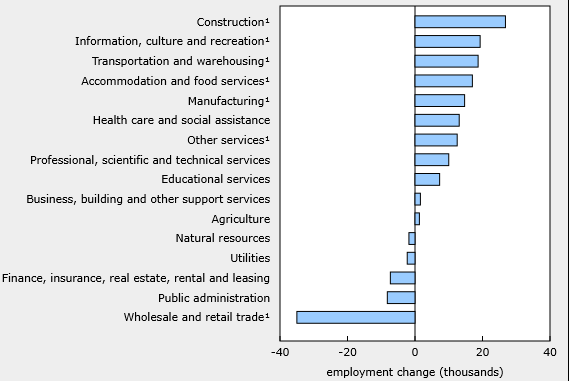
The one notable drag was wholesale and retail trade, which shed 35,000 jobs — continuing a downward trend that began in October 2025 and leaving the sector down 64,000 positions compared with a year ago.
Youth and core-aged workers
Average hourly wages rose 3.0% year-over-year in May to $37.24, a deceleration from the 4.5% growth recorded in April (not seasonally adjusted), said the Labour Force Survey.
Youth aged 15 to 24 saw their unemployment rate fall 0.9 percentage points to 13.4% — the first decline since January — though the rate remains well above the pre-pandemic average of 10.8% and has been consistently elevated since the start of 2024.
Full-time employment among young workers jumped by 99,000, offsetting a comparable drop over the previous four months, though that was partially offset by a 76,000 decline in part-time work among the same group.
For core-aged workers between 25 and 54, unemployment fell 0.4 percentage points among both women, to 5.5%, and men, to 5.7%. Employment among core-aged women rose by 31,000, all in full-time positions. For core-aged men, employment rose by 25,000. Workers aged 55 and older saw little change in either employment or unemployment, with the latter holding at 5.0%.
Summer jobs in Canada
May also offered an early read on the summer student job market. The unemployment rate among returning students aged 15 to 24 came in at 18%, down 2.1 percentage points from the same month last year — an improvement from what Statistics Canada described as the slowest start to a summer job market since 2009, outside of the pandemic years.
Among those who did find work, the largest share landed jobs in retail trade, which accounted for 28.4% of employed returning students, followed by accommodation and food services at 23.0% — up 2.5 percentage points from a year ago — and information, culture and recreation at 12.6%.
Average hourly wages rose 3.0% year-over-year in May to $37.24, a deceleration from the 4.5% growth recorded in April (not seasonally adjusted).
Provincial breakdown of job gains
Ontario led provincial gains with 42,000 new jobs, bringing its two-month total to 84,000. The province's unemployment rate fell 0.5 percentage points to 7.0%, its lowest since September 2024. British Columbia added 25,000 jobs, partially recovering from a cumulative loss of 39,000 in February and March, though its unemployment rate held steady at 6.8%.
Alberta gained 14,000 positions, following three consecutive months of little movement, and its year-over-year increase reached 104,000 — the largest among the provinces — while its unemployment rate fell 0.4 percentage points to 6.6%. Prince Edward Island also posted a gain of 1,200 jobs, with employment up 5.1% compared to a year ago, said the Labour Force Survey
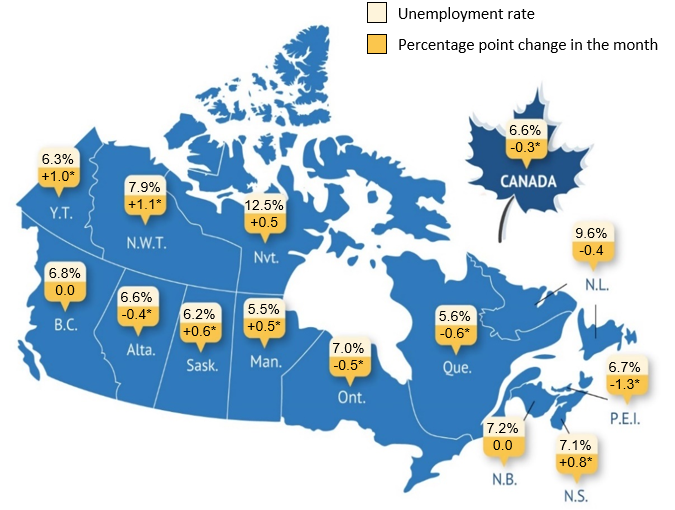
Quebec edged up by 13,000 jobs after shedding 91,000 between January and April. Its unemployment rate dropped 0.6 percentage points to 5.6%, though Statistics Canada noted the decline was partly driven by fewer people actively searching for work rather than employment gains alone.
Saskatchewan was the only province to record a meaningful decline, shedding 6,100 positions, pushing its unemployment rate up 0.6 percentage points to 6.2%, though employment there remained little changed on a year-over-year basis.
In the country's largest cities, Toronto's unemployment rate fell 1.1 percentage points to 6.8%, its lowest since November 2023 and well below its recent peak of 9.0% last spring. Montréal dropped 1.2 percentage points, largely reversing the previous month's increase, to land at 6.5%. Vancouver fell 0.6 percentage points to 6.4%. All three cities were little changed on a year-over-year basis.