'It's a dismal number': ADP research shows low employee engagement globally

“One in five workers are willing to be all in for your organization, compared to 80% that are just doing their jobs or coming to work… It's a dismal number.”
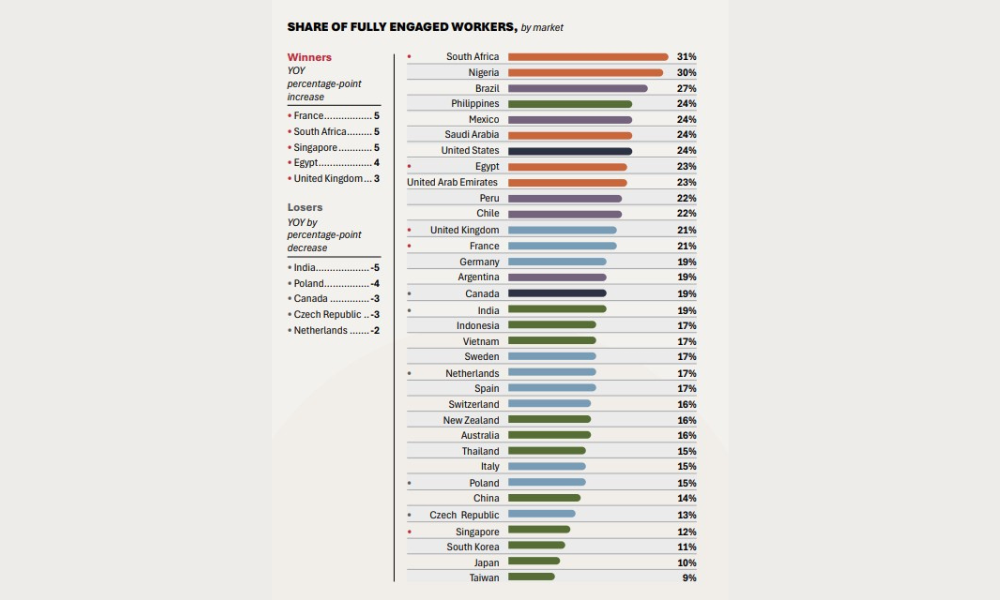
So says Mary Hayes, director of research, people and performance at ADP, in highlighting that, globally, only about 19% of workers are fully committed to their organization, while 80% are merely fulfilling their duties.
The decline in engagement levels is also evident among Canadian workers, with only 18% of employees reporting full engagement and a three-point overall percentage drop compared to 2023.
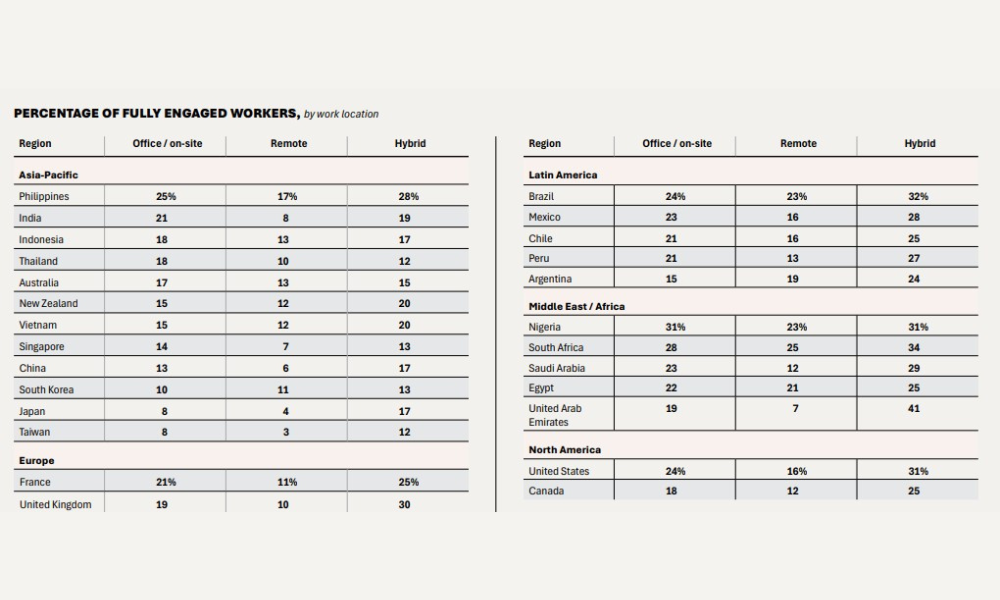
Clear generational and work arrangement disparities have emerged in recent years, she says, pointing out that in Canada in particular, engagement levels drop significantly among older workers—particularly Gen Xers aged 40 to 55—compared to their younger counterparts, while remote workers face extra challenges in finding engagement relative to those in office or hybrid settings.
Development programs and employee resource groups
The challenges faced by older workers and remote employees highlight the need for targeted strategies – which is where Aryme Massad, senior director of people services at Colliers, says her organisation has excelled, through dedicated investment in employee resource groups (ERGs), development programs, and – most importantly, she says – direct responses to employee feedback.
 Source: ADP Research “People at Work 2025”
“We have development programs that help identify people that are up-and-comers, give them opportunity and space and a spot at the table,” says Massad.
“We have a lot of people that want to be in ERGs. We have lots of ERGs that have started because people have put their hands up and said, ‘Hey, this is something that I think that we should have, and we don't.’ So, we've had really good participation in our ERGs, honestly.”
These development and community-focused initiatives are critical for creating an environment where employees feel seen and supported, Massad explains – and it’s a constantly evolving process that ultimately centres around employee participation and leadership.
“We're always looking at new ways to evolve them, and develop and bring in new ERGs, but we have a pretty passionate group of people that want to be involved and want to find community and work towards something greater, too.”
Fostering a culture of feedback and continuous change
Hayes says the employer response to employee feedback is a crucial element in preventing employee engagement decline – and this means demonstrating deliberate efforts to implement changes that reflect the input of the workforce.
By ensuring feedback mechanisms are robust and there are clear, transparent processes for action, companies can foster a sense of autonomy among employees, which is an important factor in employee engagement.
“The important part is that you understand that people are going to provide you information, and you need to do something with it,” she says.
“So have a plan, have a feedback mechanism. If you ask a question, you ask a survey, close the feedback loop to the people that are responding so then they feel like they're being listened to and cared about … so that they are more willing to be open and honest the next time.”
 Source: ADP Research “People at Work 2025”
Massad highlights the importance of the feedback cycle at Colliers, sharing that when employers act according to employee feedback, it cultivates trust, an essential element of engagement.
“I think people can see that change comes from them sharing their opinions,” says Massad, explaining that when feedback is encouraged and valued, it sets the stage for a work environment where continuous improvement becomes part of the organizational culture.
“I think that it can be really easy to say, ‘Oh, well, give us all your feedback.’ But then if nothing changes, then I think that demotivates people more.”
As more employees witness how their input leads to constructive changes, their willingness to speak up increases, creating a self-sustaining cycle of open dialogue and proactive problem-solving: “I think that just eventually snowballs, and people feel more comfortable,” says Massad.
Flexibility, freedom, and autonomy: balancing the equation
While many assume that flexibility is the key to boosting engagement, Hayes offers a more layered perspective on what promotes employee engagement: “Freedom, flexibility and autonomy.”
Achieving a balance of these three elements is what leads to an engaged workforce, she explains, not just a reliance on increased flexibility; while flexible work arrangements are important, they must be complemented by genuine freedom and autonomy to truly drive engagement.
“We found in a recent study that workers might not have all the flexibility they need … but when they have higher levels of freedom and autonomy, they're still more likely to be fully engaged than those without it.”
This insight is valuable for HR professionals navigating operational constraints while seeking to meet employee engagement expectations, potentially providing opportunities where remote or hybrid flexibility isn’t an option.
“Where you work is important, but how you get work done is also important,” says Hayes.
“Organizations can look at ‘Maybe I can't let them work from home, but maybe they get some more autonomy, or more freedom as to how the work gets done.’”
Team dynamics and the role of leadership
The ADP research identifies team dynamics as an important factor in employee engagement – the stronger the team, the more engaged the employees will be.
Hayes explains that teams are crucial for employee engagement.
“Teams matter to employees, and work can be lonely at times, and having someone to share the workload or bounce ideas off of can help.”
In her research, Hayes finds that about 90% of workers across various markets are part of a team, with about 88% in Canada and around 81% among remote employees. Since most workers are on a team, the strength and unity of these teams play a vital role in driving employee engagement, she says – and the way to do that is through empowering managers to know their teams as individuals, and to do what they feel is best for their well-being, even if it’s not exactly policy.
“The way that we improve the world of work is through leaders having the power to help foster a high-performing team, because it's not just being on a team, it's being on a team that I can say for certain is the best team I've ever been a part of,” says Hayes.
“Senior leaders at organizations should allow leaders, the people who work with the employees on the day-to-day basis, the grace to know what's best for them.”