It’s not just the commute — noisy, open layouts drain employees’ mental energy
BCE was in the news recently, after word got out that the massive telecom had done layoffs around office attendance.
The company said certain workers were entering offices, swiping in with their key cards to register their presence and then immediately leaving the premises — conduct it characterized as “swipe and go” behaviour.
Of course, the federal government has been in the headlines for several months with its return-to-office (RTO) mandates, with unions and employees concerned about the lack of available space.
Whether it’s Bell employees or public servants, we know people are unhappy about heading back to the office, thanks to costly, stressful commutes and the well-established fact they can work productively at home.
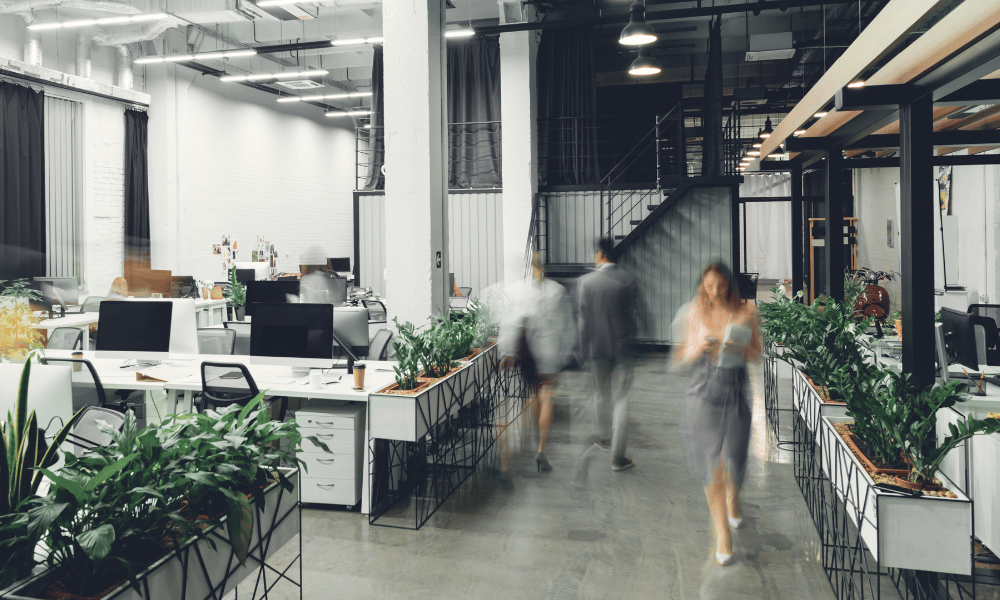
But another reason people may be avoiding the great return to the office is the actual environment. While it can be great to brainstorm with colleagues, catch up over a coffee or partake in in-person meetings, it can also be a noisy, distracting place — especially when it’s open concept.
Unlike a home setup, where people can control room temperature, lighting, background noise and the desk setup, most offices offer very little control in this regard. And you don’t just lose comfort — you lose the ability to manage your mental load throughout the day.
Mental load in open-concept offices
That's backed up by a recent study out of Spain shows that many workers face a heavier mental load in the open-office concept.
The study used EEG — a diagnostic test that measures and records the electrical activity of the brain using small sensors (electrodes) attached to the scalp — to compare the mental workload in open-plan offices versus enclosed work pods during typical office tasks.
It was a small study, just 26 participants, but the researchers clearly found that in open-plan settings, “neural activity progressively increased throughout the tasks, indicating a growing effort to maintain performance,” whereas in work pods, “activation levels decreased, suggesting reduced cortical effort required to sustain task.”
In other words, identical tasks required more and more mental energy in the open-plan office but were easier to sustain in the pod.
These results provide neurophysiological evidence that “the spatial configuration of the work environment modulates cortical activity associated with typical office-related cognitive tasks,” say the researchers, and the workplace is not a neutral backdrop but an “active factor influencing the efficiency of cognitive processing.”
The authors argue that enclosed microspaces such as work pods can function as genuine focus environments within predominantly open-plan layouts, supporting lower cognitive load, better attention, and potentially healthier, more efficient work over time.
A similar study from Cambridge University in 2021 found a link between a typical open-plan office (OPO) and psychological stress. Studying 43 participants in controlled conditions — using heart rate, skin conductivity and AI facial emotion recognition — they found that negative mood in an OPO rose by 25% and physiological stress by 34%.
While the researchers said the OPO did not reduce immediate cognitive task performance compared to the quieter environment, it did take a clear toll on how people felt. They argue that a multimodal assessment of noise (combining self-report, behavioural and physiological data) is crucial, so HR can make “data-driven recommendations about the design and modification of workspaces” that actively minimize noise-related stress and better support employee well-being.
In other words, the noise may not reduce performance immediately, but it quietly drives up stress and chips away at well-being — common metrics that HR is trying to improve.
Boosting the office setup
There have been other studies around cognitive performance, satisfaction levels and mental health in open-concept offices, so the challenges are becoming increasingly apparent.
Expecting people to come back for at least a couple a days per week is reasonable – I agree with the boosts to important factors like collaboration, culture and creativity with the in-office environment.
But now that RTO mandates are in full swing, in the private and public sector, I would hope that HR has taken the time to look at the actual layout of the office to make sure it isn’t quietly undermining people’s energy and well-being. Factors include:
• Control and choice: Does hotelling create stress and resentment, or can people reliably find a desk each day? Are there truly quiet spaces — offices or pods — where people can go when they need to focus?
• Noise and distraction: Do conversations and activity at a nearby kitchen spill into focused work areas? What are the acoustics like, and could simple changes (such as panels, carpeting or layout) reduce how far sound travels?
• Comfort and basic well-being: Is there enough natural light so people don’t feel trapped indoors? How’s the spacing between workstations — does it allow people a bit of room to breathe, move and think?
There are a lot of small fixes that could make a real difference and make the RTO less of a chore for those opposed.
That’s not to say the office should feel like home — far from it — but it should adapt alongside the tools and type of work that people are doing.