We hear from HR leaders about how they've boosted efforts around communication, empathy and tech

The past year has been a tumultuous time, to say the least. Employers have faced unprecedented logistical and human challenges as COVID-19 forced many to shutter their doors and have employees work from home, along with significantly boosting health and safety efforts for those on the front lines.
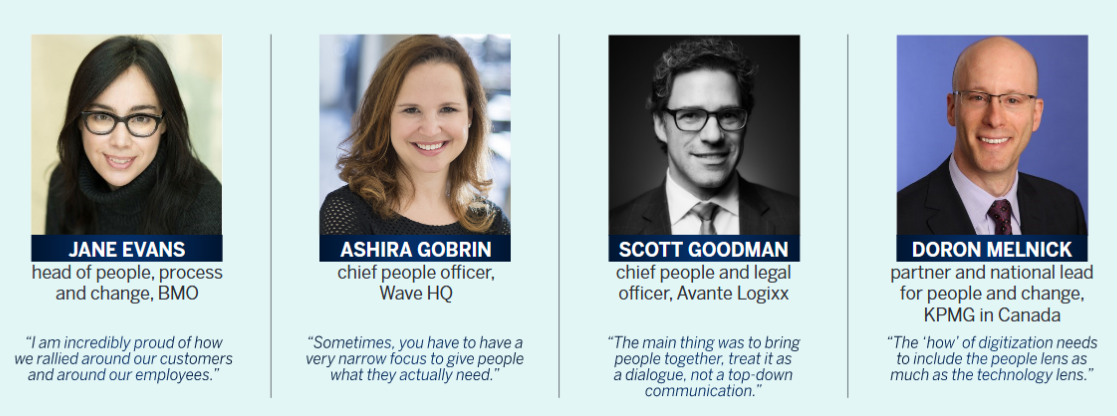
No group has been more at the forefront of this massive transition than human resources, and a roundtable presented by KPMG in Canada in partnership with Canadian HR Reporter featured several senior HR leaders ― Doron Melnick, partner and national lead for people and change at KPMG in Canada; Ashira Gobrin, chief people officer at Wave HQ; and Scott Goodman, chief people officer and legal officer at Avante Logixx ― to discuss the massive changes and plans for the future.
HR responds quickly
The last year has been critical for the Bank of Montreal (BMO) as it shifted to remote work, according to Jane Evans, head of people, process and change.
“It was really intense. I have to say I am incredibly proud of how we rallied around our customers and around our employees,” she says.
The financial institution had to deploy resources in ways that it hadn’t anticipated ― and do it really quickly.
“We had to, overnight, make sure that our trading floor was operating from people’s homes. We had to make sure our call centre was operating from our homes. Technology that we didn’t know we could secure in a disperse, remote way, we got out there really, really fast and we didn’t have any breeches.”
In moving one of Canada’s largest banks to a remote scenario, BMO learned some important lessons, says Evans.
“We’re a 200-year-old company and we have over 45,000 employees spread across Asia, Europe [and] North America, [but] we learned that we can change on a dime and we didn’t know that we could. So, that was pretty incredible,” she says, adding that things that normally would have taken BMO years to do were done within hours.
Communication key in ‘craziness’
The best thing about the craziness of the last few months was how agile Avante became, says Goodman, as the company focused on its business and key stakeholders.
“The main thing was to bring people together, treat it as a dialogue, not a top-down communication, because we haven’t been through this before either and we need [their] ideas and to be flexible together,” he says.
“I found a lot of teams bonded in a way that I understand soldiers would bond in trench warfare in World War II because now we’re going through something real together. And even in the face of… temporary salary reductions, which usually do not lead to a bunch of happy people, it was another thing that we were going through together and I found no ill effects from that.”
The power of empathy has also become really clear at all levels of leadership at BMO, says Evans. “It connects back to that sense of purpose around business and life where we’re getting way better at listening.”
That meant frequent short surveys with employees and customers to see how they were feeling and to stay connected, she says.
“[BMO began] really caring about the well-being, protecting the well-being, of the people that worked in our company and really wanting to tap into what was working and what wasn’t working.”
Back in 2019, BMO took an-in depth look at its purpose and how it works with its clientele, which helped it to be more prepared for an event such as the pandemic, says Evans.
“We worked with our customers, with our communities, with our employees and we landed on describing our purpose, [so] we exist as being the bold, the good in business and in life... and that meant sustainable finance. It meant creating a more inclusive society, it meant creating a thriving economy,” she says.
Focus on culture, mental health
At Wave HQ, all the staff had worked remotely previously, so the shift due to COVID-19 was fairly straightforward, according to Gobrin. Ultimately, the big transition for the financial services company was more of a cultural one. For example, in-person events such as monthly town halls or recognition disappeared overnight.
“Our ability to figure out ways to give people the time, the attention, the connection without having that was actually quite difficult,” says Gobrin. “What was and remains tough is the amount of mental weight and emotional things that people are experiencing and how much that’s actually changed and influenced the way that we work, the way that we communicate, the way that we think.”
The world is upside down politically and economically and the lives of our families have changed, and our work environments and our social interactions have changed, says Gobrin, which makes day-to-day experiences “one-thousand times more difficult.”
“We’ve had everything from people being diagnosed with various serious illnesses and miscarriages and losing some family members close to them to exciting things that have just been hard to deal with ― how to have a baby in the middle of a global pandemic, [how] to sell or move your house. Those are typically celebrations and things that are exciting and just extraordinarily difficult, so the line between coming to work and getting your job done and what’s happening in your personal life is very blurry.”
One big lesson? Different groups of people need different things, and, sometimes, what is right for one person isn’t right for another, says Gobrin. By not trying to have one overarching goal that will please everyone and instead doing smaller, focused things that helped individuals as opposed to groups, Wave learned a lot, she says.
“Sometimes, you have to have a very narrow focus in order to give people what they actually need... Parents need something very different than people who live completely alone and are totally isolated; introverts need something very different than extroverts.”
Another big shift was to protect the health and safety of people who weren’t really considered at risk before, says Evans. While that might be a priority if you’re running a manufacturing company or a hazardous materials company, worrying about people’s physical and mental health in other sectors came to the forefront in the pandemic.
“[It raises the question] ‘Has the institution really done enough to protect the mental health of people that work for them and what does that even mean?’ That’s a whole world that we need to explore, a whole different level of transparency in our culture and in our companies,” she says.
“So, I think that this idea of building resilience and well-being is so foundational to organizations being able to survive when they’ve seen how important institutional knowledge is to their ability to survive a crisis.”
New ways to work in ‘new normal’
Another big lesson for BMO? Experimenting in the moment and learning as they go, despite being in the risk management business, says Evans.
“[That] was a really big part of how we tackled this and one of the things that we saw really swing around on is to what extent are we going to centrally make decisions, try and communicate like crazy about what we just decided, and how are we going to trust people at the moment to really make the right call? And I think that has created a different context for talent and institutional knowledge,” she says.
“You are forced to be more agile with different corporate functions and, hopefully, that’s a good thing because you’ve got to figure out [how to] empower mid-managers to actually speak and make decisions and don’t freak out if they don’t say exactly what the CEO would have said because they have their space, too.”
One big change amid the pandemic has been around the ability to make decisions using data, says Gobrin.
“We have to align now much more with intuition, which is a much more emotional expense of what we think is going to happen, how we think people are going to respond… both at a customer level and at an employee level.”
There are behaviours now that are hard to understand, where patterns are different and data doesn’t align, she says.
“We see people leaving jobs just on a whim and just deciding, ‘The world is so up and down. The reality has shown me I don’t want to do this for the rest of my life. Now is my chance to take a rest.’ And you think, ‘What? Now, in a global pandemic, you’re quitting a good job?’ And [then there are] other people who are holding on for their life to the things that they know and are familiar. You don’t know which one anyone’s going to choose.”
The priorities for people are totally different. For some, it’s about security; for others, it’s about rising up and innovating, says Gobrin.
“What is universal is that we have to care, we have to listen, we have to include, we have to respond. And this is a real investment that we have to make in the people side of the business. That’s what makes the difference. Without the people, none of this would work. I think the easiest place to reflect on this is the higher value that frontline workers have all of a sudden played and that they used to be at the bottom of the pole and now, all of a sudden, they are the heroes of almost every industry.”
When everything’s upside down, you have to throw away all the assumptions and start from the beginning to reinvent the way that you really would like things to be, says Gobrin.
“People are much more open to making mistakes… because everything is in test mode right now. I refer quite frequently to the concept of being in this paradigm shift that we’re in now where it’s not been a gradual transition from the old into the new ― it was a shock and something that changed overnight and something that we don’t yet quite understand, and that has created a huge amount of opportunity for lots of people.”
That can mean people stepping up into new roles or having to pivot a product, “things that used to be legacy and it gives you a chance to build them from scratch and because of the urgency of the time to do things much faster,” says Gobrin. “A lot of my colleagues are saying, ‘It took us six months to have a conversation and now all of a sudden we’re getting approval in six minutes.’”
Focus on people amid move to AI, automation
Judging by KPMG’s survey in 2020, remote work is here to stay and more automation and AI will be rolled out, says Melnick.
“What we’re saying is let’s look more closely at the why and the how from a people [standpoint]… If we do that purely for the sake of efficiency, what’s going to happen?”
People are often resistant to change because they fear for their mental health and for their jobs, he says.
“They fear for what could go wrong and affect customers and then, two, the people most likely to face job loss or hourly reductions are people in the entry-level or administrative roles, which tend to be filled by women, people of colour, immigrants,” he says.
“We can see organizational resistance making it harder to digitize and, in the event that we do actually implement some tech, the job impact will damage the community, it could damage the brand and it could damage employee engagement.”
So, employers need to be clear on why they’re carrying out digitization, and it needs to be a positive story for customers, employees and the community, says Melnick.
“The ‘how’ of digitization needs to include the people lens as much as the technology lens. It leads us to realize the importance of future options for the people in terms of new job designs, alternative career paths, upskilling programs as well as better resources and support for remote work, diversity, psychological safety,” he says.
“And, often, we see companies run these things as separate programs or initiatives ― they’re not really connected and I’m not really sure a typical employee is actually piecing together the whole story of what we’re doing, why we’re doing it and how we’re going about it for the greater good.”
To operate well in the future with automation and AI, people need to understand the professional side and the process, the technology and the data, and be able to lead teams and manage all this complexity behind the scenes, says Melnick. To that end, HR functions should do more to cultivate the operational side of the department, such as mentorship and training to develop multi-skilled people, he says.
“It’s not enough to just be an HR professional who designs policies and adjudicates. You’ve got to become familiar with tech and data and processes and the various techniques and skills that come with that.”
To evolve, it’s really about taking advantage of technology that is available to bring the employee, the candidate and the employee experience into the 21st century, says Goodman. And while there are great applicant tracking systems available, there’s room to do even more.
“Especially since people are taking on new careers and deciding to sail the world last minute to get away from the virus or whatever they’re doing, we really need systems to be able to pick it up so that we don’t have to waste time on this transactional stuff and that nothing falls apart if you’re administrator of whatever doesn’t show up tomorrow.”
About KPMG
KPMG Advisory professionals work with you to improve and enhance the value of your business in today’s rapidly changing marketplace. We develop practical recommendations designed to help you work smarter, grow faster and compete stronger. We are trusted advisors to Canada’s leading organizations. They choose us because we are known for our talented people, deep technical experience, industry insights and our ability to get the job done. Learn more at kpmg.ca.
ROUNDTABLE PARTICIPANTS: