'Ruling with an iron fist doesn't translate to better performance from employees, and it drives managers right out the door'
“Ruling with an iron fist is laziness… It doesn't lead to good performance. We've known that for a long, long time,” says Hayden Woodley, assistant professor of organizational behaviour at the Ivey Business School at Western University.
His words echo the findings of a new survey which reveals that pressure from above to adopt tougher tactics may be pushing managers and employees to the breaking point.
The Perceptyx survey found that 64 per cent of managers feel pressured to take a harder stance on performance this year.
And 40 percent of workers agree that their managers adopted a more demanding leadership style in the past year.
About seven in 10 say they’d give up managing people altogether if they could and 1.6 times as many managers are seeking a new role compared to last year.
“Managers are really on the edge — and it’s not getting better. Organizations putting extra pressure on their managers to harden their leadership style may think they are getting better results, but the data say otherwise. Ruling with an iron fist doesn’t translate to better performance from team members, and it also drives managers right out the door,” said Emily Killham, senior director and head of the Center for Workforce Transformation at Perceptyx.
‘Pressure-cooker’ for managers
Managers are twice as likely to say their job is more challenging than last year, and 1.8 times as likely to say workplace stress makes it hard to be productive, found the survey of more than 1,500 managers and 4,300 employees in the U.S. and Europe.
The report “paints a vivid picture of the pressure cooker many managers seem to be operating in right now,” says Nick Turner, professor of organizational behaviour and human resources at the Haskayne School of Business at the University of Calgary, citing the “striking” finding that many people leaders would walk away from their role.
Over the last few years, pressures on managers have increased, he says, meaning higher performance expectations, doing more with less, greater scrutiny and often conflicting expectations.
“Many are being pushed to take a tougher stance, but without meaningful support, training or clarity on what good looks like.”
Managers squeezed from both sides
This is a problem, agrees Woodley, as managers are often expected to deliver tough feedback to their teams while receiving little guidance from above.
“If you're not giving me the guidance I need, then how am I going to then act, to switch my role to be a leader to these other individuals? So, it’s the old adage of being stuck between a rock and a hard place.”
The survey reflects this tension: 56 per cent of employees say their manager expects them to step up to new challenges without extra support.
The Perceptyx data also shows that nearly three in four employees with demanding managers say work stress made it hard to be productive at least one day last week.
This recalls the job demands/job resources model which is important for understanding the health, wellbeing and outcomes of the workplace, says Woodley.
“If your demands outweigh the resources you get, people get burnt out.”
The cost of strong-man leadership
The survey finds that three in four employees who say they’re being “ruled with an iron fist” are actively job seeking.
The result is “strongman” leadership, meaning “control-heavy pressure that’s meant to enforce accountability but often undermines it instead,” says Hunter.
“When managers feel unsupported, over-extended and squeezed between demands from above and distress below, both their teams and their own well-being suffer.”
Woodley believes that company culture plays a major role in perpetuating strongman tactics.
“Culture is the normative behaviours that take place within an organization, like what do people do regularly. And if a company is generally doing strong man tactics, sometimes that just carries on down through and creates a culture of that.”
And a culture of uncertainty and ambiguity, he says, makes it very tough for employees to demonstrate their capabilities.
“Incivility, even interpersonal conflicts, all these little things that they're doing are really detrimental to performance. If you are rude to me today, I'm not going to forget about it in an hour and go back to the way I was performing. That's going to linger. It has a longstanding impact on my performance. And if you keep doing it, then maybe [I’m] going to leave.”
On the other hand, managers who challenge with care, clarity, and a commitment to their people engender respect and loyalty, finds the Perceptyx survey.
Even when their managers aggressively drive performance, employees with excellent bosses:
- are nearly 4x as likely to believe their manager isn’t tough just for the sake of appearances, but rather because they authentically care about employee success
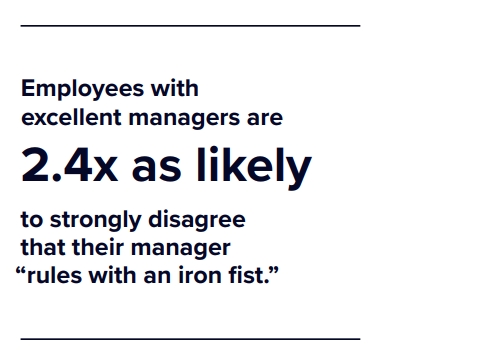
- are 2.4x as likely to strongly disagree that their boss “rules with an iron fist” and 2.5x as likely to strongly disagree that their organization views softer approaches as weak
- are 2.7x as likely to feel valued.
Trust key to effective leadership
Trust is at the heart of effective leadership, Woodley says, and if you feel like someone's using strongman tactics, you don't trust that person.
“That's the thing about leadership and followership, is that trust is core to that progress.”
If we want leaders who are confident, intelligent and capable, we also want them to be “caring and compassionate and considerate and trustworthy,” he says. “If you’re not bringing both those things to the table, you’re not going to be able to support these individuals.”
Woodley cautions, though, that authenticity alone isn’t always positive as people may do “terrible things” because they don't care about anybody else, but feel they’re being authentic to themselves, he says.
“We sometimes assume being authentic means you're going to try to do the right thing — that's not necessarily the case.”
Woodley argues that focusing on the human side of leadership is not just good for people—it’s good for business.
“If people realize that instead of focusing on the task, focusing on the person you need to do the task would make people understand the importance of the human side of these situations.”
Rethinking leadership: support over shortcuts
Both Woodley and Turner agree that the answer to better performance isn’t more pressure — it’s more support.
“Leaders need to provide direction, but they also need to empower their employees, and these things aren't in competition with each other, in that you need to be able to switch and do both,” says Woodley.
“So, if someone's not performing well, you need to give them guidance and direction in such a way that they feel like they can improve their performance. If you just say, ‘You need to be better,’ that's the strong man tactic, and it lacks the necessary information to allow the person to get better.”
Remarking that “strong man” is a sexist term, Woodley says that research has shown females are perceived as more effective leaders.
“They’re more likely to engage in this dual role of ‘What does this situation need? Does this person need feedback and guidance? Or do I need to come down a little harder on this person?’” he says.
“This is where things like emotional intelligence play an important role.”
Is ‘reluctant leadership’ the answer?
As a final consideration, Turner points to research on the notion of a “reluctance to lead,” meaning the hesitation some individuals feel about stepping into leadership roles.
“While that reluctance is often mistaken for a lack of ability or ambition, emerging research shows that moderate levels of reluctance can actually make someone a more effective leader,” he says.
“These individuals tend to be more humble, more likely to share power, and more attentive to the needs of their team. In other words, they may be exactly the kind of manager we would like to have, but we’re screening them out because they don’t signal confidence in the way we’ve come to expect.”
That entails recognizing that good leadership often looks “quieter, more relational and more context-sensitive than our current mental models of leadership allow,” says Turner.
“If we want managers who can challenge without driving people away, we need to support them, but we also need to rethink how we identify and develop them in the first place.”