
Workers who experience high friction levels 34 per cent more likely to feel unmotivated, leading to lower productivity and performance

Technology disruption and a fluid operating environment are creating friction among executives and workers across organisations, according to a recent report.
In exploring different types of workplace friction – staffing, agility, change, and technology - the findings show widespread organizational challenges are hurting productivity and the bottom line by keeping people from doing the work they’re meant to do.
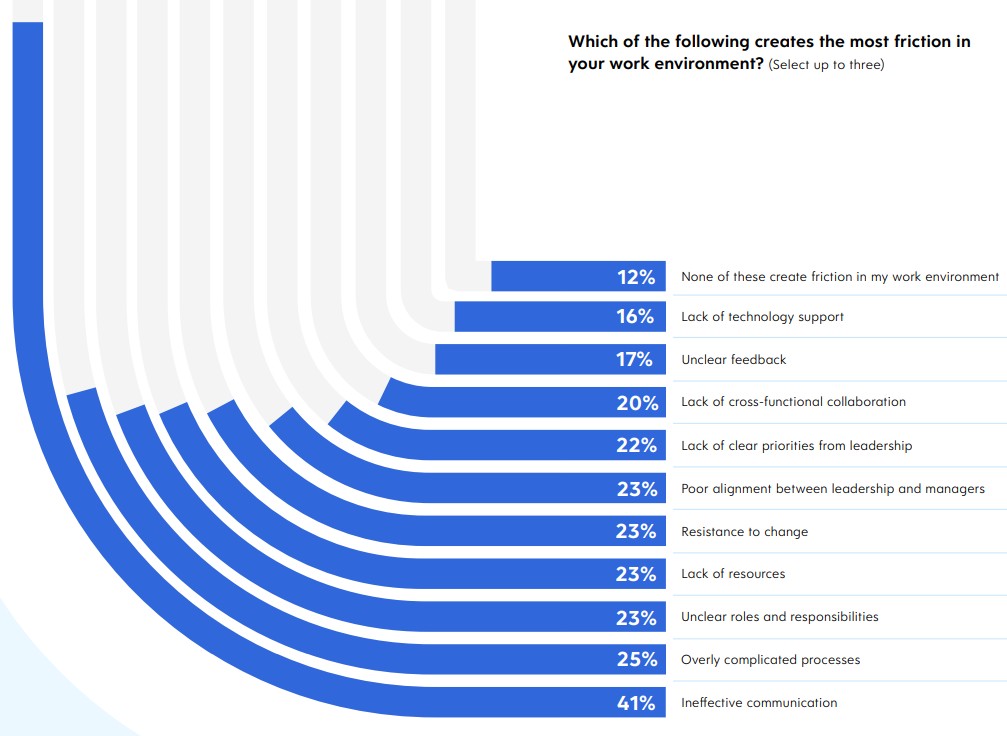
Top causes of friction include ineffective communication, overly complicated processes and unclear roles and responsibilities.
Other sources of friction within organisations are found below, according to the Dayforce report:
Work friction is getting worse, according to a previous report.
Change and technology friction
“Adopting technology that fosters equitable communication at every job level in every industry is key to effective employee communications in general,” reads the Dayforce report titled Fighting workforce friction to power productivity. “But that ability becomes even more essential and valuable in times of change.”
However, as companies increasingly rely on more systems and tools, workers continue to face troubles with technology.
Specifically:
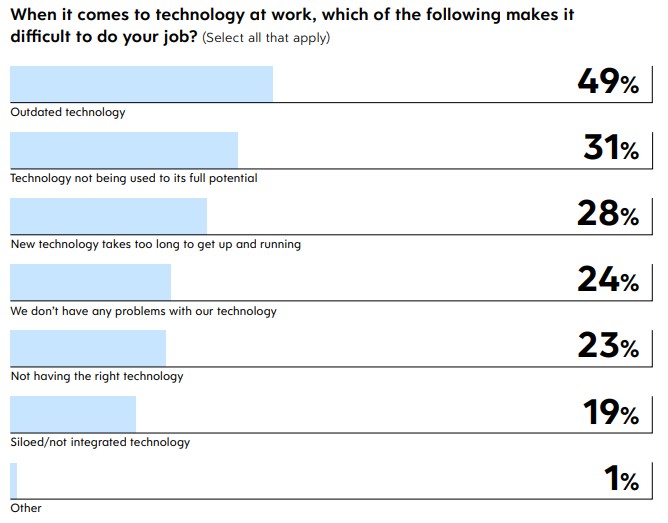
Sixty-six per cent of respondents agree that the new technologies their organisation adopts often decrease efficiency rather than improve it. Preparation could play a big part in this, but only 43 per cent of workers say they feel somewhat or extremely prepared when their organisation rolls out new technology.
“Proper advanced training could help bring back the efficiency increase organisations expect from new technologies,” says Dayforce.
The people platform provider also notes that 69 per cent of workers say their organisation has too many platforms or technologies for getting work done.
“Organisations should prioritise streamlining their tech stack while ensuring their people receive the necessary training and support. This will help them better leverage workforce technology and eliminate friction.”
Most employers are still far from benefitting from the full potential of AI, according to a previous IBM report.
Resistance to organizational change
A majority (84 per cent) of respondents said they have faced organisational change in the past 12 months.
While 61 per cent of executives say that their workers are resistant to change, the number drops to just over half (51 per cent) when managers are asked. This drops even lower to 41 per cent when citing employees’ opinions, finds Dayforce.
The majority of executives (71 per cent) believe their organisation is good or very good when it comes to communicating change to employees, but far fewer workers agree.
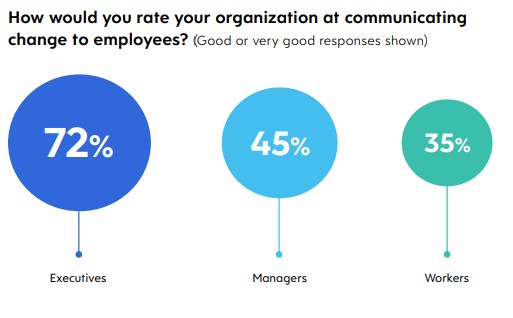
Overall, less than half (48 per cent) of Canadian workers say their organisation is good or very good at communicating with employees.
Canadian businesses could face an uphill battle harnessing artificial intelligence (AI) as new research reveals the country’s workforce trails much of the world in both confidence and literacy related to AI systems, according to a previous KPMG report.
What is the cost of workplace friction?
Workforce friction is costing Canadian organisations valuable time and resources, with significant implications for productivity and employee engagement, according to Dayforce’s report. The findings are based on a survey of 6,178 respondents across Australia, Canada, Germany, New Zealand, the United Kingdom, and the United States, conducted from April 14 to May 1, 2025.
Specifically, workers who experience high friction levels are 34 per cent more likely to often or always feel unmotivated, which can easily translate into lower productivity and performance.
High-friction respondents are also 19 per cent less likely to say they have enough time in their workday to complete their most important tasks.



