Expert claims ‘pro-age actions’ will help employers combat ageism, support older employees needed for Canada's labour market

Companies must “set fire to the career ladder” if they are going to address the existing “age debt” in Canada’s labour market, according to an expert.
"Our talent structure was set up by a very antiquated cycle — literally invented in 1924 — which says the only way to grow your career is to move up,” Dan Pontefract, leadership strategist, tells Canadian HR Reporter.
“Instead, what I want leaders thinking about is what I call the career canvas."
The canvas treats a working life as something the employee authors, with the employer's support, rather than a single climb. Pontefract claims that some staff want to stay in a role; others want to move into individual contributor work later on — which HR still labels a demotion.
He urges phased retirements, "boomerang-in" returns for retirees, reduced-hours arrangements and multi-generational project teams instead of a cliff-edge exit.
'Age debt' in Canada
Pontefract labels the stakes "age debt" — an organisation's failure to account for falling birth rates, an aging population and weakening immigration.
Canada's fertility rate has dropped to 1.26 children per woman, he notes, and RBC projects that roughly 2.7 million Canadians aged 60 to 64 will retire within four years, with too few younger workers to replace them.
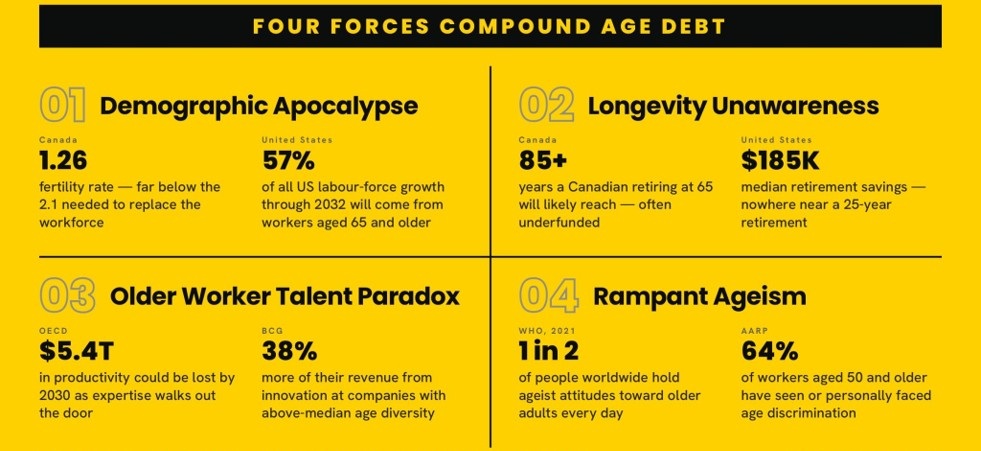
The economic upside is substantial. The Federal/Provincial/Territorial (FPT) Ministers Responsible for Seniors cite an estimate that raising older-worker participation could add $56 billion to Canada's economy. A 2024 University of Alberta master's thesis by Jonathan Lai found older workers reported the highest engagement of any age group, countering the stereotype that they coast toward retirement.
Ageism the 'last ism'
Bias remains the barrier. In the 2023 "What We Heard" report from the FPT seniors ministers, 48.4 per cent of respondents said they had experienced ageism, and 69.9 per cent believed it had increased since the COVID-19 pandemic.
"It's a quiet discrimination," Pontefract says. "It's the last ism to be solved."
Employment ranked among the most common settings. The same report found discrimination against older job seekers in hiring was their top employment concern (49.5 per cent), followed by older workers being fired, laid off or forced to retire (38.2 per cent). Pontefract stresses the bias cuts both ways; as a young hire, he was told it was "a shame" the employer was "hiring people so young these days."
Pontefract argues that ageist language in job ads and budget-driven decisions to cut older, "more expensive" staff quietly erode belonging, performance and innovation.
The FPT report note that ageism can negatively impact workers.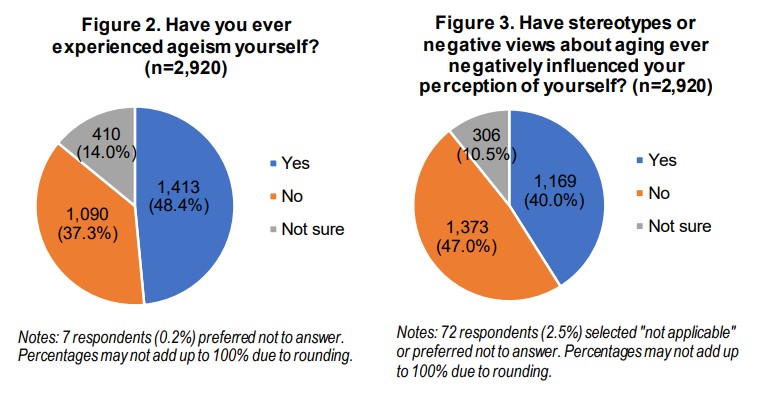
Previously, in Dunlop v. Interspec Systems Ltd., the Ontario Superior Court found the move amounted to termination for an older, long‑service workforce – so the court added on damages for unpaid entitlements, age discrimination and “reprehensible” conduct.
How to be a 'pro-age' employer
Pontefract’s prescription starts with measurement. "How do you get out of debt? You invest," he says. He urges leaders to track the age composition of their workforce, audit recruitment language and marketing for age bias, and treat older workers as an asset to develop rather than a cost to cut.
He wants those choices made deliberately.
"What we have to be thinking about is where the age-positive, even age-neutral, actions are," Pontefract says. "Are you being pro-age with your culture and your marketing? What photos and stories are you using? When you look at team composition, are you looking at age? These pro-age actions are what will help you in the long term, rather than always thinking in the short term. I urge leaders to be far more pro-age inclusive than they've ever been, because our heads have been in the sand."
The FPT report offers concrete steps: flexible hours and remote options, formal and informal mentoring, deliberately mixed-age teams, and regular talks about every employee's goals rather than pointed questions about when older staff will retire. It also recommends addressing ageist comments and discrimination immediately.
Crucially, the guidance notes the return on training older workers can match or beat that for younger staff — undercutting a common excuse.
Pontefract, a former culture executive at TELUS and SAP, concedes he ignored age himself for years: "I'm waking up now, and I wish I'd thought of it in my 30s and 40s."