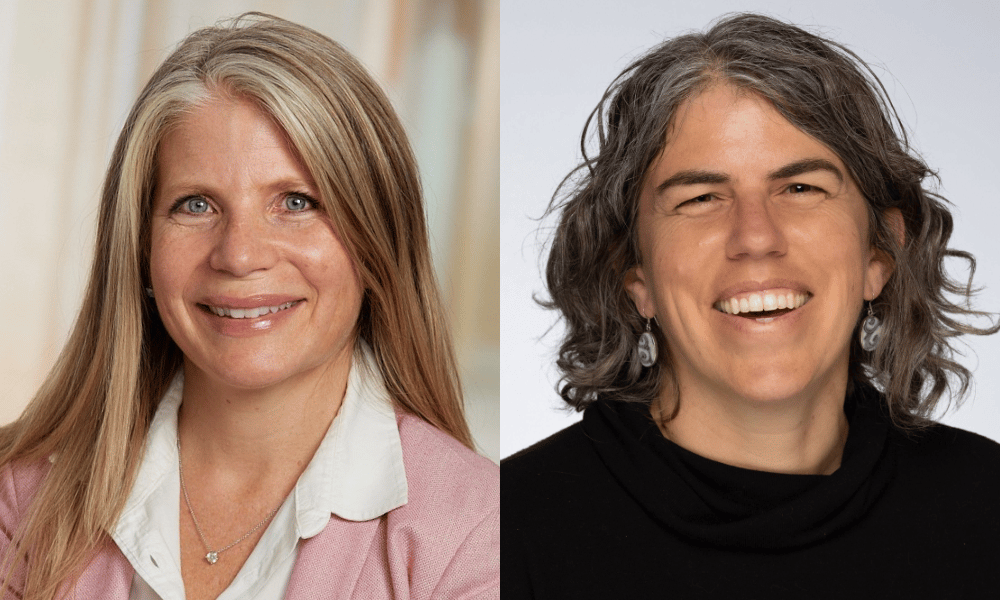
Chief people officer leans on transformative initiatives in past roles to press ahead with key HR priorities

Coming out of university, Anna Filice wasn’t quite sure on her direction, as an undergrad in French and linguistics.
But a well-timed conversation with a cousin at a family event provided a welcome direction. Four years into an HR career at Bell, the cousin provided an interesting perspective on the profession, says Filice.
“I was getting kind of excited and interested [to hear] about all the different streams and possibilities. And I felt like it was a good combination of business and the human side of things.”
The very next day, she applied to the postgraduate program at Humber College, and a co-op turned into a full-time position: “I would say I fell into it a little bit, but it ended up being a great fit,” says Filice, who is now chief people officer at the Workplace Safety and Insurance Board (WSIB).
‘Meaty’ role at VicWest
Filice’s career really picked up when she joined the manufacturing company Vicwest in 2008, in taking on a “meaty” management role.
“We had a new executive team at the time and we were acquiring and merging recently acquired companies across Canada. And so there was a real opportunity to reset culture — actually, establish a culture because everyone had their own little cultures — and look at back office, how we could transform and become more efficient,” she says.
They kicked off a series of transformation initiatives that included an org design, a new ERP program and communication strategy, and a total rewards redesign over the nearly five years there.
“In a really short time, we made a really big impact in terms of transformation and integrating the various offices and building those networks and relationships. So, I think from that role, I really acquired a passion for transformative roles as opposed to those maintenance or firefighting roles,” says Filice.
“It was a big learning experience for me. I understood better how to engage and network and the change management involved in things of that magnitude.”
HR transformations in Hamilton
Next up was the City of Hamilton in 2012, where one of the biggest transformations was the automation of transactions through the PeopleSoft system and the introduction of a people analytics function, she says.
“At that time, it wasn't really being done, but we jumped into it because we had a very public media issue around absenteeism,” says Filice, citing HR’s work with IT. “That was something I was really proud of on the operational side. And we made significant strides in terms of leadership development, culture and all those pieces.”
In joining the Hamilton Police Service in 2018, Filice says they were looking for a transformation of the corporate service function.
“I was the first civilian to take on that role at the police service and the first female to do so with an all-male executive. So that, in and of itself, represented some level of progress,” she says.
“Optically, behind the scenes, it was a little more challenging, but… it represented progress.”
While proud of initiatives around how business functions operated and economies of scale, Filice says she is most proud of bringing the civilian and business voice to the service.
“At the most senior level, it resulted in the civilianization of critical functions like crime analytics that traditionally were wholly staffed by sworn officers. And in police services, sworn officers move around a lot — it's really hard to set and achieve long-term objectives. So, bringing the right talent in to advance their priorities and helping to manage the change and buy-in required doing that in a very traditional environment was no small task.”
Joining the WSIB
By 2022, Filice was ready for a change, and decided to join the WSIB after an encouraging meeting with the president and CEO, Jeff Lang.
“He articulated a really compelling vision not only for the transformation of WSIB in the business sense, but really from the lens of the injured worker and businesses that we supported,” she says. “I saw a ton of opportunity to apply my prior experience to make some immediate impacts on the business side and just decided on the spot that it was a perfect role for me.”
And Filice has no regrets, calling her time so far with the board “an amazing experience,” in combining the business and human elements.
HR priorities at WSIB
When it comes to what's on the HR agenda, Filice says WSIB's challenges aren't entirely unique — but they're still important.
"We're considering how do we remain an employer of choice in the face of things like return to office, the rapid emergence of AI, and the impact to employees in terms of their experience at work and the skills they need to build," she says.
Chief among those priorities is AI enablement, which Filice describes as a major focus for the HR function in the months ahead. That work spans org design — specifically how organizational structures can support humans and AI agents working alongside one another — as well as identifying and building the capabilities employees and leaders will need to thrive in a rapidly shifting environment.
Underpinning all of it, she says, is culture.
"Building a psychologically safe workplace, maintaining that shared mission — that's something that is a strength for us… We are all kind of focused on the right set of values to ensure we protect the psychological safety of the workforce."
Rounding out the priorities are learning and development, and change and communications — also under Filice's portfolio. With employees spread across the province, she says a clear, multi-channel communication strategy is essential to accompany any major initiative.
"[It’s about] making sure that people are getting the right messages at the right time, that they have multiple ways to receive that message… both internally and public facing, just to mitigate some of the trust that erodes when we start going through all of this rapid change."
Supporting summer students
The organization has roughly 4,500 employees but during the summer, the workforce number rises with the advent of summer students — nearly 200 in 2026.
“This is the easiest thing to brag about at WSIB,” says Filice. “We know a lot of organizations are, in tough economic times, scaling back on these programs — we just keep ramping up.”
The students come through a program called a scholarship program called WSIB Scholars, the regular application process or partnerships, she says.
“We know they bring different backgrounds and perspectives so we make sure that we create that accessible environment for them to learn and receive mentorship and onboarding supports, and to make peer connections.”
This year, WSIB hosted a two-day conference for the students called “Career Ignite” at the head office in London, Ont. The event is appealing because many students work remotely, so they appreciate the opportunity to socialize and network with others, says Filice.
“Our student program is growing every year, really through the commitment of leadership, from front-line managers to VPs. It’s incredible to me, the effort they put into making sure students are working on meaningful projects that help build their skills and connections.
“We really see it as an investment in our future workforce.”
Integrating DEI
Also a priority at WSIB is a focus on equity, diversity and inclusion. The organization has an employee-led EDI Advisory Council that helps to support and implement diversity priorities.
There are also listening groups that are affinity-based communities and forums for discussion, networking and peer support for Muslim, Jewish and Christian employees. And WSIB has several Employee Resource Groups (ERGs) including ALIGN’D - Advocating for Learning, Inclusion, Growth, Neurodiversity & Disability, BEEN - Black Employee Excellence Network, Bridges: Indigenous & Allies Network, Pride Forward supporting 2SLGBTQIA+ career development and engaging allies, PAGE - Pan-Asian Group of Employees, Réseau Franco for francophone employees and WPN - Women’s Professional Network.
“It’s important for us both internally and also to the people we serve,” says Filice, citing the importance of an EDI focus.
“Even in terms of the number of languages that we support, people, when they're calling in with an injury or a language, that can't be a barrier to getting the service they need — it is just that simple.”
EDI is a robust program at the WSIB, she says, with strong governance, leadership support and employee voices.
“We’re at a point where we don’t really see it as a DEI initiative but really a core part of everything we do. It's finally starting to get embedded through all of our programs. And that's really nice to see.”