
'There are fine lines that need to be walked,' says lawyer, discussing when HR should intervene in workplace relationships — and when they shouldn't

With Canada’s largest bank RBC countersuing its former CFO in defence of a very public wrongful dismissal accusation, experts are advising HR professionals to take a close look at their policies around employee personal relationships — if they even have them.
Nadine Ahn, who was slated to be RBC’s first ever woman CEO, filed a multi-million-dollar lawsuit against her former employer after RBC announced in April it had fired Ahn and another executive, Ken Mason, for an “undisclosed close personal relationship which led to preferential treatment”.
Mason has also filed a wrongful dismissal claim. The pair are both denying any wrongdoing, claiming the accusations by RBC were without merit and a “discriminatory and unbalanced misstep” according to Mason’s statement of claim.
Code of conduct requiring disclosure for reporting work relationships
While employers in Canada are not required to have policies around workplace personal or romantic relationships, it is highly recommended that they at least have a basic one around disclosure of relationships between bosses and subordinates, says Jenson Leung, employment lawyer at Kane Shannon Weiler (KSW) Lawyers in Vancouver.
“When you don't have that type of policy in place, and a relationship between a supervisor and a subordinate goes sour, then it can be relatively easy for there to be allegations of the supervisor having used the power imbalance between them to pressure the subordinate into that relationship,” he says.
“It's not that an employer should be saying, ‘You may not have that type of relationship at all’, it's that it is entirely legitimate for the employer to require that that relationship be disclosed.”
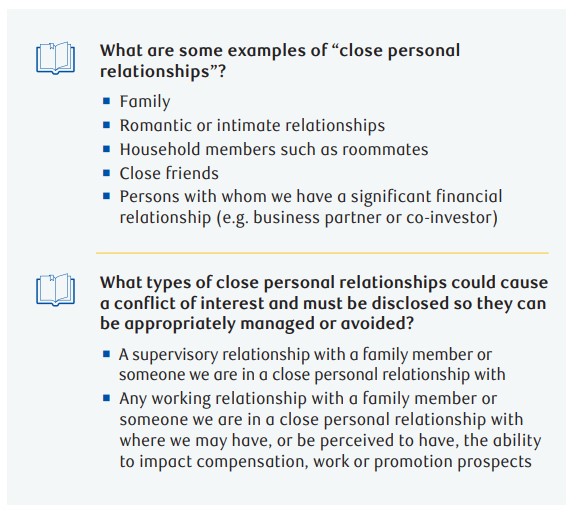
Source: RBC Code of Conduct Code of Conduct Integrity: Doing What’s Right (rbc.com)
A recent survey conducted by U.S. resume builder Zety revealed a disconnect between employee sentiment around workplace relationships and actual practices; while 80% of 1,000 surveyed employees said they have been involved in a “romantic relationship, casual dating, or sexual encounter” at work, even more (91%) said employers should prohibit such relationships.
Eighty-eight per cent reported having observed negative consequences to romantic relationships in their workplaces, the top three being:
- retaliation (34%)
- worsened work-life balance (33%)
- decreased sense of belonging at work (30%).
“Challenges happen when personal relationships are the result of harassment or lead to harassment or retaliation,” says Sylvie St-Onge, professor of management at HEC Montréal.
When personal relationships result in disruption to overall health of the workplace or decreased productivity, she says a move of one of the individuals to a different unit of the company may be necessary: “They must be under [the] radar when they are negatively affecting the individual and collective performance and climate.”
St-Onge’s own research into how Quebec HR personnel handle workplace romances showed that nearly 40% of surveyed professionals rely on informal policies to manage workplace romances.
Due to changing socioeconomic factors such as late marriage and higher divorce rates, there are more single people in the workplace. Combining that with evolving working conditions such as “longer working hours, atypical schedules and teamwork” is increasing the frequency of interpersonal interactions at work, she says, giving “more opportunities and freedom to engage in romance.”
When are workplace relationships okay?
Achieving a balance between monitoring personal relationships and respecting employee privacy is the challenge for HR, says Arianny Mercedes, CEO of HR consultancy Revamped. When managed effectively, she says, workplace relationships can enhance organizational effectiveness through increased collaboration and trust.
“There are fine lines that need to be walked at the intersection of professionalism, employee autonomy, and risk management,” she says — however, romantic relationships at work can also “play a significant role in shaping organizational culture and social cohesion. Positive relationships can foster a supportive and collaborative environment, enhancing team morale and collective efficacy.”
Negative consequences from poorly managed romantic relationships can disrupt harmony among teammates and affect overall performance, Mercedes says, but overly restrictive policies around personal employee relationships can be perceived as micromanagement and send a message of distrust.
Whether a workplace relationship should be disclosed or not is determined on a case-by-case basis, Leung says, depending on policies in place, and to what extent a conflict of interest exists.
“Generally speaking, if it's a relationship between two people that are not in a reporting relationship, it is a lot less problematic for the employer, and some workplace policies might not even require that that type of relationship be disclosed,” he says.
“The way that a company will have the policy drafted is going to be shaped by what their concerns are and what lines they want to draw. Essentially, there's not going to be a one-size-fits-all policy for these types of things, because different employers will have different levels of risk tolerance … in an ideal world, workplace policies are meant to spell out expectations and responsibilities so that lawsuits don't happen.”
When is firing for work relationships appropriate?
Just cause terminations without warning, as was the case with Ahn and Mason, are uncommon, Leung explains. However, the higher up in an organization and the more fiduciary responsibility an employee has, the more severe a breach of a code of conduct may be.
“If someone is in a leadership position, then they're supposed to essentially set an example for their subordinates, and they also are given a higher degree of trust by the employer,” he says. “The more senior someone is, the more inexcusable an act of dishonesty would be, and the more likely it is that an employer would be justified in terminating someone who has not been honest.”
Additionally, the matter of dishonesty in a case involving executives will be more seriously addressed, says Leung: “Basically, it's a very different scenario where someone has simply breached policy, versus when someone is actively trying to circumvent a policy that they know about.”
Clarity and fairness topmost priorities with workplace relationship policies
The Zety survey revealed that 92% of employees who reported having had workplace romances said it was against company policy. Forty per cent of respondents said they never reported their relationship; 33% admitted they cheated on their partner with a colleague.
Despite negative effects of workplace romances, there are also positive benefits; for example, 25% of respondents claimed they met their spouse at work — a finding corroborated by St-Onge’s research, which found that “as organizations tend to attract and hire people who share similar expertise, attitudes and values, there is a greater chance of finding a soulmate at work, especially for people with [the] same profession, similarity being a factor of attraction.”
Mercedes recommends a thoughtful approach to setting policies and rules and stresses the importance of proactiveness and clarity as essential ways to maintain a sense of organizational fairness and transparency among workers, while also respecting privacy.
“Establishing clear, fair policies that respect personal boundaries while addressing potential conflicts of interest is essential for maintaining trust and ethical standards,” she says.
However, even when implementing policies meant to prevent harassment or unfair practice, HR must keep an eye out for potential bias which can arise from inappropriate monitoring or interventions.
“A nuanced approach to managing workplace relationships can enhance cultural sensitivity and support a diverse workforce,” says Mercedes. “Recognizing and addressing the varied ways personal relationships intersect with professional roles can contribute to a more inclusive and supportive organizational culture.”


