
Feds racing to replace Phoenix payroll system with $4.2‑billion fix — while slow rule changes, massive backlog and shortened rollout raise fears of another meltdown, says report

Ottawa has an opportunity to “address risks” before launching the government’s new pay system, but only if it tackles long‑known problems that helped sink Phoenix instead of carrying them into its replacement, Auditor General Karen Hogan says in a new report.
The Office of the Auditor General (OAG) says the government’s move to the new Dayforce platform is, so far, being managed so that “federal public servants’ pay transactions will be accurate and on time and that the project will provide value for money once implemented.”
But the report stresses that both the Treasury Board of Canada Secretariat and Public Services and Procurement Canada (PSPC) still need to change course on several fronts as the project evolves “to address emerging risks.”
The warning comes a decade after the rollout of Phoenix, which changed how the government processed pay for public servants by centralizing services – and quickly unleashed a raft of failures. Once Phoenix went live in 2016, employees began experiencing significant pay issues, including delays in pay as well as being underpaid, overpaid, or not paid at all.
The government is now attempting to replace that system with Dayforce through the Human Resources and Pay Transformation Project, led jointly by the secretariat and PSPC. At the end of the audit period, “the secretariat and the department were still in the planning phase” and are not expected to finish that phase until June 2027.
Phoenix lessons at risk of being ignored
After the Phoenix debacle, a central lesson was clear, says the new report: “Pay rules and processes should be simplified and standardized before launching a new system to avoid costly and complex system customizations.”
The Auditor General found, however, that the Treasury Board of Canada Secretariat “made slow progress in simplifying pay rules,” the report says. That lag has direct consequences for the new system: “Consequently, Public Services and Procurement Canada was proceeding with customizations to Dayforce to avoid delays in transitioning to the new system.”
Those customizations – described as “cloud extensions” – are needed because the secretariat “did not yet reach a consensus with unions on simplified pay rules for Dayforce.” As a result, PSPC is building add‑ons so the platform “can process government pay rules that may remain in effect without being simplified.”
The price tag for those extensions is estimated at “at least $4 million each year.”
The concern from the Auditor General is that Ottawa risks repeating a core mistake: bending an off‑the‑shelf system around complex, fragmented rules, instead of fixing the rules first.
Massive backlog, shortened schedule
The report highlights another key risk: the sheer size of the unresolved pay backlog.
Public Services and Procurement Canada “had made limited progress in eliminating the substantial backlog of pay transactions,” says the Auditor General report. As of Sept. 30, 2025, the total backlog for departments and agencies serviced by the Public Service Pay Centre stood at over 233,000 pay transactions, impacting over 133,000 employees.
“This is very important,” the report stresses, “because if the backlog is not cleared before the transition to Dayforce, there is a risk that existing errors will carry over and undermine the effectiveness of the new system.”
Compounding that danger is a more aggressive implementation timeline. In January 2026 – after the audit period – PSPC shortened the schedule to move departments and agencies to Dayforce by about three years. The change was made “in part, to mitigate the complexities and costs of operating two pay systems at the same time for several years.”
The Auditor General acknowledges the logic but underscores the new pressure it creates.
“It will be important for Public Services and Procurement Canada to identify early on, monitor regularly, and mitigate the risks that a shortened schedule could create so as to avoid pay issues similar to the ones experienced from the deployment of Phoenix.”
Billions at stake, savings still undefined
The scale of the federal pay operation makes those risks more than theoretical. “In 2024–25, the federal pay system processed $38 billion in pay for over 430,000 current and former public servants,” the report notes.
PSPC’s preliminary price tag for Dayforce is also hefty: the new human resources and pay system will cost more than $4.2 billion. Yet that estimate “did not include important costs needed for all departments and agencies to transition” to the platform.
At the same time, “Public Services and Procurement Canada is still determining how it will measure the cost savings the new human resources and pay system is supposed to achieve, says the report — and that is a problem: “To assess whether value for money is being achieved once the new pay system is implemented, cost estimates that consider the life cycle of the Human Resources and Pay Transformation Project must be detailed, and key performance indicators must be developed, tracked, and monitored.”
There is also a hard outer boundary on how long Ottawa can rely on Phoenix. “Vendor support for the Phoenix pay system could end as early as 2036,” the report says. PSPC originally planned to replace Phoenix with Dayforce by 2034, but has now pulled that timeline forward with the shorter schedule.
Service standards and front‑line impacts
The Auditor General’s message is that accurate, timely pay is not simply a question of software.
“Accurate and timely pay depends on having a reliable and cost‑effective integrated human resources and pay system for departments,” the report says, but also on broader processes: “The simplification and standardization of pay rules and processes are important to ensuring the pay problems resulting from the Phoenix implementation are not repeated.”
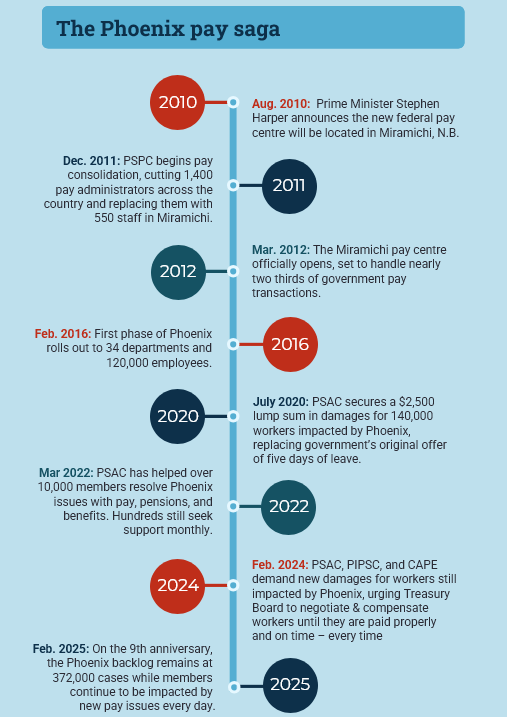
Source: PSAC
One of the headline recommendations is that the Treasury Board of Canada Secretariat, “in coordination with Public Services and Procurement Canada, should address gaps in service standards that support timely and accurate pay and report government‑wide results in meeting the standards to help ensure the employees’ transactions are processed in a timely and accurate way.”
On the financial side, the Auditor General recommends that as PSPC develops “detailed cost estimates” for the transformation project, the department should “include estimates of costs to transition departments and agencies to the new system and develop key performance indicators that would measure whether costs to process pay transactions with Dayforce would decrease as compared with Phoenix.”



