More than 8 in 10 say AI tools boost employee productivity

Nearly half (49 per cent) of Canadian employees believe using artificial intelligence should be required in the workplace, according to a report from KPMG.
This is the case even though 40 per cent do not know what AI controls are in place where they work, and only 29 per cent say their employer has a comprehensive AI policy—up from 18 per cent in 2024.
Davin Gnanapragasam, chief technology officer and tax partner at KPMG in Canada, is calling on employers to move quickly to close the policy gap.
Organisations “can’t leave employees guessing at the expectations around AI use,” he says, calling for comprehensive policies that spell out acceptable use, controls and responsibilities, backed by learning that “bridges deep industry expertise and a strong understanding of AI.”
Previously, Canada developed a legislation, including the Artificial Intelligence and Data Act (AIDA) - which is part of Bill C-27, the Digital Charter Implementation Act, 2022, Canada’s first attempt to create a national regulatory framework for AI that specifically focuses on the regulation of international and interprovincial trade and commerce in AI systems - and the Consumer Privacy Protection Act (CPPA), re-introduced to apply to those who develop and use “automated decision systems.”
Several benefits to using AI
Despite that policy vacuum, employees report significant benefits from generative AI tools, according to KPMG’s survey of more than 2,200 adult employees, conducted Aug. 15 - 29, 2025.
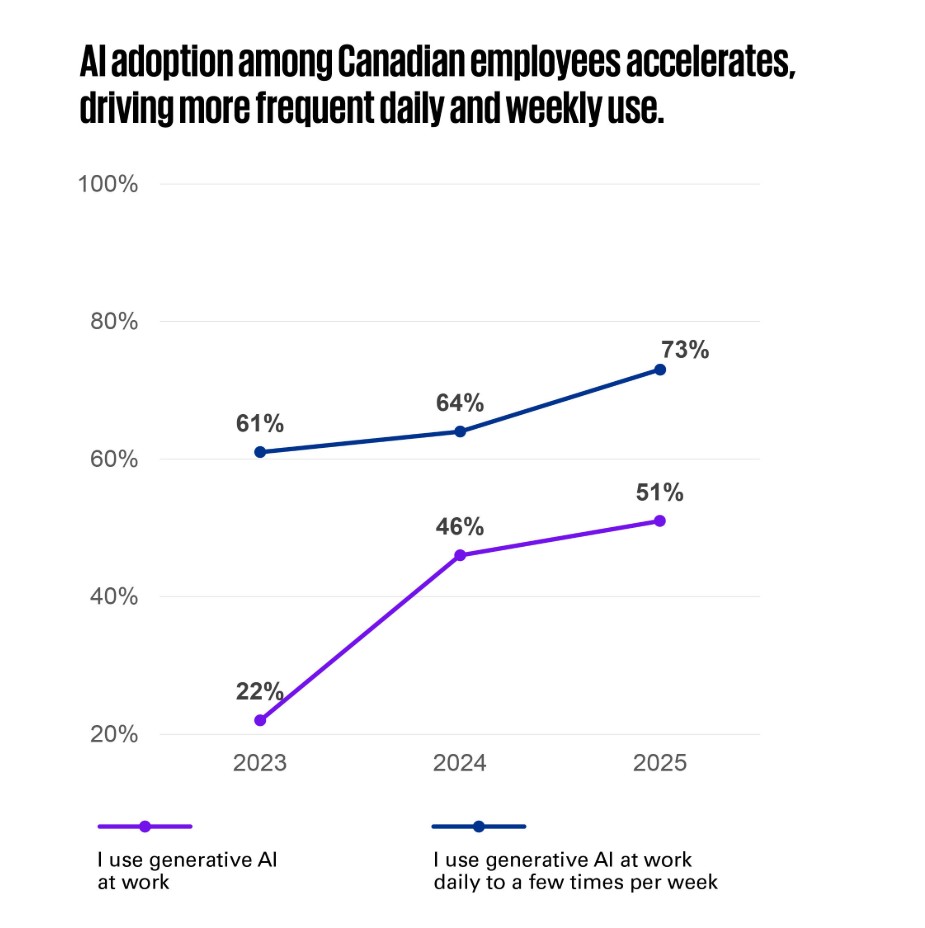
More than half (51 per cent) of Canadian employees now use generative AI at work, compared with 46 per cent in 2024 and 22 per cent in 2023.
Among users, 79 per cent say generative AI has improved their productivity, while 51 per cent are redeploying the time they save to higher‑value work, up from 45 per cent a year earlier. The tools are used mainly for:
- research (62 per cent)
- idea generation (58 per cent)
- summarizing publicly available information (37 per cent)
Gen Z workers are emerging as the main drivers of artificial intelligence (AI) adoption in Canadian workplaces, according to a report by the International Workplace Group (IWG).
Half of workers say AI is helping close generational divides at work, with senior leaders reporting that collaboration with younger colleagues enables them to focus more on “higher-value tasks.” The IWG survey—cited in a report from The Economic Times—also shows that 82 per cent of workers credit AI innovations with opening new business opportunities.
Efficiencies from AI use
About 86 per cent of office workers said AI has made them more efficient, while 76 per cent believe it is helping their career growth. Among Gen Z respondents, 87 per cent said AI is boosting their professional development, indicating that younger workers are particularly inclined to use AI tools to advance their careers.
On average, workers reported saving 55 minutes a day through the use of AI tools, according to the findings.
This reported time saving suggests a potential reallocation of working hours toward more complex or strategic tasks as AI takes on routine or repetitive work.
Concerns about artificial intelligence
However, the KPMG survey also highlights considerable challenges and room for improvement inside organisations. Although 83 per cent of respondents say they “want and/or need to learn how to use generative AI tools more effectively,” only 48 per cent describe their employer’s training as helpful.
Over a third (36 per cent) of workers received AI training but have not started using the tools because they are too busy or overwhelmed to change existing processes, and another 37 per cent began using AI after training but later stopped for the same reason.
Concerns about accuracy and risk are also holding back wider use. According to the survey, 58 per cent of employees are extremely or very concerned about “hallucinations or inaccuracies in gen AI responses,” and 46 per cent say those worries discourage them from using AI at work.
Legal experts at Osler also say that employers should ensure their use of AI is consistent with existing internal policies, employment contracts and collective agreements—if applicable.
“If it is not, the use of AI could be subject to challenge, even if it is otherwise consistent with recommended best legal practices,” say Steven Dickie, Sam Ip, Melanie Simon and Chloe Jurczyk.
“Before implementing AI systems, employers should review these documents to confirm that the introduction or use of AI does not conflict with existing rights, obligations or processes, particularly where AI may influence monitoring or evaluation. Employers should consult with legal counsel to discuss any risks before changing existing policy, procedures or contractual terms.”
When it comes to using generative AI for things like drafting or HR letters, the key is keeping a human in the loop, according to one expert.