AI agents popular for hiring, performance evaluations, finds KPMG survey – but ROI still lacking

Canadian business leaders are rapidly moving toward a future where humans and AI agents work side by side, with many already redesigning roles, teams and workflows on the assumption that agents will handle tasks such as research and coordination while people focus on judgment, decision-making and accountability, according to a new survey.
It shows that AI has become a top investment priority for Canadian organizations, with agentic AI — systems that can operate independently with minimal human oversight — emerging as a key lever for driving operational efficiency.
“As organizations move quickly to scale AI agents, we’re seeing a generational shift in how work gets done,” says Stephanie Terrill, Canadian managing partner of digital and transformation at KPMG Canada.
“Business leaders are starting to design roles, teams and workflows on the assumption that humans and agents will work together, with agents taking on work such as research and coordination, and people focusing on judgement, decision-making and accountability.”
In the survey of 306 executives at Canadian companies, KPMG found that more than three-quarters (77 per cent) reported they are already using AI agents to assist with tasks such as knowledge sharing between departments.
Two-thirds (66 per cent) say they are moving toward a fully integrated AI-human workforce where humans work alongside agents.
AI agents for hiring, performance evaluation
More than half of Canadian respondents (59 per cent) say AI agents have already changed how their organizations hire entry-level workers, and 63 per cent report similar changes when it comes to experienced talent.
According to the survey, when it comes to entry-level hiring, employers are increasingly emphasizing:
- creative thinking (46 per cent)
- problem-solving skills (44 per cent)
- adaptability (43 per cent).
Respondents also anticipate shifts in how employees are evaluated. Expected changes include:
- building AI collaboration competencies into performance reviews and role requirements (39 per cent)
- placing greater emphasis on human capabilities such as critical thinking and contextual awareness over tasks now handled by AI (39 per cent)
- redefining promotion criteria to prioritize AI literacy and effective agent delegation (36 per cent).
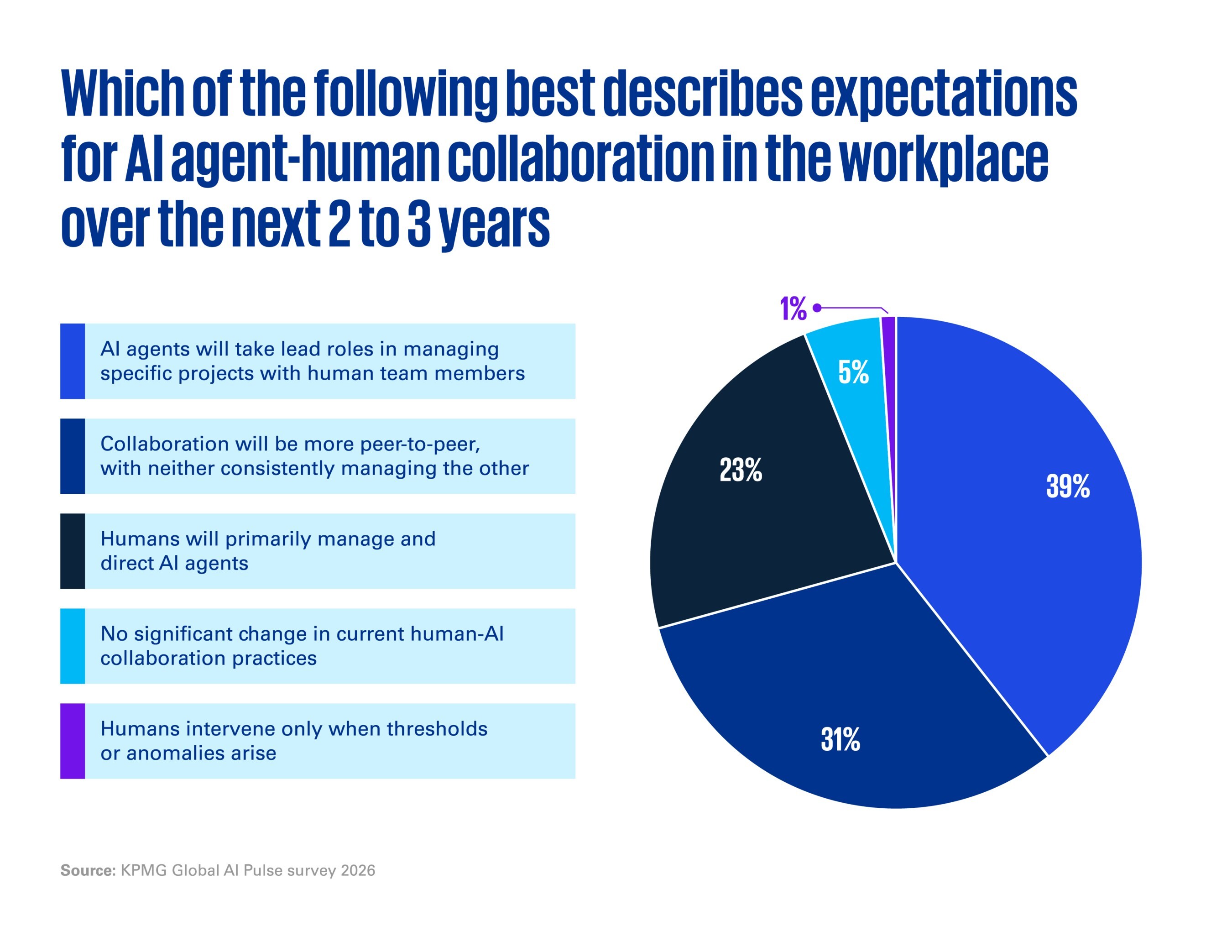
In terms of day-to-day work, business leaders predict that in the next two to three years, AI agents will either be leading project management for teams (39 per cent) or working alongside humans as peers to complete tasks (31 per cent).
Telecommunications unions are urging Ottawa to restrict how artificial intelligence (AI) is used in the industry, saying the technology is reshaping job design, monitoring and performance management.
ROI lags as skills gap and resistance slow adoption
Despite high levels of investment and early signs of business value, Canadian organizations are struggling to turn AI into measurable returns. While 70 per cent of organizations say AI is delivering meaningful business value, only three per cent have achieved measurable returns on their AI investments.
The primary obstacle cited by respondents is a workforce skills gap. Globally, eight per cent of respondents report that they have successfully realized a return on their AI investments.
Another hurdle is uneven adoption of agentic AI across the workforce. In Canada, 31 per cent of employees are seen as resistant to the technology, compared to 16 per cent globally.
More than half of respondents (51 per cent) attribute this hesitation to trust and ethical concerns, while nearly 40 per cent point to job security worries or a lack of confidence in employees’ AI skills and capabilities.
To close the gap, organizations must move beyond basic training and take a more deliberate approach to how human-AI collaboration creates value, says Lewis Curley, partner in the people and change practice at KPMG Canada.
“When organizations are looking at upskilling their workforce, they must have a clear picture of how their people can use AI agents in ways that deliver meaningful impact on the business,” he says.
“A skilled employee can build an agent to automate tasks and get work done faster, but if it’s not being used on work that produces results, companies won’t see the returns they’re looking for.”