Lowe's exec at HRFest Canada outlines best practices for effective people analytics
It is a scenario HR is unfortunately all too accustomed to —, the dashboards are built, the survey results are in, but none of it is moving leaders to act.
It is a gap Khalifa Oliver, senior director of technology at Lowe’s Companies knows well. Working at the intersection of HR analytics, employee experience, and business outcomes, she says the problem is HR produces the people data, displays it, but stops short of showing what leaders can do with it.
“Your deliverable when it comes to data is not the dashboard, it is the decision. If you are not delivering a decision, there’s no point in your people data investment,” she says.
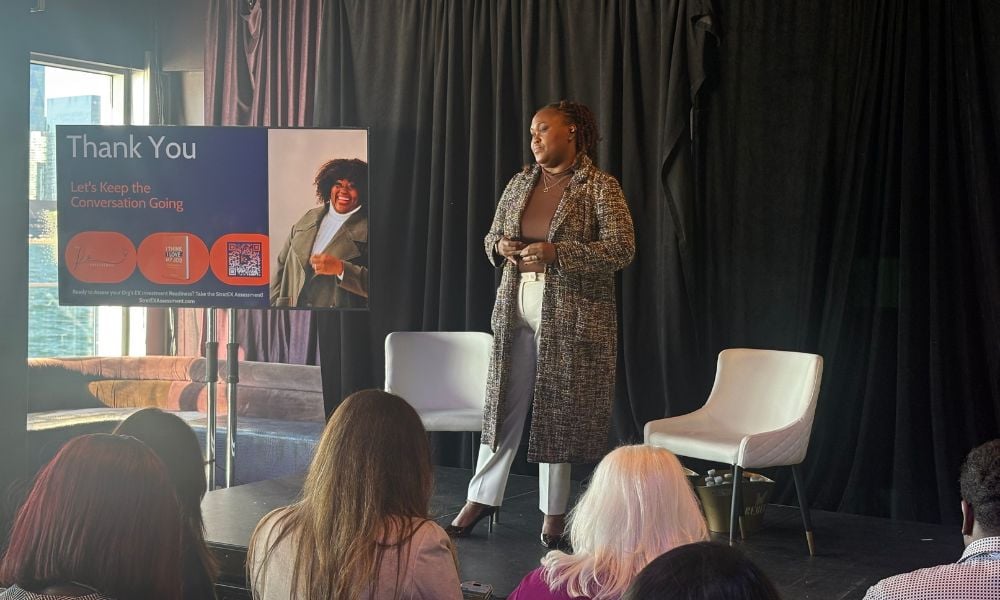
Oliver led the session "From Surveys to Storytelling: Making People Analytics Land with the C-Suite" at HRFest Canada at Rebel in Toronto on Nov. 11, walking HR professionals through how to build a narrative process with people analytics data that drives business decisions.
Too much data, not enough direction
The problem is not the data, Oliver says, but that there tends to be too much with no context.
“We are our own worst enemy,” she says. “We have been hoarding data for years. We just mine data.”
While HR will create many different dashboards to show leaders different types of data, it ends up having the opposite effect of creating information overload instead. It leads to a scenario where the executive, ends up having to piece things together themselves, Oliver says.
“Executives, they’ll nod and smile, thank you for the dashboard, close it, and that’s it. If you’re lucky, they’ll send it about two levels down to take a look at it and tell them what they need. Now they’ll run it through ChatGPT,” she says.
Oliver explains the information overload problem through a car analogy — when a driver wants to gauge fuel, the dashboard does the important work of calculating the complex data behind it, such as wind speed, mileage and temperature. That data is never visible to the driver. The only thing that matters is whether they need gas or not.
“What we do when we create dashboards is we create dashboards that say, ‘Here’s the wind speed, here is the time to your destination,’” she says. “So, you got leaders going, ‘I don’t know what to do with this information.’”
The narrative approach
There is a three-step narrative framework Oliver says HR should follow to show data in a way that leads to decisions: framing, visualizing and linking.
The first step is to frame the insight that can drive people to action. That must include the context before the data.
“Set the business scene. Don’t just go in there and say, ‘The data shows…' What was the thing that was keeping them up at night before you walked into the room?” she says.
Oliver says to frame insights as a challenge and a path forward. “Here’s the issue, here’s what we do. We often go in with the problem, and if we’re stuck on the problem, they’re stuck on the problem,” she says.
Visuals are an important part of telling a story with data and the goal Oliver says is not to show everything. It should be one visual that a leader can glance at and immediately understand.
“How much of you would read your gas gauge if you had to calculate to the nth degree where it was? You just need to know if it’s full, quarter, empty, and in that red line that you might be able to get home, so you might not fill your gas tank. That’s all you need to know,” she says.
She challenges HR to find that one visual — something that, if screenshotted into an email to a travelling executive, would tell the whole story of the data on its own.
Link to business outcomes and speak their language
On the linkage side, the people data must connect to outcomes, Oliver says. HR needs to focus on connecting and quantifying people data to measurable operational and financial results — not just isolate the engagement score.
“That’s going to mean those investors go, —'Well, I’m going to do something about that then’,” she says.
It is also important, for HR to replace HR language with something that speaks to leaders’ priorities, Oliver says. “They just want to know the business implications, right? What does that mean for retention risk, attrition?”.
AI does not build the narrative
With all the data there might be an urge to use AI features inside survey tools to assist with understanding and building the narrative — however Oliver says it should be used with caution.
“AI is a baby. We treat it like an adult,” she says.
Since AI only learns based on what it is taught, Oliver says putting in data without context means it will generate results and context that don’t make sense for the context of the company. When large language model (LLM) tools are given the wrong information, it can also cause lasting problems.
“This technology, (LLMs), they only learn what is given to them. And a key thing that I always, always, always stress is this: it cannot unlearn. It doesn’t matter if you put the right information in after,” she says. “The only way to change, fully change, an AI model is to kill the model. And that costs a lot of money and stress.”
HR, she says, should also go in and create the narrative.
“This is how you get people analytics and people data to land with the C-suite. Because you’re in the decision and you’re in the room. And even if they don’t make the decision you recommend, your narrative still exists,” she says.
Rethinking the survey
However, building a stronger narrative starts even earlier. Oliver says organizations need to rethink what they are measuring in the first place — and that starts with decentering engagement as a metric.
Workplaces are ecosystems with many variables, and most surveys — whether annual, pulse, or even benefits — tend to come back to one Net Promoter Score (NPS)-style question, she says
“One question, 4 questions, and then we diagnose that the whole company is in trouble. That’s what we do. You know what that makes us? Quacks,” Oliver says.
Surveys should also be looking at other aspects including commitment, leadership effectiveness, manager effectiveness and even compensation.
Before creating those surveys, she says HR should make sure it knows what it is trying to solve.
“When you ask the benefit survey, are you just asking it to ask it, to annoy your employees one more time? Is there a decision that will be made because of the survey? What is the expected decision and how will you report that back to your employees?” she says.
Oliver does not believe in survey fatigue — if anything, she calls it “inaction fatigue.”
When employees are repeatedly asked for their input and nothing changes, they stop responding honestly.
“Stop asking me stuff if you ain’t going to do nothing about it,” she says.