Rising wages, labour shortages and hesitant diners squeezing industry, says report - will FIFA help?

Canada's restaurant industry is under mounting financial pressure in 2026, with rising operating costs, persistent labour shortages, and a cautious consumer landscape combining to test the sector's resilience.
New data from Restaurants Canada's Q1 Quarterly Report paints a sobering picture: One in three operators is now either breaking even or operating at a loss — triple the levels seen in 2019.
As further proof:
- 49% of operators report lower sales so far this year
- 54% report fewer guests
- 71% report declining profitability.
"The restaurant industry is typically the first to feel economic pressure when Canadians are struggling. And right now, that pressure is building," says Kelly Higginson, president and CEO of Restaurants Canada.
"Canadians visit restaurants 23 million times every day, supporting 1.2 million jobs across the country. When affordability is strained, it doesn't just affect restaurants, it ripples through communities, supply chains, and local economies."
A cascading cost problem
Labour sits at the heart of the pressure. It represents between 30 and 35% of a restaurant's overall cost structure, according to Ian Tostenson, president and CEO of the BC Restaurant and Foodservices Association — and minimum wage increases create a ripple effect throughout the wage structure.
"As minimum wage increases, you get the cascading effect, whereas your hourly rate bands automatically all sort of adjust themselves," he says.
In British Columbia, the minimum wage is moving to $18.25 — a 40% increase — on June 1, 2026.
The math is unforgiving for smaller operators. On a million-dollar restaurant carrying roughly $300,000 in labour costs, a 4% wage increase adds $12,000 annually — or $1,000 a month — with no corresponding rise in revenue, according to Tostenson.
"In a normal economy, whatever that is, you would see that those adjustments could easily be made up but with price increases in the overall mix," he says. "But when everything else around you is increasing, it becomes very, very difficult."
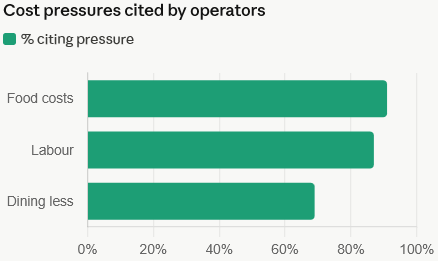
That “everything else” includes food costs — now rising further due to fuel prices — along with occupancy, electricity, and gas costs. Nationally, 91% of operators cite food costs as a pressure point and 87% cite labour, according to the Restaurants Canada report.
Kitchen labour crisis deepens
Recruitment and retention pressures are not evenly distributed across restaurant operations. Front-of-house staff remain relatively accessible, with gratuities capable of lifting a base $18.25 wage to $40 an hour in some cases, according to Tostenson.
The kitchen is a different story.
"Every restaurant is probably short a cook or a chef at some point," he says. British Columbia alone has roughly 15,000 restaurants and 190,000 employees operating within a $20-billion industry — and the province graduates around 800 culinary students per year, a figure Tostenson describes as inadequate.
The skilled labour shortage, which he estimates at 10,000 to 15,000 workers in B.C., has historically been offset somewhat by temporary foreign workers, who have represented around 4% to 5% of the sector's overall labour market. That pipeline has narrowed.
"That shortage now is becoming systemic, and I would say industry out here feels almost at a crisis," says Tostenson.
Restaurants are adapting by closing one day per week or limiting operating hours — measures that cap revenue potential.
"You're running at about an 85% capacity with that restaurant. And so you're not getting the most out of your revenues," he says.
Middle management squeeze
The compensation imbalance between servers and managers is also creating a retention problem in restaurant leadership, according to Tostenson. In some operations, servers earning base wages plus gratuities are taking home more than the managers.
"There's a lot of headaches here for scheduling and filling in, and there's a lot of chaos," he says, while many servers feel they can have an easier life through their tips and wages. “It's out of balance,” says Torenson.
The problem is compounded by the structure of the industry itself. Larger chains and restaurant groups can offer defined career pathways and dedicated HR resources. Independent restaurants — which make up the vast majority of Canada's foodservice landscape — typically cannot, he says. "You see a lot of management of your independent restaurants are actually the owners themselves.”
Immigration policy out of step with industry needs
Tostenson argues that federal immigration policy has failed to account for the distinct labour needs of the hospitality sector, and that a one-size-fits-all approach from Ottawa is leaving industries like his behind.
"The government needs to… isolate industries and to develop a strategic plan on labour for industries as opposed to a one-size approach," he says.
In B.C., the province's allocation of federally approved positions has been directed toward engineers, doctors, and nurses. Cooks and chefs are not on the priority list.
Torenson notes the issue extends well beyond restaurants.
"We're talking about work camps and institutions and prisons and hospitals, and they seem to ignore that."
Tostenson also points to the cultural dimension of the shortage: many Asian restaurants in BC rely on cooks in their 60s and 70s who want to retire but cannot find qualified successors.
"You're not going to bring in Johnny from Capilano College cook school to start doing that. In cuisine, you need some authenticity," he says.
Policy asks
Restaurants Canada is calling on the federal government to take targeted action to ease pressure on the sector. At the top of the list: permanently exempting all food from GST, which the organization argues would provide relief to consumers while correcting inconsistencies in how similar food items are taxed depending on where they are purchased.
The association is also seeking accelerated capital cost allowance for the foodservice industry to support reinvestment and modernization.
"Treating food consistently in the tax system and supporting investment in our sector would help Canadians today while strengthening one of the country's most important engines for jobs and local economic activity," says Higginson.
The sector generates $125 billion in annual sales, equal to 3.9% of GDP, and supports 17.7 jobs per $1 million in output — more than double the industrial average. Every dollar spent in a restaurant generates $2.25 in total economic output, according to Restaurants Canada.
For operators like those Tostenson represents, the underlying resilience of the sector is not in doubt — but it is being tested. "They somehow figure it out," he says. "They kill themselves doing it."