Wage growth hits 9-year low: StatCan

Canada's labour market cooled sharply in August, with employment falling by 42,000 positions and wage growth slowing to its weakest pace since 2017, according to the latest Labour Force Survey released today by Statistics Canada.
The August pullback follows a strong four-month run in which the economy added a cumulative 181,000 jobs between April and July. Despite the monthly setback, employment remains 217,000 positions higher than a year ago — a year-over-year gain of 1.0%.
The national unemployment rate held at 6.4% in August, unchanged from July, though the headline figure masks diverging trends across demographic groups.
August’s numbers mark a step backward for the labour market, says Cory Stahle, senior economist at Indeed.
"Shedding jobs after three months of consecutive gains doesn’t feel good, but this reads more like a giveback than a turn. The three-month average of job gains remains positive, employment is up from last year, and young workers appear to be faring better than they did last year. Unfortunately, the path ahead is covered with shadows. Any potential impacts from a reignition of trade tensions with the United States would not be reflected in the August data and may not be fully understood for months.
Employment levels: Men, women, youth
Core-aged men (25 to 54) saw their unemployment rate tick up 0.2 percentage points to 6.0%, driven by more men entering the labour force and searching for work. Women in the same age group fared better: their unemployment rate fell 0.2 points to 5.0%, as fewer women actively sought employment during the month.
Youth aged 15 to 24 faced additional pressure, with employment falling by 19,000 (-0.7%) and the unemployment rate edging up to 12.9%, says Statistics Canada. That figure, while still elevated compared to the pre-pandemic average of 10.8%, is 1.4 percentage points lower than a year earlier — a sign of gradual improvement.
The employment rate — the share of Canadians aged 15 and older who are employed — slipped 0.1 percentage points to 60.8%.
One bright spot in the report: a meaningfully better summer job market for students. The unemployment rate for returning students aged 15 to 24 averaged 15.9% from May to August 2026, down from 17.9% over the same period in 2025.
The improvement was most pronounced among older students. Those aged 20 to 24 saw their summer unemployment rate drop to 9.2%, compared to 12.3% the previous year.
Sectoral gains, losses in Canada
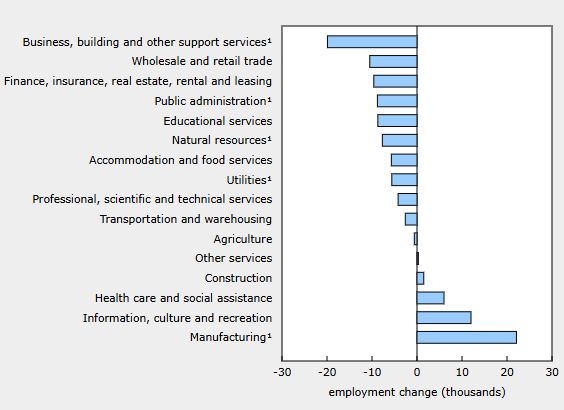
August's job losses were spread across several sectors. Business, building and other support services shed 20,000 positions (-2.8%), while public administration lost 8,800 (-0.7%), natural resources fell by 7,700 (-2.3%), and utilities dropped 5,600 (-3.5%). The public sector overall has now declined by 78,000 positions since May.
Manufacturing stood out as the lone significant gainer, adding 22,000 jobs (+1.2%), most of them in Ontario, according to Statistics Canada.
"Against the backdrop of an escalating trade war, it’s not clear if manufacturing will be able to keep that up," says Stahle.
Looking at the full year, the strongest growth sectors were health care and social assistance (+129,000; +4.5%), information, culture and recreation (+49,000; +5.9%), and transportation and warehousing (+47,000; +4.4%). Wholesale and retail trade saw the steepest year-over-year decline, shedding 55,000 positions (-1.8%).
Statistics Canada also flagged ongoing uncertainty in industries that depend on U.S. export demand, noting that new American tariffs on Canadian goods have compounded challenges for those workers. Over the past 12 months, the layoff rate in export-dependent industries averaged 0.9%, compared to 0.7% in other sectors.
Wage growth slowest since 2017
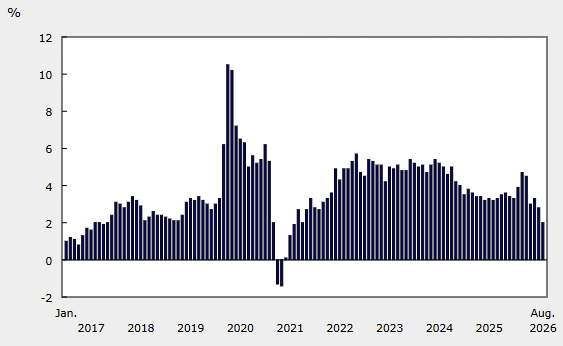
Perhaps the most striking figure in the report is the deceleration in wages. Average hourly earnings rose just 2.0% year over year in August — reaching $37.02 — the slowest pace of growth since November 2017, excluding the pandemic year of 2021, says Statistics Canada.
That's a notable step down from 2.8% in July and 3.3% in June, and a far cry from the 4.9% average that prevailed through 2023 and 2024.
Lower-wage workers are feeling the slowdown most acutely. Employees in the bottom quarter of the wage distribution saw hourly pay rise just 1.1% to $18.66, while those in the top quarter experienced 2.1% growth, reaching an average of $65.15 per hour.
Regional picture: Quebec and Ontario pull back
Geographically, Quebec bore the brunt of August's losses, with employment falling 19,000 (-0.4%) — concentrated largely in the Montreal metropolitan area (-21,000). Quebec is also the only province to be down on a year-over-year basis, having shed 54,000 jobs (-1.2%) since August 2025.
Ontario also edged lower, losing 18,000 jobs (-0.2%), though the province remains up 116,000 positions (+1.4%) compared to a year ago, according to Statistics Canada. The Toronto area's unemployment rate held steady at 6.7% in August — well below the 9.0% peak recorded as recently as July 2025.
New Brunswick offered a rare positive note, adding 2,400 jobs (+0.6%). Employment was little changed elsewhere across the country.