Firm expects economy to slow sharply late this year, while new Statistics Canada data show real GDP was flat in July
Canada's economy will grow faster this year than previously expected but slow sharply heading into 2027 as the latest round of U.S. tariffs takes hold, Deloitte Canada said Tuesday in its fall economic outlook.
The consulting firm raised its 2026 growth forecast by 0.2 percentage points to 0.9 per cent, citing a stronger-than-expected first half, and cut its 2027 forecast by 0.4 percentage points to 1.6 per cent.
"The resilience of Canada's economy is being tested once again as the trade tensions between Canada and its largest trading partner, the US, widened in late August," Dawn Desjardins, Deloitte Canada's chief economist, wrote in the report's foreword.
The forecast, completed Sept. 9, includes the U.S. Section 338 tariffs imposed Aug. 22 and Canada's retaliatory tariffs of Sept. 8. It does not include an expansion of the U.S. tariffs that took effect Sept. 15 or a U.S. ban on certain Canadian goods that takes effect today, which the report said represent downside risk.
"On net, the direct impact on the economy looks like it could be relatively contained," Desjardins wrote. But she warned that "further escalation would exert downward pressure on a growing number of sectors and damage business and consumer confidence."
Canadian HR Reporter recently spoke with three HR leaders about how their companies are coping with the US tariffs war.
Exports expected to take the hit
Deloitte expects exports to fall 0.9 per cent annualized in the third quarter and 5.0 per cent in the fourth, after a 15.1 per cent jump in the second quarter, with the decline concentrated in goods. Exports are forecast to grow just 0.3 per cent in 2027.
Business investment is forecast to rise 1.6 per cent this year as many firms hold off on expansions amid uncertainty over U.S. market access, before strengthening to 3.5 per cent in 2027 as major projects reach final investment decisions. The report said federal support, including a new $7.5-billion package for tariff-affected businesses and workers, is helping cushion the economy.
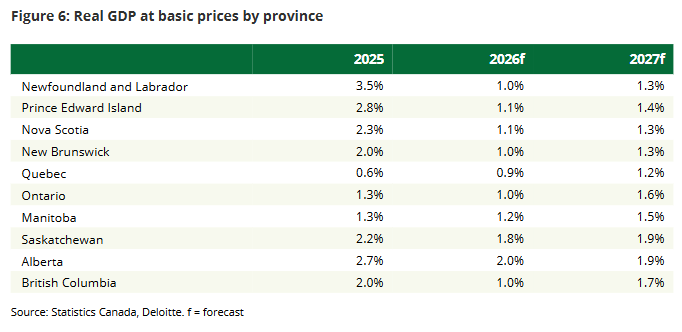
Alberta is expected to post the fastest provincial growth this year at two per cent, followed by Saskatchewan at 1.8 per cent. Quebec is forecast to grow 0.9 per cent, the slowest among the provinces, amid headwinds for its aluminium and other manufacturing sectors.
Ontario is forecast to grow one per cent in 2026 and 1.6 per cent in 2027. The report described it as one of the most tariff-exposed economies in the country, given its concentration of automotive manufacturing and steel producers. British Columbia, New Brunswick and Newfoundland and Labrador are also forecast to grow 1.0 per cent this year.
An interactive tool built by researchers at the University of Toronto, called Mapping Tariffs, lets employers and HR professionals see tariff exposure broken down by business count and employee headcount across Canadian municipalities.
Rate hikes forecast for 2027
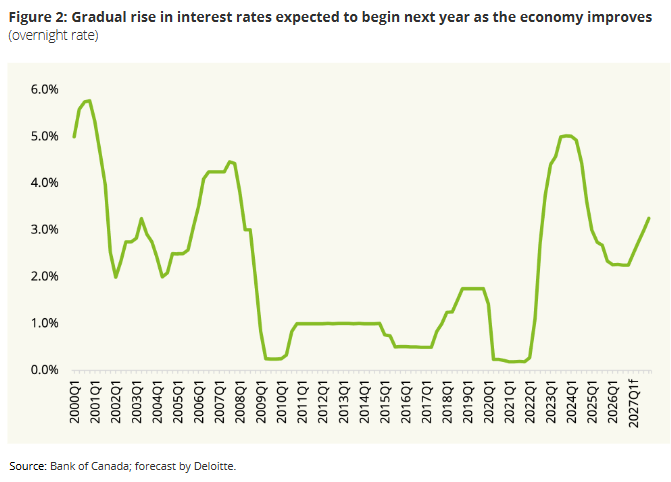
Deloitte expects the Bank of Canada to hold its policy rate at 2.25 per cent for the rest of 2026, then raise it four times in 2027 to 3.25 per cent.
"The combination of downside risks to the economy and upside risks to inflation puts the Bank of Canada in a difficult position," Desjardins wrote.
The report noted headline inflation hit three per cent in July on higher energy prices, while inflation excluding energy is running at 2.2 per cent.
With Canada's population declining for three straight quarters, Deloitte expects consumer spending growth to slow from 2.1 per cent this year to 1.4 per cent in 2027 as job growth cools.
Among the provinces, Alberta is forecast to lead in 2026 with 2.0 per cent growth, while Quebec trails at 0.9 per cent. Ontario, which the report described as one of the most tariff-exposed provincial economies, is forecast to grow 1.0 per cent.
Desjardins struck a muted but hopeful note.
"We remain cautiously optimistic that progress toward establishing new trade and supply chain relationships, growing participation by companies in government-initiated projects, and a renewed commitment to addressing impediments to investment will advance, allowing Canada's economy to weather this latest blow," she wrote.
The report warned that further escalation, including U.S. talk of raising tariffs on Canadian autos, auto parts and steel to 50 per cent in January 2027, could put CUSMA itself at risk. Deloitte's modelling found a U.S. exit from the agreement could cost Canada's economy $402 billion, a real GDP loss of 1.6 per cent compared with its baseline.
July GDP flat as gains and losses cancel out
Statistics Canada data released the same day showed real GDP by industry was essentially unchanged in July, with 10 of 20 industrial sectors expanding.
There was little indication of a significant broader negative economic impact in August after the United States imposed 50% tariffs on a subset of Canadian exports on Aug. 22, said a "Data Flash" from RBC economist Abbey Xu.
"Upcoming data reports will be watched closely -- the new tariffs are expected to cause significant disruption for directly affected industries and regions, although rising hours worked and resilient consumer spending suggest activity elsewhere in the economy continued to expand."
She said growth is expected to be substantially slower than in Q2 as earlier support from recovering auto production and net trade fades.
"New tariffs and tighter financial conditions remain important downside risks, while targeted government support should help cushion the impact on affected businesses and workers."
Construction grew 1.3 per cent for a fourth straight monthly gain, with non-residential building construction up 2.9 per cent, its fastest growth since January 2022, on institutional work tied to a new hospital in Ontario, said Statistics Canada. Utilities rose 1.7 per cent as a heat wave drove up electricity demand, and accommodation and food services grew 0.8 per cent as more international travellers entered Canada.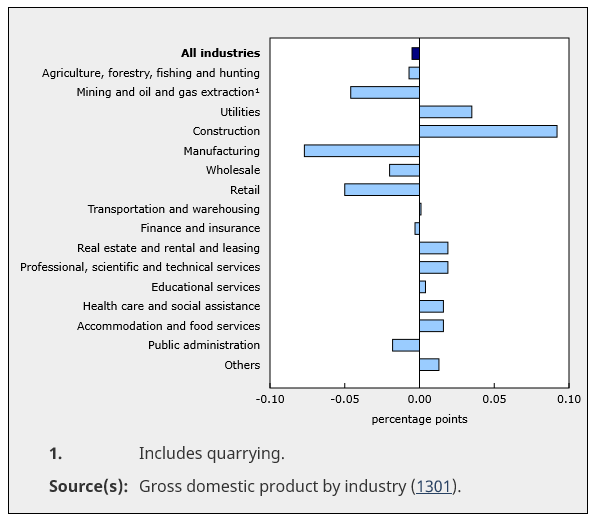
Those gains were offset elsewhere. Manufacturing fell 0.9 per cent, its first decline in four months, led by a 5.7 per cent drop in petroleum and coal products after unplanned downtime at a refinery in southwestern Ontario. Retail trade fell 1.0 per cent, including a 3.5 per cent decline at gasoline stations and fuel vendors that coincided with rapidly rising gas prices. Wholesale trade slipped 0.4 per cent, and mining, quarrying and oil and gas extraction contracted 0.5 per cent, with potash mining down 6.4 per cent.
Statistics Canada's advance estimate indicates real GDP grew 0.2 per cent in August, with gains in mining and quarrying and retail trade partly offset by lower oil and gas extraction. The figure is preliminary and will be updated on October 30, 2026.