Unemployment edges lower, youth employment rebounds — but economists say old rules for reading jobs report no longer apply

Canada's labour market held its ground in June as hiring remained modest, the unemployment rate ticked down for a second straight month and young workers posted their strongest gains of the summer, according to new data from Statistics Canada.
The June Labour Force Survey shows employment rising by 18,000 (+0.1%), building on a strong gain of 88,000 in May. The national unemployment rate fell 0.1 percentage points to 6.5% — matching the rate last observed in January — while the employment rate nudged up to 60.8%.
The results suggest the labour market is stabilizing after a turbulent spring, with the unemployment rate now down 0.4 percentage points from a year earlier and job-finding conditions clearly improving. Statistics Canada reports the job-finding rate — the share of unemployed people who secured work between May and June — was 24.3%, up from 21.3% over the same period in 2025. The layoff rate, meanwhile, remained steady at 0.6%, in line with pre-pandemic averages.
However, a new report from TD Economics adds important context to June's modest hiring numbers. Published July 8, economists Marc Ercolao and Matt Palucci argue that Canada's "breakeven" pace of job creation — the monthly hiring needed just to hold the unemployment rate steady — has fallen close to zero as immigration policy tightens and population growth stalls.
Youth catch a break heading into summer
One of the headline developments in June is a meaningful improvement for young workers. Employment among those aged 15 to 24 rose by 33,000 (+1.2%), driven largely by part-time work (+25,000; +1.9%). The youth unemployment rate fell 0.7 percentage points to 12.7%, following a 0.9 percentage point drop in May — the second consecutive monthly decline.
The June youth unemployment rate now sits near the recent low of 12.8% observed in November 2025 and January 2026. However, it remains above the pre-pandemic average of 10.8% from 2017 to 2019, says Ottawa.
The summer job market for returning students also brightened compared with a year ago. The unemployment rate for returning students aged 15 to 24 was 15.3% in June, down 2.1 percentage points from June 2025 (17.4%), though still above the pre-pandemic June average of 13.0%. The improvement was most pronounced among post-secondary students aged 20 to 24, whose unemployment rate fell 4.1 percentage points year over year to 8.2%.
Core-aged workers hold steady
Among core-aged workers (25 to 54), conditions were broadly unchanged in June. The unemployment rate held steady for both women (5.5%) and men (5.7%), and employment edged up for core-aged women (+18,000; +0.3%) and men (+15,000; +0.2%). For men in this group, the unemployment rate was down 0.4 percentage points from a year earlier.
The picture was somewhat less favourable for workers aged 55 and older. Employment in this group fell by 47,000 (-1.1%) in June, pushing the unemployment rate up 0.2 percentage points to 5.2%.
Statistics Canada notes, however, that both employment levels and the unemployment rate for this group were little changed on a year-over-year basis, suggesting the June decline may be a monthly fluctuation rather than a trend.
Private sector employment rose by 32,000 (+0.2%) in June, while public sector payrolls declined by 31,000 (-0.7%). Over the past 12 months, private sector employment has grown by 94,000 (+0.7%), while public sector headcount has shown little net change.
Hospitality climbs; manufacturing slips
Average hourly wages among employees rose 3.3% year over year in June (+$1.19 to $37.20), accelerating slightly from 3.0% growth in May (not seasonally adjusted).
On the industry side, accommodation and food services posted its third consecutive monthly increase, adding 15,000 jobs (+1.2%) in June. Gains were concentrated in Quebec (+11,000; +4.3%) and Ontario (+9,800; +2.3%). Year over year, the sector has added 39,000 positions (+3.4%).
Manufacturing moved in the opposite direction, shedding 17,000 jobs (-0.9%) and erasing May's gain. Statistics Canada notes employment in the sector has now declined by a net 61,000 (-3.2%) from its peak in January 2025, a stretch that coincides with sustained tariff-related uncertainty facing Canadian exporters.
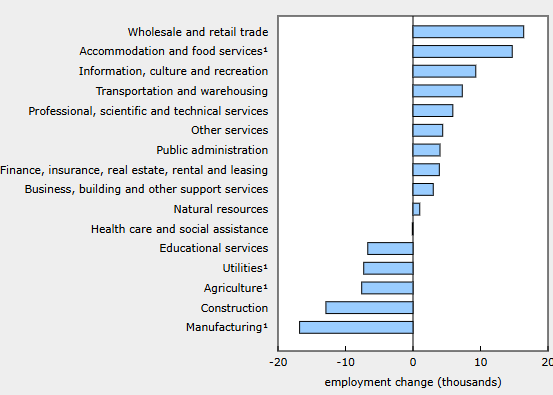
Agriculture (-7,600; -3.3%) and utilities (-7,300; -4.3%) also recorded notable declines in the month.
Ontario flat, Quebec recovering
Provincially, the story in June is largely one of stabilization. Employment rose in Nova Scotia (+4,800; +0.9%) and Saskatchewan (+2,900; +0.5%), while most other provinces showed little change.
Ontario's employment was little changed in June after a cumulative gain of 84,000 (+1.0%) over the previous two months. The provincial unemployment rate held at 7.0% — unchanged from May but down 0.8 percentage points from a year earlier. In the Toronto census metropolitan area, the unemployment rate was little changed at 6.9%, continuing a gradual descent from a recent high of 8.5% in February.
Quebec's labour market continued its tentative recovery, with employment edging up 14,000 (+0.3%) for a second consecutive month following a net decline of 91,000 (-1.9%) between January and April. The provincial unemployment rate was 5.4% in June, down 0.8 percentage points from its recent peak of 6.2% in April. In Montréal, the unemployment rate fell 0.6 percentage points to 5.9% and was down 1.1 percentage points year over year, says Statistics Canada.
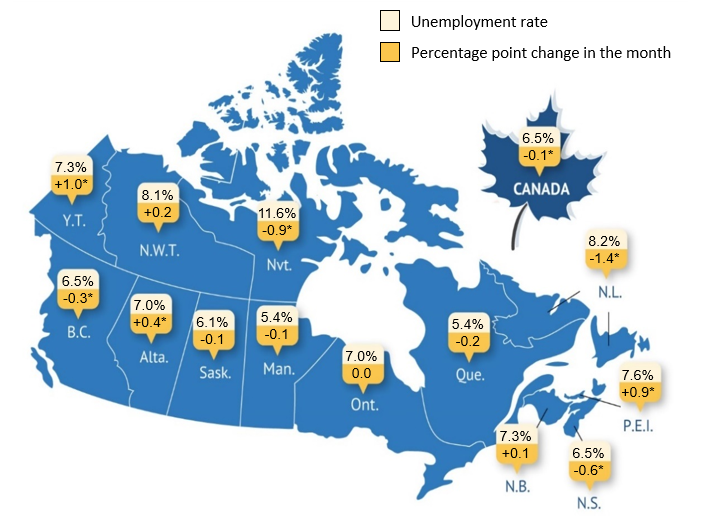
British Columbia's unemployment rate fell 0.3 percentage points to 6.5% in June, while Vancouver's held steady at 6.6% — down 0.7 percentage points from a year earlier.
The new math of Canada's job market
Canada's population has contracted outright in recent quarters for the first time on record, driven largely by a decline of nearly 600,000 non-permanent residents. As the TD authors write, "net job creation was essentially flat through the first five months of the year, yet the unemployment rate held within a narrow 6.5%–6.9% range" — a combination that would have signalled a deteriorating job market in previous years.
The provincial picture, however, is far from uniform. TD's analysis finds that Ontario, Quebec and British Columbia could actually shed jobs without pushing unemployment higher, because their labour forces are themselves shrinking. Alberta tells the opposite story, still needing to add roughly 58,000 jobs annually just to keep its unemployment rate from rising.
The broader warning from Ercolao and Palucci is that monthly hiring figures are losing their diagnostic power: "National data may understate weakness in provinces where labour forces are still growing, while overstating weakness where labour supply has flatlined."