
'This capacity is made up primarily of compensation advisors who process pay cases directly'

The Phoenix pay system drama at the hands of HR professionals in the federal government is not yet over.
Public Services and Procurement Canada (PSPC) is extending hundreds of term contracts at the federal pay centre in Miramichi, N.B., and allocating $36 million in extra funding to handle an expected surge in pay transactions as thousands of public servants retire or are laid off, according to a recent report.
PSPC is extending the contracts of between 750 and 800 term employees at the Public Service Pay Centre, which administers the Phoenix pay system, until the end of December 2026, reports the Ottawa Citizen. Term staff work on fixed‑end contracts and do not have the same job security as indeterminate employees.
“This capacity is made up primarily of compensation advisors who process pay cases directly,” PSPC spokesperson Mario Morneau said in an emailed statement to the Citizen, adding that their contracts will now expire at the end of 2026.
The federal government plans to spend $36 million on “surge capacity” at the pay centre to process exit packages, severance and other pay changes linked to Prime Minister Mark Carney’s spending review, which is expected to cut about 30,000 positions from the federal public service, according to the same report. The funding was announced in the spring economic update released in late April.
PSPC’s decision to extend term contracts and add surge funding is intended to ensure the pay centre can manage increased volumes of complex transactions associated with retirements, layoffs and redeployments during the spending review period.
Phoenix pressures and system risk
The Phoenix pay system has faced ongoing difficulties since its rollout, and the anticipated rise in pay events is adding pressure to a platform that remains under strain. As of April 22, the pay centre had a backlog of 214,000 unresolved cases, including 88,000 that had been open for more than a year, based on government data cited by the Ottawa Citizen.
In early May, Parliamentary Budget Officer Annette Ryan told parliamentarians that the planned spending review could have implications for the already stressed Phoenix system, according to the Citizen. Her comments highlighted concerns that an influx of new cases related to exits and severance could further burden an existing inventory of unresolved files.
Weeks before the surge funding was disclosed, Alex Benay, then associate deputy minister at PSPC responsible for government payroll, said the pay centre was deploying a “white glove service” to respond to increased demand from early retirements and layoffs, the Ottawa Citizen reported. The approach is intended to provide more intensive support for affected employees as their pay and benefits are adjusted.
PSPC has said it is concentrating on maintaining additional capacity to manage the workload associated with the spending review. In a previous statement, spokesperson Nicole Allen said the department is focused on “maintaining surge capacity at the Pay Centre to support the administration of workforce reduction measures, including the Comprehensive Expenditure Review and voluntary departure initiatives.”
The combination of a significant backlog and a projected rise in transaction volumes underscores the operational risk facing the federal payroll system as the spending review proceeds.
Workforce adjustment, incentives and processing load
Many federal departments and agencies began the workforce adjustment process over the winter, notifying thousands of public servants that their positions could be eliminated. Under workforce adjustment rules, indeterminate employees who receive notices may be offered alternative employment, where possible, in other parts of the public service, according to the Citizen.
Options under these rules include “alternation,” in which an employee whose position is affected exchanges jobs with another employee who wishes to leave, as well as opportunities to compete for other roles. These mechanisms are designed to reduce involuntary layoffs while allowing organisations to meet staffing reduction targets.
The federal government has also introduced early retirement incentives to further limit forced departures. Thousands of public servants have applied for the incentives since applications opened in late March, with a deadline of July 24 for applications.
All severance payments, early retirement incentives and related pay adjustments tied to workforce adjustment will be processed through the Miramichi pay centre, along with any resulting pay issues. The extended term contracts and dedicated surge funding are intended to support the processing of these transactions at a time of significant restructuring in the federal public service.
Phoenix timeline
In 2021, the federal government signed an eight-year, $16.9-million contract with Ceridian to run a pilot project for four government departments, starting with Canadian Heritage, then began testing Dayforce in 2022 against the complex HR and pay landscape across federal departments.
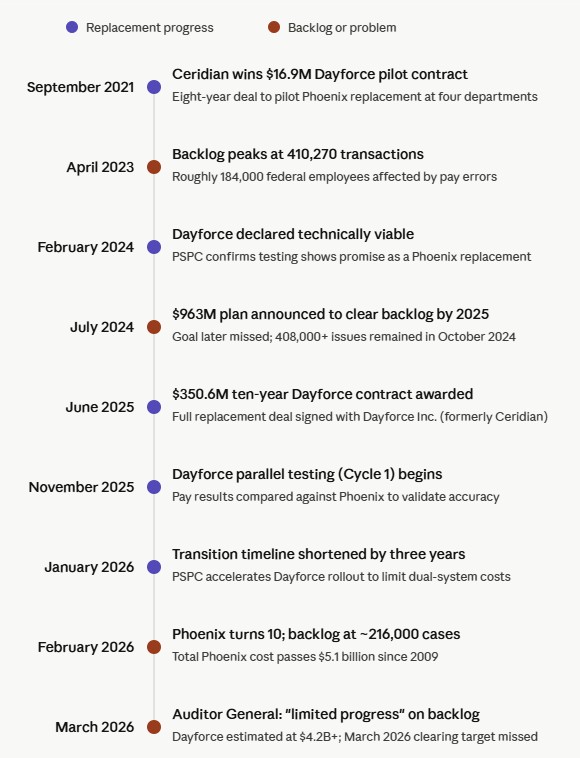
The backlog has been the more visible problem. As at Sept. 30, 2025, the total backlog for departments and agencies serviced by the Public Service Pay Centre stood at over 233,000 pay transactions, impacting over 133,000 employees, with the number standing at 216,000 transactions as of February 2026.
The most recent shock came from the auditor general in March 2026: the report said the government earlier this year shortened the timeline for bringing departments and agencies under Dayforce by about three years, in part to mitigate the complexities and costs of operating two pay systems at the same time, but Public Services and Procurement Canada's preliminary estimate for the new HR and pay system, Dayforce, will cost more than $4.2 billion — and that estimate did not include important costs needed for all departments and agencies to transition.



