Despite provincial strategies to improve healthcare, report shows Canadians 'waiting too long to receive treatment'

Canadian patients are still facing months‑long delays for medically necessary care, with direct implications for employers and HR leaders managing absence, disability and benefit costs, according to a new Fraser Institute study.
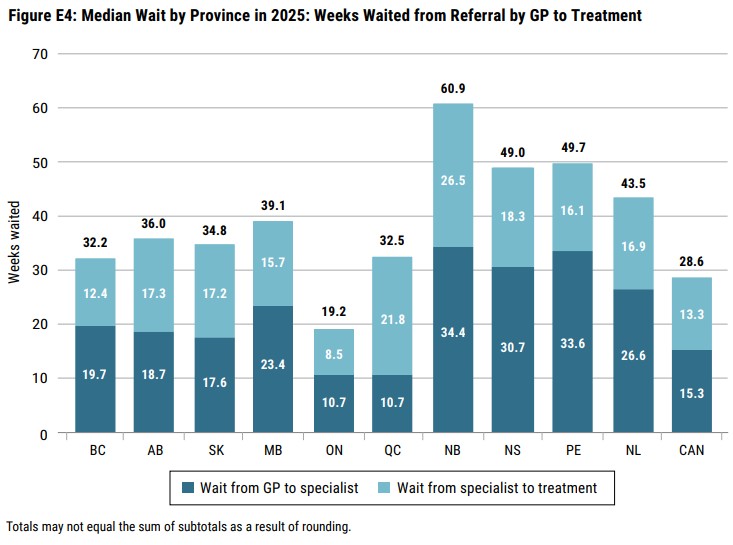
The median wait between referral from a general practitioner (GP) and receipt of treatment is 28.6 weeks, down from 30.0 weeks in 2024.
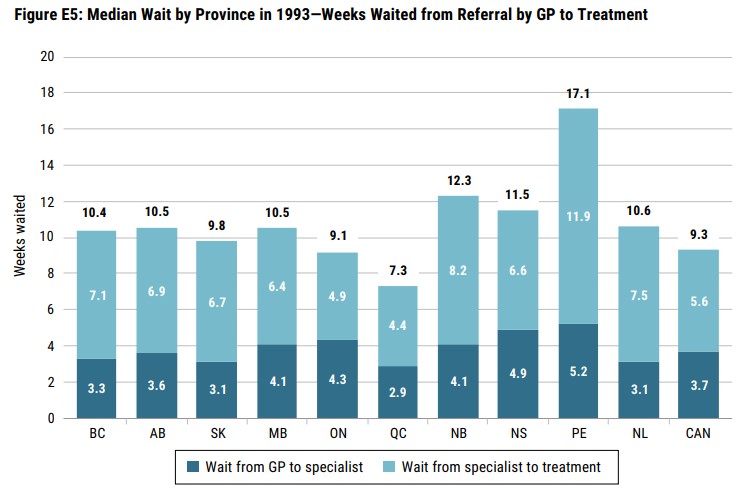
However, the 2025 data are still “208 per cent longer than the 9.3 week wait Canadian patients could expect in 1993.”
The 2025 figure “marks the second highest overall wait time in the survey’s history,” despite the modest year‑over‑year improvement, note authors Mackenzie Moir and Nadeem Esmail in the report.
Previous Fraser Institute work cited in the report found that waiting longer than medically recommended for certain surgeries and MRI scans carried a “cumulative total lost economic output” of $14.8 billion in 2007. More recent analysis by the institute estimated the cost of waiting per patient in Canada to be roughly $3,364 in 2024 “if only hours during the normal working week were considered ‘lost’,” and as much as $10,266 “if all hours of the week (excluding eight hours of sleep per night) were considered ‘lost’.”
According to the report, “despite provincial strategies to reduce wait times and high levels of expenditure on health care, it is clear that patients in Canada are waiting too long to receive treatment.”
Over a third (36 per cent) of all Canadians who sought an initial specialist appointment in 2024 waited three months or more, according to a previous report from Statistics Canada.
Wait times differences, bottlenecks
The wait from GP referral to consultation with a specialist increased to 15.3 weeks in 2025, up from 15.0 weeks the previous year, according to the Fraser Institute report. That first segment, the report notes, “is 313 per cent longer than in 1993, when it was 3.7 weeks.”
The second segment, from specialist consultation to treatment, shortened to 13.3 weeks from 15.0 weeks, but remains “138 per cent longer than in 1993 when it was 5.6 weeks.”
Crucially for employers, the authors say that “after seeing a specialist, Canadian patients waited 4.5 weeks longer than what physicians consider to be clinically reasonable (8.8 weeks).” Across all specialties and provinces, the study finds that actual specialist‑to‑treatment waits exceed what doctors deem reasonable in 74 per cent of cases.
Wait times vary sharply across provinces. Ontario posted the shortest total wait at 19.2 weeks, followed by British Columbia at 32.2 weeks and Quebec at 32.5 weeks. At the other end of the spectrum, New Brunswick recorded 60.9 weeks, Prince Edward Island 49.7 weeks and Nova Scotia 49.0 weeks. National employers with staff across multiple jurisdictions therefore face very different absence and accommodation profiles depending on where their employees live.
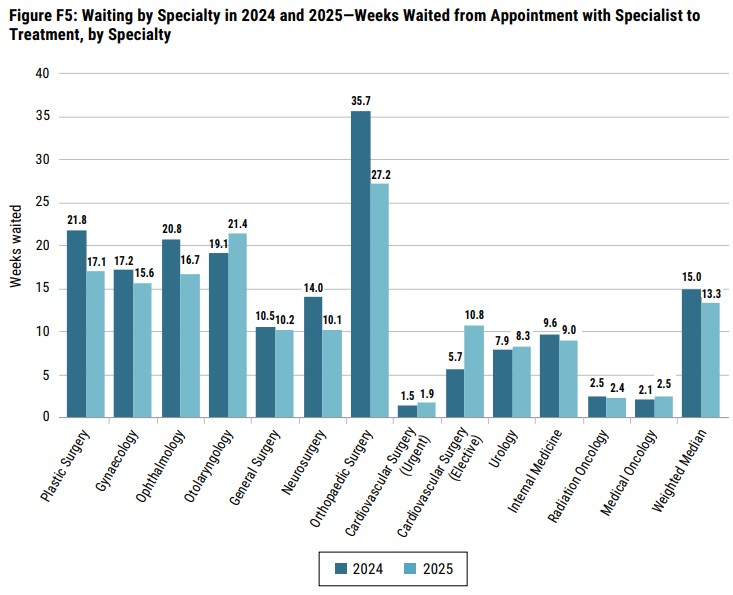
By specialty, radiation oncology and medical oncology show the best access, with total waits of 4.2 and 4.7 weeks respectively. In contrast, the Fraser Institute reports that “patients waited the longest for Neurosurgery (49.9 weeks) and Orthopaedic Surgery (48.6 weeks),” while otolaryngology (ear, nose and throat) recorded a 43.8‑week median.
The report highlights that for orthopaedic surgery, “the actual waiting time is 13.6 weeks longer than what is considered to be ‘reasonable’ by specialists,” underscoring the potential length of musculoskeletal‑ and spinal‑related absences.
Diagnostic bottlenecks also remain serious. National median waits are 8.8 weeks for CT scans, 18.1 weeks for MRI scans and 5.4 weeks for ultrasound, compared with 8.1, 16.2 and 5.2 weeks in 2024. Provincial figures range widely: Ontario patients wait a median 6.0 weeks for a CT scan and 12.0 weeks for an MRI, while in Prince Edward Island the MRI wait hits 52.0 weeks and the CT wait 12.0 weeks. Delays in imaging can keep employees in diagnostic limbo, prolonging modified duties and disability claims.
Reducing wait times in Ontario
Recently, the Ontario government announced it is investing $125 million over two years to add four new community surgical and diagnostic centres licensed to deliver orthopaedic surgeries across the province.
This expansion will reduce wait times and support up to 20,000 additional publicly funded orthopaedic surgeries as part of the government’s plan to protect Ontario’s health‑care system, according to the provincial government.
“Our government is leading the country with continued investments that have resulted in the shortest surgical wait times of any province, as we continue taking bold action to help more Ontarians live fuller, more active lives,” says Sylvia Jones, Deputy Premier and Minister of Health. “By expanding orthopaedic surgery capacity across Ontario, we are redoubling our efforts to reduce wait times and get more people access to life‑changing procedures sooner, helping them regain mobility, reduce pain and return to the activities they love.”
According to the provincial government, the new community surgical and diagnostic centres build on the progress the Ontario government has made since the launch of Your Health: A Plan for Connected and Convenient Care, including:
- Achieving the shortest surgical wait times for key procedures of any province in Canada in 2024, with over 83 per cent of people receiving their procedure within clinically recommended target times.
- Funding up to 65,568 MRI and 31,220 CT operating hours in existing community surgical and diagnostic centres over the past year.
- Adding 50 new MRI machines in 43 hospitals across the province to increase MRI capacity and services.
- Adding four new licensed cataract centres to provide more publicly funded cataract and other eye surgeries. In the past year, the government has funded 40,000 eye surgery procedures at community surgical and diagnostic centres.
- Eliminating the backlog of cervical cancer screening tests at the end of August 2023. Testing turnaround times returned to the pre‑pandemic standard of 10 to 14 days.