
Tim Hortons in political crosshairs following cut to employee benefits, perks
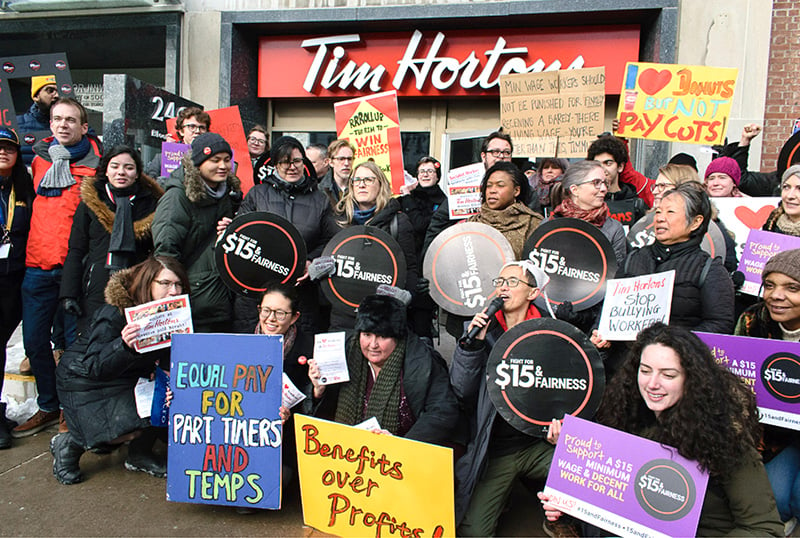
Many cries of “Happy New Year!” in Ontario turned into chants railing against the country’s iconic coffee chain following Tim Hortons’ response to a legislated 21 per cent rise in minimum wage in the province.
On Jan. 1, the rate jumped from $11.40 to $14 per hour — the highest in Canada — as part of a climb to $15 per hour by 2019. In response, some Tim Hortons franchisees cut paid breaks and restructured medical benefits in an effort to reduce the financial impact.
This led to a public dispute between Premier Kathleen Wynne and children of the chain’s co-founder, with Ontario’s top politician accusing the franchisees of bullying. The province then announced it would be hiring 175 employment standards officers to ensure businesses are abiding by the new regulations.
Labour organizations went on to stage rallies at various Tim Hortons coffee shops across the province, while a social media campaign urged customers to boycott the coffee chain with a #NoTimmiesTuesday.
Further west, Alberta is also preparing for a bump in base pay, from $13.60 to $15 on Oct. 1, 2018, while the majority of the country’s provincial minimum wage rates remain in the $11 range.
New realities for employers
Employers have been overwhelmed by the amount of regulatory change being ushered through Queen’s Park in Toronto, said Ryan Mallough, senior policy analyst at the Canadian Federation of Independent Business (CFIB) in Toronto.
“The timeline plays a huge role in it, both the minimum wage part, as well as all the new employment standards compliance parts,” he said. “For us, calls (for assistance) have tripled over what they normally are at this time of year.”
More than half of Canadian private sector businesses have slashed hiring plans or raised prices, while some have delayed expansion plans, cut back hours or reduced employee benefits, according to a CFIB survey of 3,086 businesses in December.
“(The minimum wage hike) is an election goodie that’s being paid for by your local hairdresser and dry cleaner and grocer,” said Mallough. “What’s being realized is that these people can’t afford to pay for it. They have to make adjustments. And that’s what’s happening.”
There’s also a “culture of fear” being promoted by Wynne and Labour Minister Kevin Flynn, said Mallough, pointing to a minimum wage bully hotline set up by the Ottawa and District Labour Council’s to name and shame businesses that cut benefits in response to the wage hike.
“These decisions are being made across the province,” he said. “If the premier is picking a fight with anyone, it’s Main Street.”
Options for employers
Changes to compensation are never easy, but options do exist for organizations expecting blows to the bottom line, according to Christie Ferguson, a human resources consultant at 1 Stop HR in Ayr, Ont.
“My advice wouldn’t be blanket across the board,” she said. “It depends on the industry, because sometimes the industry is able to be more creative than others and clamp down on different things in order to save some money without there being as much of an impact on the recruiting side or the retention side. We have some employers who are doing layoffs, or raising their prices, or looking at reducing management numbers, so that they reduce a higher salary.”
Additional choices could include salary freezes, clamping down on overtime — for example, only permitting it if preapproved — contracting out services such as human resources, altering health benefit frameworks, or reducing workplace perks such as team-building, RRSP contributions or top-ups, said Ferguson.
“Those are things you can look at. If you’ve got all kinds of opportunity to recruit employees… then it’s a risk you may be willing to take,” she said. “But it’s a double-edged sword, where all of a sudden you get into employee morale issues… it goes all against the advice that us in the HR world are really advising our clients to do, and what we’ve been advising forever.”
Consideration of long-term impact is critical, said Ferguson, as each decision on compensation is sure to send waves through the organization.
“We’re saying to our clients: ‘All of your policies and practices need to be reviewed, and really think everything through before you make a change,’” she said. “‘Brainstorm. Think outside of the box long-term as well as short-term. Don’t act too quickly if you don’t have to... Really take your time as much as you can. Get some professional advice where need be.’”
With retention in mind, employers may want to award wage increases to valued employers earlier, said Ferguson.
“If you look at the fact that it may be more difficult to replace those roles, then people are making that decision to increase a bit,” she said.
Wage compression experienced by those making slightly higher than minimum wage is part of the ripple effect employers face in these situations, as those workers may also require a pay raise, said Janet Salopek, president of Salopek and Associates, an HR consultancy in Calgary.
“We need to have a spread, in order to be fair and equitable, between the employee level and the next level up,” she said. “It has that cascading effect… It also has a huge impact on your overtime — it’s not just that hourly rate.”
HR practitioners at small or medium-sized businesses need to encourage calm, strategic decisions on this issue, said Salopek.
“There’s not a golden nugget,” she said. “Think it through, pause, take time and do your homework. Check with your peers within the sector that you’re in… take your time to look at some alternatives and to plan. Think about the long-term impact that you’re going to make, relative to the changes that you have to do because of the increase.”
“Don’t just look at your labour costs. Look at your whole business costs. Uncover every rock to look for potential savings.”
And if a reduction to employee benefits or perks remains the most effective option, “communicate, communicate, communicate,” said Salopek.
“If you have to make changes, take time to engage, and talk to your staff. Give them lots of notice,” she said.
“Engage your employees in what’s important to them and what’s not. If you’re going to make cuts to your benefits, try to understand if there are aspects of your benefits that maybe your people aren’t using, then cut there first... It doesn’t need to be complex.”
Social media, legal risks
Transparency and open communication can significantly aid an employer making alterations to pay grades, said Salopek. These are also a necessity in an age where social media allows individuals a platform to share workplace concerns.
“Be transparent and fair when considering reducing labour costs, because it’s the right thing to do, and all it takes is somebody to go on Facebook or do a tweet and it has such a negative impact on your value proposition, on your branding,” she said.
Not only could future recruitment prospects dampen as a result, but litigation or employee unionization could also result if changes to compensation are too significant, said Salopek.
“If you cut an employee’s compensation… if you significantly reduce the compensation package, you could face an allegation of constructively dismissing that employee,” she said.
All decisions on wages, benefits, bonuses, or reductions in hourly pay should be passed by a legal team prior to implementation, said Salopek.



