Government's push for pay transparency includes annual gender pay reporting

Back in May, the British Columbia government released its second annual Pay Transparency Report, showing “modest improvements” to the gender pay gap in the province.
The biggest improvements since 2023 were noted in three sectors: agriculture, forestry, fishing and hunting (from a gap of 45% down to 36%); mining, quarrying and oil-and-gas extraction (24% to 17%); and wholesale trade (18% to 11%.)
The findings are part of the government’s push to significantly reduce the gender pay gap – and the next step takes effect on Nov. 1, 2025 when employers with 300 or more employees in B.C. are required to prepare and post reports about their gender pay gaps.
The requirement has been introduced in stages to give employers time to prepare, with the first deadline of Nov. 1, 2024 for employers with 1,000 employees in B.C. or more, and the third on Nov. 1, 2026 for all employers with 50 employees in B.C. or more.
Gender classification by employees
One of the more important areas of the reporting is the collection of gender information from employees. In doing so, employers must make “reasonable efforts” to attain the information and notify employees that the collection is for the purpose of preparing a pay transparency report.
Employees can voluntarily provide gender information but if they choose not to do so, their pay information will still be used in the report and their gender will be marked as “unknown” or “prefer not to say.”
For the most part, employers are sending out an email or quiz clearly stating the purpose of the collection, to comply with the Pay Transparency Act, and are being clear that it's voluntary, says Katy Allen, partner at Osler in Vancouver.
“Then you'll be set up for success to make sure employees understand that it's entirely voluntary and why they're being asked.”
Sam Tecle, associate at Gowling in Vancouver, also emphasizes that the employer must make it clear the survey is voluntary.
“You might have some employees that provide the number of hours or how much they've earned or their overtime but don't disclose their gender. And then you'll have some who just don't participate at all, so there's some nuance there as to the degree of participation by an employee if they still choose,” he says.
“It's obviously each employee's prerogative to participate, but certainly the more participants, the better data we can get from each employer. So maybe, over time, employees will feel more comfortable providing that information without any concern about their pay or how they identify, etc. and the personal information being disclosed.”
Reporting info: salary, bonus, overtime
As part of the pay gap report, employers are required to submit information about hours worked, overtime hours and pay, bonus pay and “ordinary pay” or salary.
The latter is defined as money paid for hours worked before deductions and includes: paid leaves such as vacation when the employee is paid at 100% of their salary; premiums that are not overtime pay or an allowance; overtime that can be banked and taken as time off; and statutory holiday pay.
Ordinary pay does not include employee benefits, reimbursement for employment-related expenses, severance pay or termination pay, vacation payouts when not taken as leave or allowances for accommodation, transportation and meals.
The definition is very particular and employers should carefully review the government’s Guidance for preparing pay transparency reports, says Allen.
“Broadly speaking, it is meant to capture an employee’s base pay. There are nuances though. For example, vacation pay counts as ‘ordinary pay’ if it is paid during a time the employee is taking time off work, but does not count as ‘ordinary pay’ if paid out as a lump sum not in conjunction with vacation time.”
As for “special salary,” the BC government guidance contemplates a concept that is not contained in the Act or its regulations, she says.
“The guidance states that special salary is intended for rare situations where an employee is paid a lump sum and determining the hours worked is challenging. In such cases, employers can estimate the hours worked to determine an estimated hourly rate for reporting the employee’s pay. It is a rare and specific reporting method, not a pay category defined by the Act.”
Overall, there will likely be some growing pains, says Allen, "as employers refine their systems to adjust to these requirements, to ensure the proper data is being collected and reported.”
Calculating the gender pay gap
Gender pay gaps must be calculated by the employer submitting the report and covering: mean and median hourly rates of pay; mean and median overtime pay; mean and median number of overtime hours; and mean and media bonus pay.
For example, the gap for the mean hourly rate of pay of employees should be determined by:
- calculating the hourly rate of pay for each employee
- for each gender category, adding the hourly rate of pay for each employee in the gender category and dividing the total by the number of employees in that gender category
- for each gender category other than the reference category, subtracting the amount determined under (b) from the amount determined under (b) for the reference category
- dividing each amount determined under (c) by the amount determined under (b) for the reference category
- multiplying each amount determined under (d) by 100 and rounding the result to the nearest whole number, which whole number is the difference, expressed as a percentage, between the mean hourly rate of pay of employees in the reference category and the mean hourly rate of pay of employees in the other gender category.
Given the work involved, Tecle recommends employers don’t wait to get started.
“The reporting requirement, in my view, isn't going anywhere anytime soon, if anything… more and more employers will need to comply. So, as good practice, I often recommend that employers start early because compiling this data should happen annually, but also every time a new employee is onboarding or is hired.”
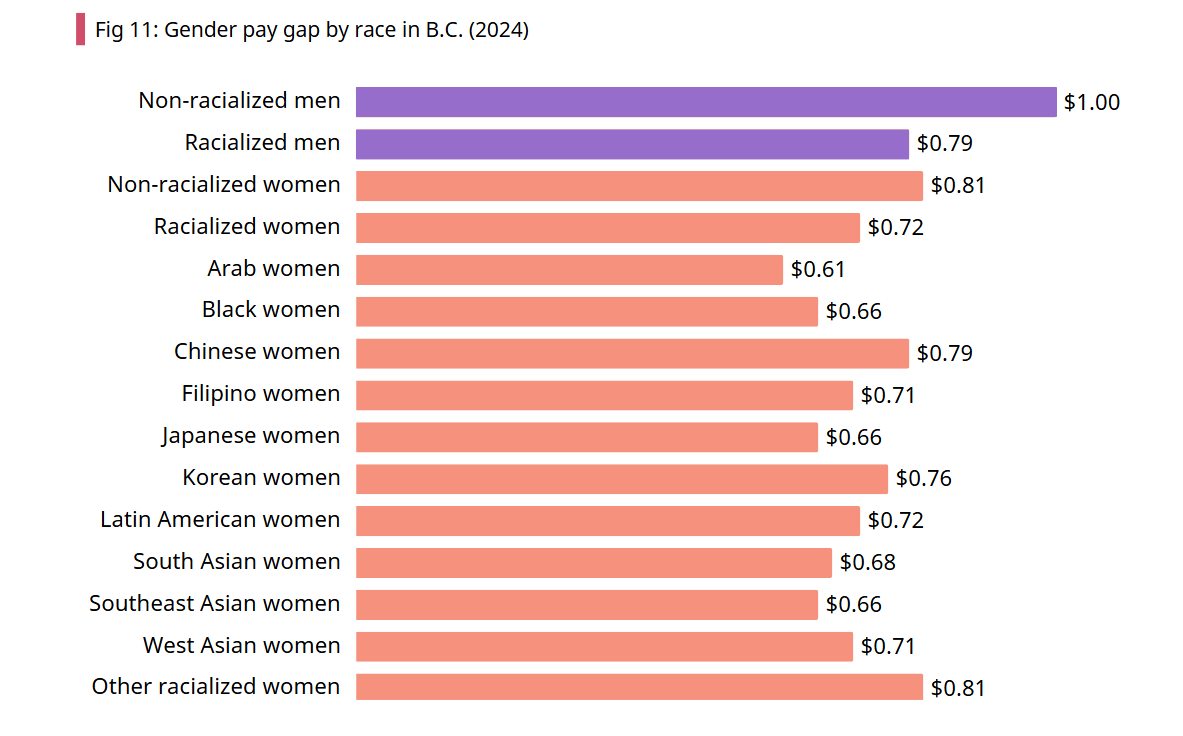
Source: B.C. government
With the ongoing requirement to update the pool of employees who will see a survey, “if an employer starts early, then it makes consolidating the information they get much easier,” he says.
Certain employers will have to identify a team or person to keep an eye on this area, he says, adding there’s probably “wiggle room” when it comes to the time period reported by employers, as data could become inaccurate with staff changes.
“Over time, we'll be able to look back and see how employers have done. But to put too many stringent requirements, I think, would be difficult.”
Employer reports on gender pay gap
Given this is the third time round, many employers have had time to anticipate the new rules, run the numbers and update their systems to comply, says Allen.
“The struggle on the employer side will be capturing all that information. I don't think every payroll system is perfectly set up to capture what those categories are aiming to capture,” she says. “So, I think there will be a bit of an adjustment period and I'm hopeful that the payroll providers will learn and help employers collect that information in a way that's easy to find when it's time to create the report.”
If anything, B.C. employers have the benefit of seeing reports that were published for the first deadline, says Tecle.
And it’s been interesting to see some employers “have gone above and beyond” to provide context behind their numbers while the legislation has only required minimums in providing the data, he says.
“Some employers are saying, ‘Well, we want to provide some context to this, and this is speaking to pay disparities, but we do pay fairly based on people in the same role to distinguish between say fair pay and pay disparities… across a range of different positions.’”
Lululemon, for example, said in its report for 2023 that the company has achieved 100% gender pay equity as a global organization, meaning employees are paid equally for equal work, regardless of gender. However, it said the B.C. Pay Transparency report uses a different methodology that focuses on the average difference in pay across gender groups, regardless of the job they are in.
“Pay gap methodology does not account for critical factors that provide a more holistic illustration of pay, such as employee performance, job type, tenure, and more,” said the company. “These factors are fundamental to lululemon’s pay philosophy and frameworks as well as in determining equal pay for equal work.”
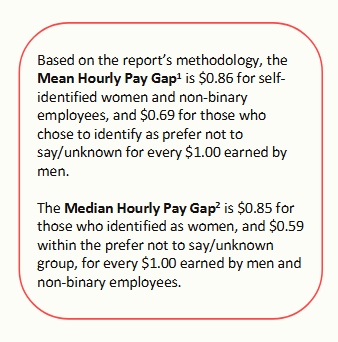
Source: lululemon
Similarly, BC Hydro explained the context behind its gender pay gaps: “Men and women at BC Hydro are paid equally for doing the same jobs. However, women are underrepresented in higher-paying technical jobs, such as engineering and skilled trades, resulting in an overall average pay difference between men and women.”
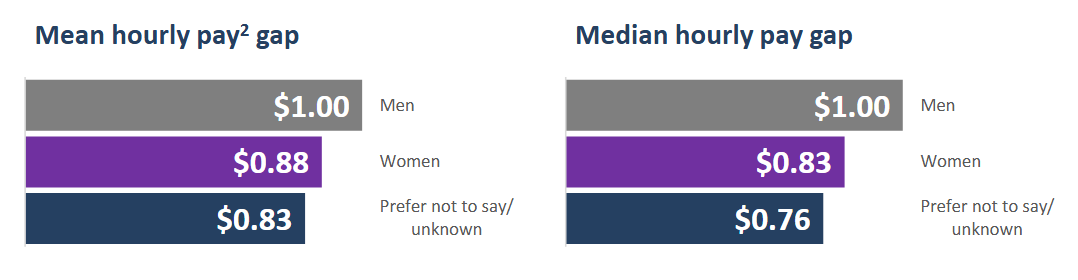
Source: BC Hydro
The next question, of course, is what employers will do to try to balance those numbers out, says Tecle.
Risks of disclosing gender pay gap
Employers will need to be prepared to address whatever their report reveals, says Allen.
“We know there is a gender pay gap. Most employers will see that in their metrics. And having a strong message around why that might be in that particular workplace, or what the employer is going to do about it, I think, will be key in ensuring that candidates are still coming to that company and wanting to help really solve the problem.”
It will be difficult to track whether job candidates will be influenced by the publishing of gender pay gaps on company sites, she admits.
“But I do believe that – especially young people – will be interested in... if they're looking for a company to spend their career at – this sort of metric,” she says.
“I also expect that unions will be looking at these reports closely and thinking about how to utilize them either to organize workplaces or bring it up during collective bargaining.”
Currently, there are no penalties or enforcement measures for not reporting in the Pay Transparency Act other than non-compliant employers may be posted in the government’s annual report, says Allen.
“In employment law litigation, I would expect that if there's some sort of contravention of the Act, employee-side counsel will be using that to claim things like aggravated and/or punitive damages.
“So, for instance, if someone is dismissed in retaliation for raising a pay issue, the fact that that's now offside this legislation will add to those sorts of claims.”
Overall pay transparency in B.C.
The most significant aspect of the Pay Transparency Act has been posting salary ranges on job postings, she says.
“I think that's made a very real impact in the market. And, of course, that is aimed at allowing candidates to be more competitive and hopefully assisting candidates who might otherwise be disadvantaged in the market.”
Overall, B.C. has four main approaches when it comes to combatting systemic discrimination, says Tecle, citing the requirement to include salary and wage information on all publicly posted jobs, not allowing employers to ask about pay history in interviews, a prohibition on reprisals, and the gender pay gap reporting.
And since many employees care more and more about an inclusive workplace, HR should anticipate more employee questions, he says.
“[It’s about] awareness, transparency, but also accountability.”