
Audit places majority of blame on government department
A year and a half after the federal government launched its Phoenix pay system, more than 150,000 civil servants paid through its pay centre had outstanding pay issues amounting to half a billion dollars, a new report finds.
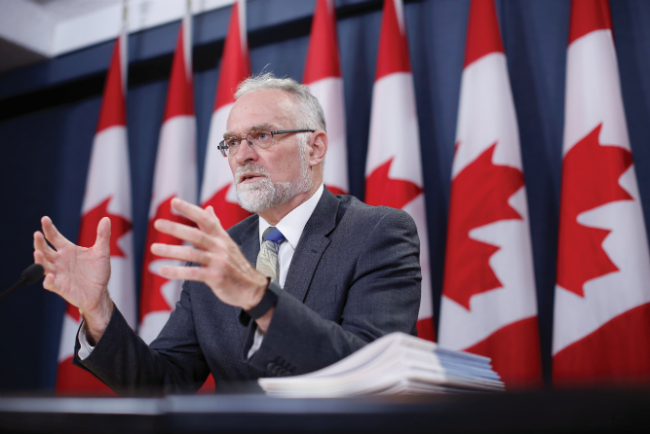
It stems from an audit of the troubled Phoenix pay system that Canada’s auditor general Michael Ferguson carried out last year.
The report places most of the responsibility for the problems on Public Services and Procurement Canada (PSPC), the department responsible for administering the government’s payroll.
“PSPC did not identify and resolve pay problems in a sustainable way to ensure that public service employees consistently receive their correct pay, on time,” it said. “Departments and agencies contributed to the problems; however, PSPC did not provide them with all the information and support to allow them to resolve pay problems to ensure that their employees consistently receive their correct pay, on time.”
The federal government has been struggling with Phoenix since it began rolling it out in 2016. Thousands of workers have been overpaid, underpaid or not paid at all. Phoenix was part of the government’s Transformation of Pay Administration Initiative, which also saw it centralize payroll services for 46 of its 101 departments at its pay centre in Miramichi, N.B.
The audit looked at whether 12 selected departments and agencies effectively resolved pay issues between Feb. 24, 2016 and June 30, 2017.
By the end of the audit period, the report said there were 152,517 employees with 494,534 pay requests, representing $520 million in outstanding pay. The numbers only include employees whose pay is processed through Miramichi since there was no information available for employees paid through other departments and agencies.
The audit also found that the number of payroll errors went up during the 2016-17 fiscal year.
“We calculated that about 51 per cent of employees had errors in their paycheques issued on 19 April 2017, compared with 30 per cent in the pay issued on 20 April 2016,” the report said. “We found that PSPC was not tracking errors in pay and did not know how many outstanding pay requests were pay errors that needed to be corrected.”
The audit found that employees had to wait an average of more than three months for pay requests to be processed, with almost 49,000 workers waiting more than a year.
“Two-thirds of these employees had a pay request that PSPC deemed to have a high financial impact, which it defined as over $100,” said the report.
Certain types of requests were particularly problematic, including those for workers on leave, those who were promoted or transferred to a different department, and summer students.
Back pay from collective agreements also proved challenging. Last April, when PSPC began processing back pay from the retroactive signing of new collective agreements, the report said it had to deal with pay increases going as far back as four years.
“Almost 40 per cent of the pay increases could not be processed automatically in Phoenix and had to be processed manually by the Miramichi Pay Centre,” the report said.
It attributed pay problems to a number of issues, including differences between the way Phoenix operated and the way in which departments and agencies processed pay.
“Phoenix was designed to process pay details entered in real time. However, departments and agencies were processing a significant number of their pay requests retroactively. This contributed significantly to the rising number of outstanding pay requests,” said the report.
This was particularly the case for acting pay, which is paid to employees temporarily filling the job of a superior. The audit found that about one in four outstanding pay requests were for acting pay.
PSPC reports showed that, even after the implementation of an automatic process for retroactive pay requests, 40 per cent of them still required some manual processing because of the large number of possible acting pay scenarios. Phoenix also experienced problems when certain types of data were entered while it was calculating pay. To address this, PSPC restricted access to Phoenix during those times.
“Therefore, pay advisors could not access parts of Phoenix for about five working days out of every pay cycle of 10 working days. Although PSPC put in place a manual workaround, we found that this caused additional problems,” the report said.
Another issue was that Phoenix was not designed to automatically process complex shift-work rules for a number of different types of employees, such as correctional officers, nurses, and coast guard crews. They make up close to 10 per cent of federal workers.
“As a result, departments with employees subject to those rules found that processing those employees’ pay was cumbersome and prone to error. This required extensive manual and customized processes outside Phoenix to get those employees paid accurately and on time,” the report said.
The report said PSPC did not always give departments and agencies enough time to review paycheques before issuing them or provide them with timely and accurate information to help employees resolve payroll problems.
It also said departments and agencies often had difficulty meeting Phoenix’s processing deadlines. For instance, although Phoenix was designed to receive information about new hires on the day they began working, departments and agencies continued to submit pay requests later than that.
“PSPC did an analysis in early 2017 and found that these requests were submitted on average eight to 10 days after the employee started work,” the report said.
The audit also found that PSPC did not fully understand the extent of the problems or what was causing them and initially attributed issues to employees, managers and pay advisors not understanding how and when to enter information into Phoenix.
“PSPC identified, tracked, and devoted significant effort to resolving pay problems. However, it has not fully addressed the underlying causes of pay problems or developed a long-term sustainable solution,” the report said. “Without a full understanding of the causes of pay problems, PSPC cannot work with departments and agencies to resolve pay problems and achieve the efficiencies expected to result from the Transformation of Pay Administration Initiative.”
The audit also found that pay problems had a negative effect on the government’s payroll staff.
“They wanted to deliver good service and process pay on time. However, the lack of complete and accurate procedures, the number of outstanding pay requests, and an inability to predict how Phoenix would process pay requests meant that the pay advisors could not deliver a level of service of which they could be proud,” the report said. “This meant that they could not keep up with the problems and felt extensive fatigue, stress, and low morale.”
Fixing the problems could be costly and take a long time.
The report said that while the government expects to spend $540 million over three years to resolve the issues, a similar situation at an Australian government department cost C$1.2 billion over eight years to fix and issues are still arising.
The audit put forward six recommendations, including the need for the government to resolve outstanding pay requests as soon as possible and to regularly report on its progress.
It also recommended that the government carry out an in-depth analysis of what caused the pay problems and develop a sustainable solution to fix it.
Further, it said PSPC should provide departments and agencies with more timely information to help them assess pay problems and should give them “sufficient, reliable, and timely access to the pay system” to process requests and verify data.
Additionally, PSPC is advised to establish timelines for departments and agencies to submit accurate pay information and develop performance measures to track and report on the accuracy and timeliness of pay.
PSPC was also advised to track and report on the costs to fix the problems and implement a sustainable solution.
In response, PSPC indicated it is developing a new HR-to-Pay Integrated Plan alongside cost estimates for fixing the current problems with hopes of implementing a solution by May’s end.



