
‘These findings highlight retention issues for skilled immigrants’

The number of Canadians moving permanently to the United States has declined significantly over the past decade, according to a report from Statistics Canada (StatCan).
The average number of Canadian-born individuals granted U.S. permanent residency fell by 30 per cent from the late 2000s to the late 2010s, dropping from 15,600 to 10,900 annually.
Levels in 2022 and 2023 remained essentially unchanged from 2019, the year before the COVID-19 pandemic.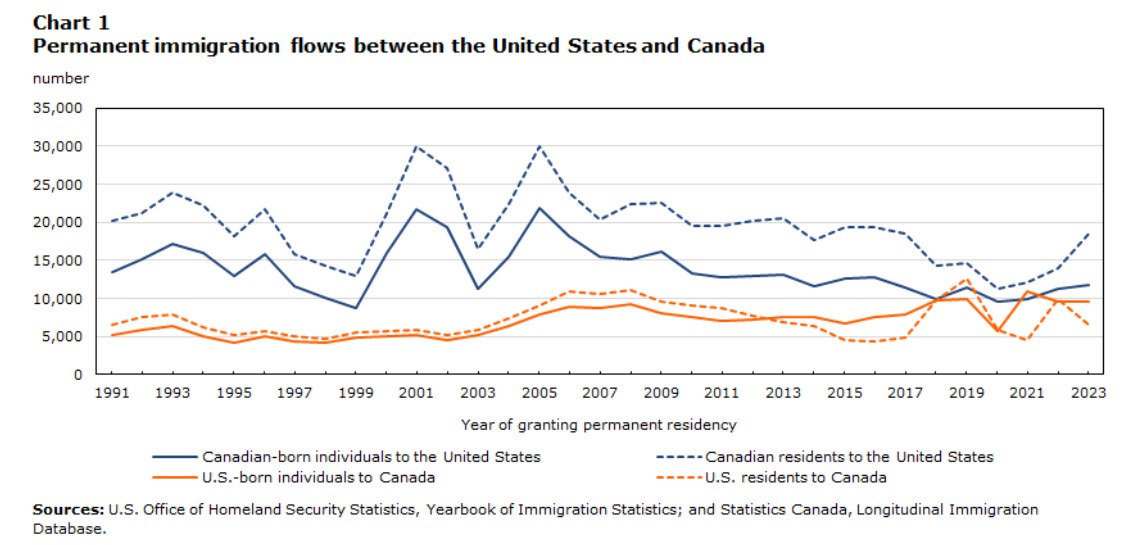
A significant number of Canadians who had considered relocating to the U.S. are now re-evaluating their plans, according to a previous report.
Permanent residents migrating to Canada
Approximately 30 per cent of permanent residents migrating from Canada to the U.S. were not born in Canada, according to StatCan’s study.
“Based on 2016 Canadian census population estimates and the number of permanent residents moving to the United States in that year, the rate of emigration to the United States was 4.8 per 10,000 for the Canadian-born population, compared with 8.2 per 10,000 for the foreign-born population,” say experts Feng Hou, with the Economic and Social Analysis and Modelling Division, Analytical Studies and Modelling Branch at StatCan; Milly Yang, with the Department of Sociology at Yale University; and Yao Lu, with the Department of Sociology at Columbia University.
While permanent migration from Canada to the U.S. has declined, the report notes that foreign-born Canadian residents are more likely than Canadian-born individuals to become U.S. permanent residents. In 2016. The emigration rate to the U.S. was 4.8 per 10,000 for Canadian-born individuals, compared to 8.2 per 10,000 for the foreign-born population.
This pattern reflects “second-step migration,” where immigrants first settle in Canada and later move to the United States.
Education levels of workers
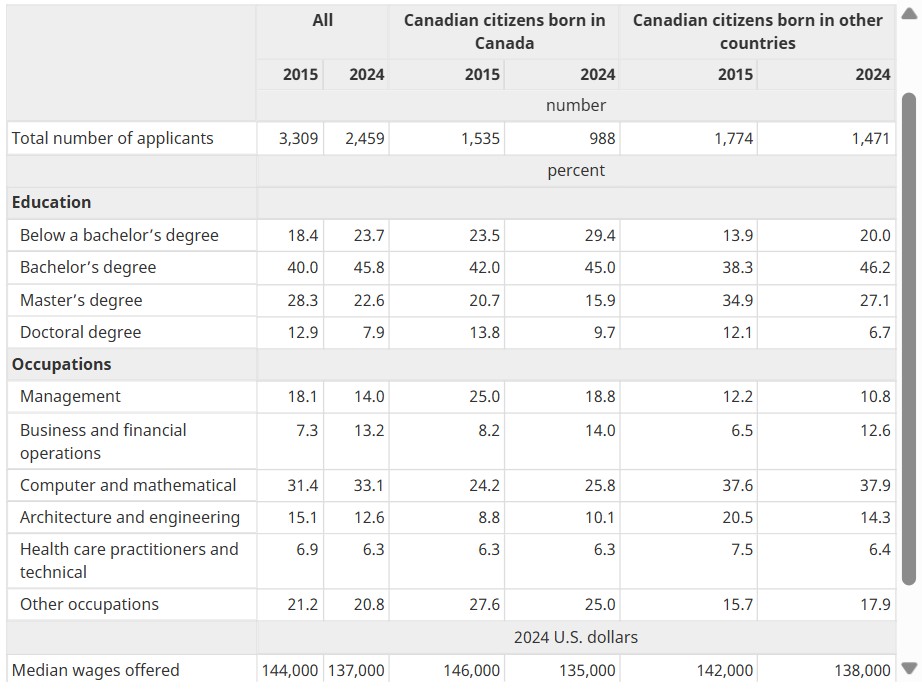
Also, while Canadian workers moving to the U.S. remain highly educated, the proportion holding a master’s or doctoral degree dropped from 41 per cent to 31 per cent between 1991 and 2023.
Nearly half of Canadian applicants were concentrated in computer, mathematical, architecture, and engineering occupations, with foreign-born Canadians more likely to work in these fields. The median wage offer for these positions remained high, at $137,000 (U.S.) in 2024, though slightly lower than a decade earlier.
From U.S. to Canada
In contrast, the number of U.S.-born immigrants moving to Canada has increased in recent years. Since 2018, the flows of permanent residents between the two countries have become largely balanced, with some years seeing more U.S.-born residents moving to Canada than Canadians moving to the U.S. This shift was temporarily disrupted by the COVID-19 pandemic, but the overall trend points to a narrowing gap in migration flows.
While there has been a surge in the number of temporary foreign workers coming to Canada in recent years, the number arriving from the U.S. has been declining over the past decade, StatCan previously noted.
“The continued movement of highly skilled Canadians—both Canadian-born and foreign-born—into the U.S. labour market has important implications for both countries. For Canada, these findings highlight retention issues for skilled immigrants,” say the experts in the StatCan report.
“In the United States, the influx of highly skilled Canadian workers continues to bolster key sectors, but the overall decline in Canadian immigration suggests tightening competition for global talent.”
The number of Canadians open to relocating within the country for employment has risen slightly over the past three years, but remains relatively low, StatCan previously reported.



