
Why are global employees increasingly resistant to relocations?
Demographic shifts of unprecedented proportions are underway in many of the world’s developed nations. At the same time, rapid advances in technology are creating new demands for talent and disrupting many workplaces. Combined, these complex forces are making it increasingly difficult for companies to manage and set strategy.
Shortages of skilled workers are impacting economic growth and business expansion around the globe.
The supply of highly skilled workers is not growing fast enough to meet the increasing demand, and access to key talent is a priority for many of today’s CEOs — 77 per cent of global executives worry that skills shortages could impair their company’s growth, according to a 2017 PricewaterhouseCoopers (PwC) report based on interviews with 379 leaders in 79 countries.
A large part of the solution to these challenges, and securing a supply of skilled labour, lies in greater mobility of the workforce and increased economic migration.
But there’s been a noticeable decline in the willingness of employees when it comes to making a move for work — even when attractive incentives are offered by the employer, according to the 2017 Global Mobility Survey, released by the Canadian Employee Relocation Council (CERC) in partnership with Ipsos Global Public Affairs.
About two in 10 (18 per cent) employees in 20 countries say they would be “very likely” to temporarily relocate for up to two years and take a full-time job in another country with a 10 per cent pay increase, found the survey of 10,091 employees in 20 countries.
By comparison, in 2012, one-quarter (25 per cent) of employees said they would be “very likely” to take a full-time job in another country.
Furthermore, 40 per cent of global employees agree there is nothing their employer can do to convince them to take an international assignment, compared to 35 per cent in 2012, found the survey.
Gauging interest
Globally, more than one-quarter (27 per cent) of employees are “somewhat likely” while just under one-quarter (23 per cent) are “not very likely” and three in 10 (31 per cent) are “not at all likely” to relocate.
Less than one-fifth (17 per cent) would be willing to relocate permanently in 2017. If there is a guarantee of a full-time job, the proportion indicating they are very likely to relocate increases to 28 per cent, but drops significantly if there is no such guarantee (seven per cent).
Among Canadian workers, 19 per cent (a similar proportion compared to 2012) are “very likely,” 23 per cent are “somewhat likely,” 19 per cent are “not very likely” and 39 per cent are “not at all likely” to relocate for employment — significantly more than in 2012 when only 26 per cent said they would be not at all likely to relocate.
Among those Canadians who indicated they are “likely” to move, potential barriers include family and friends (40 per cent), followed by location (10 per cent), money/financial stability/salary (nine per cent) and job security (eight per cent).
One of the most important incentives to an employee considering a move is the guaranteed option to return to their current role after two years (36 per cent), found the survey.
Among those who indicated they are “unlikely” to move, the top incentives that might make them consider the move are a pay increase (27 per cent) and the country of the relocation (six per cent).
But more than four in 10 (43 per cent) said nothing would make them consider relocation, found the survey.
However, global employees are less motivated than they were in 2012 to relocate by virtually all incentives.
Top barriers to an employee making the move include his concerns about the family and spousal employment.
The importance of government policy and relocation is also evident in the 2017 survey.
A majority of global employees, 82 per cent, said they would only move to a country that has high-quality health care, and 77 per cent would only move to a country that is welcoming to immigrants.
Both factors work in Canada’s favour in attracting talented global recruits.
United States holds top spot
More than one-third (37 per cent) of employees surveyed “strongly agree” that the location of the foreign work assignment is a major factor in their determining whether they want to relocate or stay put.
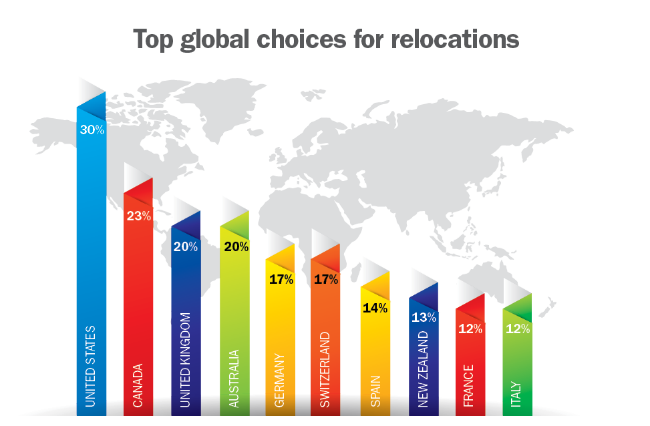
While the United States continues to remain the preferred choice for employees, down slightly from 2012, Canada moved up to second spot as a destination (up from fourth in 2012) and the United Kingdom and Australia rounded out the third and fourth spots respectively.
In Canada, employees are most likely to pick Australia (40 per cent), the United States (37 per cent) or the United Kingdom (30 per cent) as their preferred options for workplace relocation.
In an interesting twist, the number of employees in Mexico selecting the U.S. as one of their three choices declined heavily from one-half (52 per cent) in 2012 to just one-quarter (26 per cent) in 2017, found the recent survey.
Employee relocation will continue to be a key factor in developing an organization’s global leadership competency, fulfilling business needs and addressing talent shortages.
This survey points to the growing complexities of relocation and the needs of employees that must be considered by employers in properly managing employee mobility.
Stephen Cryne is president and CEO of the Canadian Employee Relocation Council (CERC), a not-for-profit organization in Toronto. For more information, visit www.cerc.ca.



