‘If your business depends on cheap labour to survive, you need a different business model,' says expert about Ontario company's court filings

Temporary foreign workers held as much as 83% of the jobs at a Tim Hortons in Ontario, according to court filings from a franchisee now in insolvency proceedings – well above the 10% limit Ottawa sets on low-wage foreign hiring at a single work location.
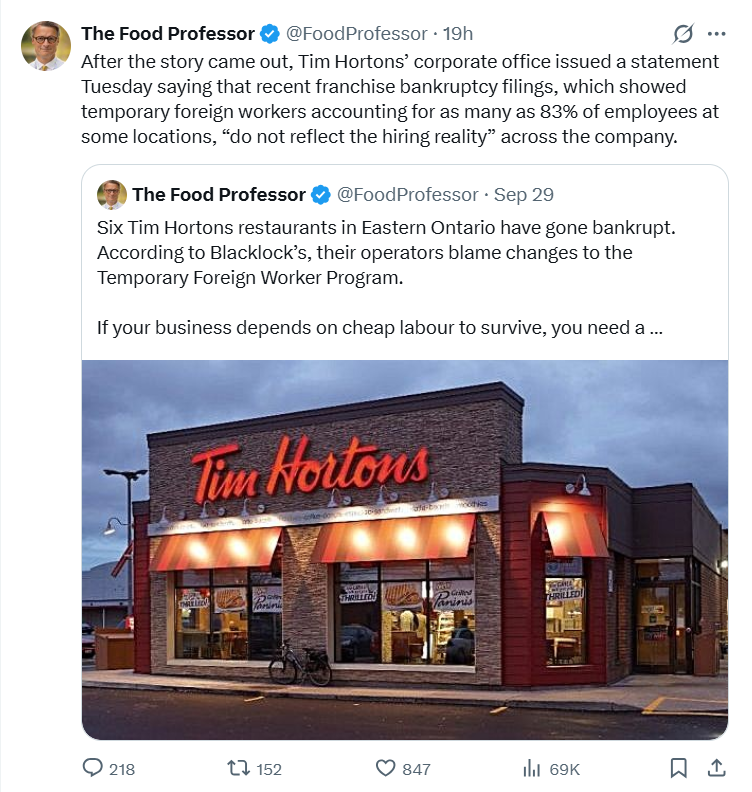
Six Tim Hortons restaurants in Eastern Ontario have gone bankrupt, with their operator — M.G.B. Ventures Inc.— telling the Ontario Superior Court of Justice that federal restrictions on the Temporary Foreign Worker Program (TFWP) had shrunk its foreign workforce, according to Juno News, citing Blacklock's Reporter.
"The government of Canada significantly restricted Temporary Foreign Worker programs," the company wrote. "As a result, the company employs a lower number of temporary foreign workers."
The affidavit lists 41 temporary foreign workers among 156 employees, according to Juno News. At Alexandria, 19 of 23 employees were foreign workers. In Dunvegan, the figure was 15 of 25.
The filings list debts of $1.6 million to the Canada Revenue Agency, $1 million to Scotiabank and $600,000 to the Business Development Bank of Canada. Justice Marc E. Smith granted the company a 45-day extension to file a proposal to creditors.
Tim Hortons faces criticism
Tim Hortons told the Toronto Sun the franchisee's figures are not typical of its restaurants.
“It is extremely rare to see this type of situation and it does not at all reflect the financial viability of the restaurants in question.”
Sylvain Charlebois, director of the Agri-Food Analytics Lab at Dalhousie University in Halifax, was blunt on X. "If your business depends on cheap labour to survive, you need a different business model."
Low-wage cap applies
Employment and Social Development Canada (ESDC) limits temporary foreign workers in low-wage positions to 10% of the workforce at a specific work location. Labour Market Impact Assessment (LMIA) applications that exceed the cap may not be processed. Sectors such as construction and hospitals have a 20% cap, but restaurants do not.
The figures alone do not establish a breach. The affidavit, as reported, does not say which permits the workers held or when their LMIAs were approved.
According to Immigration, Refugees and Citizenship Canada (IRCC), 90% of permits under the separate International Mobility Program were open work permits as of Dec. 31, 2025. Those permits allow holders to work for almost any employer without an LMIA.
Tightening of temporary foreign worker rules
The cap was cut to 10% from 20% in September 2024, under the federal limits announced for the TFW Program low-wage stream. An IRCC Deputy Minister transition binder updated Sept. 4, 2026, lists further changes:
- ESDC halved LMIA validity to six months.
- It cut the maximum low-wage work period to one year from two.
- It refuses to process low-wage LMIAs in census metropolitan areas with unemployment of 6% or higher.
Canadian HR Reporter detailed those measures in its report on Ottawa's further changes to the Temporary Foreign Worker Program.
IRCC data shows new worker arrivals fell 47% in 2025 compared with 2024. The 2026–2028 Immigration Levels Plan sets a TFWP target of 60,000 for 2026. Ottawa aims to cut non-permanent residents to less than 5% of the population by the end of 2027.
Ontario rural employers left at 10%
From April 1, 2026, to March 31, 2027, ESDC allows rural employers in participating provinces and territories to keep their current share of low-wage foreign workers above the cap, use a 15% cap, or both.
Ontario is not participating, according to ESDC. Ontario Minister of Labour, Immigration, Training and Skills Development David Piccini told federal Jobs Minister Patty Hajdu in June 2026 that the jobs should go to young Ontarians, CP24 reported. Prince Edward Island has also declined Ottawa's offer to raise the rural cap.