Almost three-quarters of employers say current trade situation having negative impact on business

Canadian small business optimism continued to slide in October, according to a report from the Canadian Federation of Independent Business (CFIB).
Specifically, the October data on the group’s Business Barometer index dropped to 46.3—down 3.9 points from September and well below the breakeven threshold of 50.
The short-term optimism index, which reflects a three-month outlook, remained virtually unchanged at 44.8. This indicates persistent uncertainty among small business owners, according to the report.
Provincial and sectoral trends
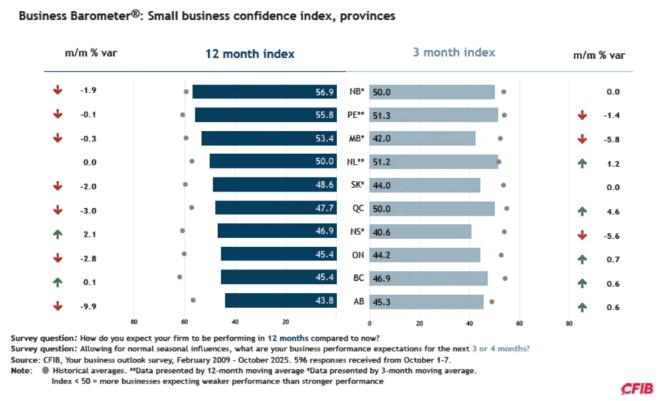
CFIB’s report—based on a survey of respondents conducted from October 1 to 7—shows that long-term confidence is declining in most provinces, with the exceptions of Nova Scotia, British Columbia, and Newfoundland and Labrador.
Only New Brunswick, Prince Edward Island, Newfoundland and Labrador, and Manitoba remain above the 50-point threshold—the level at which equal shares of entrepreneurs expect stronger and weaker performances.
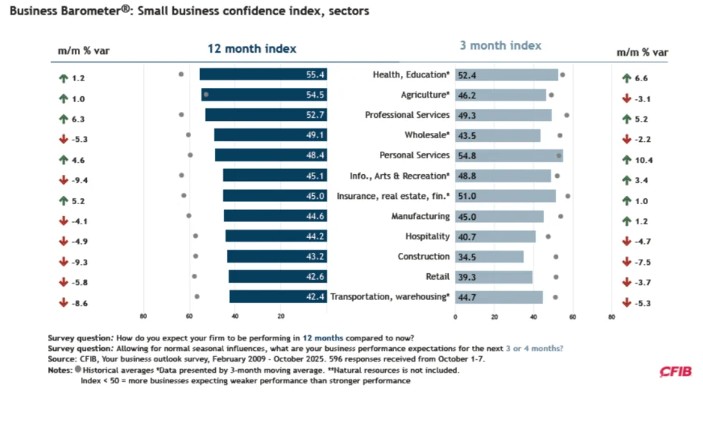
Sectorally, long-term confidence has deteriorated in most industries. However, health and education, agriculture, professional services, personal services, insurance, real estate, and financial services have bucked the trend. Of these, health and education, agriculture, and professional services are the only sectors with confidence levels above 50.
Trade tensions, inflation
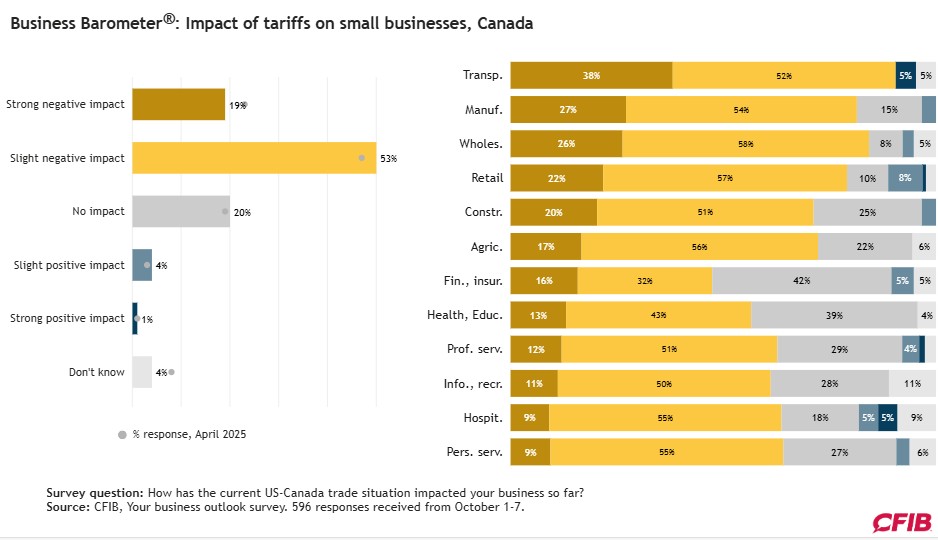
Trade tensions between the United States and Canada are weighing heavily on small businesses. According to CFIB, 72% of small business owners say the current trade situation has had a negative impact, with 19% reporting a significant effect. The transportation (38%), manufacturing (27%), and wholesale (26%) sectors are feeling the impact most acutely.
Nearly one in five (19%) Canadian small businesses facing tariff-related costs say they will not survive more than six months if current conditions persist, according to a previous Canadian Federation of Independent Business (CFIB) report.
Business health remains subpar, with the indicator at or above its historical average only eight times since April 2023, according to CFIB. Insufficient demand continues to be the primary barrier to business and production expansion, cited by 52% of small and medium-sized enterprises (SMEs). This lack of demand has exceeded its historical average for 24 consecutive months.
Inflation indicators remain unchanged from September, with the average price increase planned for the next 12 months holding steady at 2.7% for the fourth consecutive month. The average wage increase is also unchanged at 2.2%.
And labour market conditions are deteriorating, with more employers planning to reduce staff (19%) than to hire (12%). Key cost constraints hindering business growth include insurance costs (68%), tax and regulatory expenses (67%), and wage costs (64%).
Business leaders across the country are calling for increased government support, improved access to capital, and meaningful tax reform as Canada prepares for its upcoming federal budget, according to a recent report from KPMG.
Last month, the federal government announced an $80-million tariff-relief fund to support more businesses feeling the impact of tariffs imposed on Canada by United States President Donald Trump.
Earlier, Ottawa also announced it is investing $450 million over the next three years through the Regional Tariff Response Initiative (RTRI), which is intended to help businesses improve productivity, expand and diversify markets, and strengthen domestic supply chains and trade resilience.