'You have to make your employees feel safe and comfortable,' says Canadian academic providing insights, tips

“Climate anxiety” is a growing concern for many employees – and that could have consequences for many Canadian employers, according to new research.
According to a report by Sun Life, extreme heat events alone could lead to 128 million lost work hours annually by 2100. But the impacts aren't only in the future; Sun Life’s surveys reveal that over half of Canadian workers report their mental health has been impacted due to the effects of climate change. The impacts have real consequences in the workplace, with 28% of respondents reporting taking days off due to climate change effects, 31% reporting impacts to productivity and 30% saying their engagement at work has been affected.
Additionally, 28% citing absences, 31% impacts to productivity and 30% saying their engagement at work has been affected.
In a conversation with Canadian HR Reporter, Charles Cho, professor of sustainability accounting at York University, says he is “not very surprised” by these findings, explaining that climate anxiety is no longer a fringe issue but a mainstream concern affecting a significant portion of the workforce.
It’s also unpredictable, he says, due to the lack of precedent – but he agrees with the Sun Life report that turnover and absenteeism are real risks to companies that fail to take climate anxiety seriously.
The problem is that climate anxiety is an externally caused stress, Cho explains, as opposed to harassment, work overload and burnout, for example. But climate anxiety has real consequences – although “climate anxiety” is not yet a recognized mental health condition, over a quarter of respondents (27%) said they have experienced or are experiencing it right now.
“People get scared … maybe it's a great company to work for, but because the employee is psychologically affected and vulnerable, you don't know what they're going to do,” he says.
“You could lose them, and that's a serious risk.”
Uneven impacts of climate anxiety on employees
Sun Life’s research reveals that almost all (77%) of Canadian employees have experienced a severe weather event in the last three years.
As extreme weather events happen continuously closer to home, employees expect to see action or at least acknowledgment from their employers, and those who fail to respond to climate change and extreme weather events can see increased turnover.
The report also notes that organizations in regions prone to climate disasters, such as wildfires or floods, are likely to face higher turnover rates and increased absenteeism; for example, 60% of employees in the Atlantic provinces reported experiencing mental health impacts due to climate change or extreme weather events, compared to 46% in Quebec.
Effects of climate change are also experienced differently by employee group; for example, nearly half of Canadian employees under 35 report experiencing anxiety about climate change compared with 15% of Boomers, and women consistently experience more symptoms of climate anxiety and physical effects than men.
Employees with existing chronic health conditions are around twice as likely to experience climate-related health impacts, the report stated.
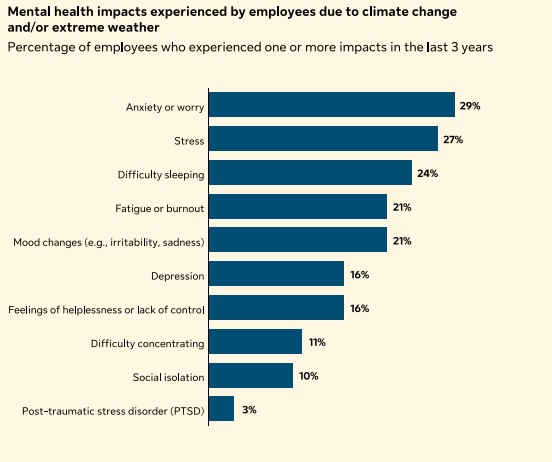
Source: Sun Life
Climate anxiety risk to employers
Cho, who researches “greenwashing” – when organizations perform environmental interest without real accountability – stresses the real risk to employers who fail to acknowledge their employees’ climate anxiety.
“Employees are one of the most important stakeholders of the company,” he says.
“Employee retention issues, human resource issues, will happen, and from the outside point of view, not doing anything – [employers are] going to get subjected to backlash.”
Plus, many employees free to take to social media to voice their feelings about their employers, which can add even more reputational risk, Cho adds.
“You have to make your employees feel safe and comfortable,” he says, explaining that doing so builds employee loyalty.
“That's a very intangible asset … there's a lot of value in employee loyalty, employee respect.”
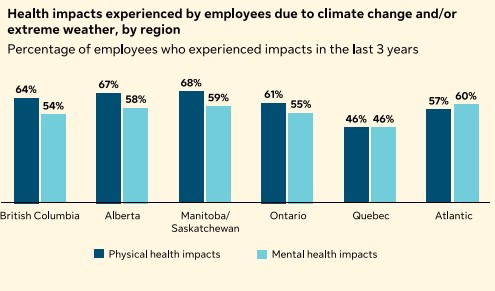
Source: Sun Life
Workplace policies and mental health support
Sun Life’s data shows that only 25% of Canadian employers have specific policies or programs in place to address climate-related health impacts, despite 54% of employees already reporting negative mental health effects from climate change.
The report also finds that employees in climate-affected regions are twice as likely to report mental health challenges related to environmental stressors.
Cho warns against employers wrapping up climate anxiety-related mental health support into existing group benefits and ERPs, recommending instead that they lean into an employee health risk that isn’t going anywhere.
“It's a very specific type of anxiety,” he explains.
“You have anxiety because of stress level or workload, families, personal issues, you have all those issues that affect your employees’ productivity. Ecological, environmental anxiety is relatively recent. It's not something that we have seen before.”
HR leaders need to focus on educating themselves and their teams and organizations about the effects of climate change on employees, he says.
“Investing, get the right knowledge. Because a lot of problem with environmental, social sustainability issues is that you don't get the right basic, fundamental knowledge,” Cho says.
“It's a niche area, but I think it's going to become bigger.”
Investing in long-term solutions
Sun Life reports that less than half of Canadian employers of all sizes believe that climate change or extreme weather have effected their workforce, but around 3/4 of them think benefit plans can be effective in supporting employees facing these challenges.
Cho points to current Canadian workplace health and safety rules, stating that some employers use them as “ticked boxes” in their own policies. Investing in climate change support for employees could be a hard sell for business leaders in the company, he admits, but tells HR leaders that stressing the long-term gains is how to get the message across.
“In the long run, research has shown that those companies who think long-term values, with intangible, non-financial kinds of investment, such as employees and social issues and environmental issues, that's paid off,” Cho explains.
“In terms of reputation, you get customers, you become a good citizen. You’re just doing the right thing. But it will take time, and that's the problem that companies have.”