From self-diagnosis to remote work, new Canadian study cites growing complexity of accommodation — with lawyer providing tips for HR

Workplace disability support in Canada is growing in volume and complexity, and while organizations are making real progress on accessibility, new tensions are emerging around mental health, remote work and what workers expect from the accommodation process.
That was a central finding of a new qualitative study from the Institute for Work & Health (IWH), presented in a recent webinar by Monique Gignac, IWH's scientific director and a senior scientist, who is also a professor at the Dalla Lana School of Public Health at the University of Toronto.
"Disability support provision is changing," she told webinar attendees. "It is really growing in complexity, volume, and there's increased organizational cooperation, and efforts are improving accessibility and inclusivity. But there are new challenges that are arising in implementing support, and they're related often to organizational and worker perceptions and expectations."
Complexities and tension at work
Gignac cited a variety of factors contributing to the changed workplace, such as COVID-19 adjustments, greater emphasis on equity, diversity, and inclusivity (DEI), increased recognition of psychosocial work factors, and AI.
“The impact of these changes on support and accommodation provisions to workers who are living with chronic or episodic physical conditions, mental health conditions, neurodiversity, is unclear.”
Much of the existing research on workplace disability focuses on workers themselves, Gignac said in the webinar, which drew more than 500 attendees, and the smaller body of work on support providers has centred mostly on managers and supervisors in office settings.
The IWH team wanted a broader view so researchers conducted hour-long interviews with 32 support providers across Canada, including HR professionals, disability managers and union representatives, from a range of sectors.
The study used the World Health Organization's definition of disability: a limitation in performing an activity that arises from the interaction between a health condition and personal and environmental factors, including attitudes, policies and practices.
"That's important because it means that a disability doesn't reside within an individual," said Gignac, and changes to work activities or practices "can help minimize or even remove activity limitations."
Overall, participants believed strongly in support provisions and felt processes were improving.
"Often the process was working well in a workplace for most workers," she said, but complexity and tension are emerging in areas such as accommodation and remote work.
‘Dr. TikTok’ and self-diagnosis
While physical and musculoskeletal conditions are still the most common reason for support requests, mental health, neurodiversity and well-being requests are growing in volume, frequency and complexity, Gignac said in the webinar.
Participants welcomed workers' growing willingness to share health needs. But some reported challenges with people “pathologizing or medicalizing” everyday stress.
"Dr. TikTok was a real problem here,” she said. “There were challenges with self-diagnosis and understanding what was required for work.”
Some participants also described workers wanting to forego parts of their jobs, said Gignac.
"Sometimes workers felt ‘Now that I've told you that I have this, that's enough, and I'd like to forego some job activities.’ Almost, in some cases like ‘My job is a bit of a menu, and I'm going to pick and choose what I can do, and there are things I don’t want to do.’"
In the follow-up interview with Canadian HR Reporter, Gignac said the issue sometimes arose with requests to avoid core parts of a role.
"Sometimes people were saying, ‘I don't think I should have to go to meetings’ or ‘I don't want to interact with this person.’ Well, that person may be your supervisor, meetings [are] an integral part of the job," she said.
"Support is about helping you to do the work. It's not about giving you a reason necessarily to give up."
Gignac noted this can be heard more often with younger workers, who may have come through an education system with many supports and accommodations and may not be prepared for the workplace.
Defining disabilities
Webinar attendees were keen for answers on how to define a disability, and where a condition such as ADHD fits in.
Asked whether neurodiversity is a disability, Gignac said no, any more than arthritis or MS.
“These are different kinds of conditions that people have,” she said.
A disability arises when someone with a condition such as ADHD has limitations with a particular work task, she said: “The disability comes from the interaction. It’s not the conditions.”
There’s an appreciation that people might work differently, and employers can try to support that, said Gignac in the followup interview.
“At the same time, if you come and say, ‘Well, I have ADHD, I can’t do this,’ that’s not the way a workplace wants to work.”
‘Nuanced analysis’ for ADHD
Whether a condition such as ADHD qualifies as a disability is "a nuanced analysis," says Alissa Scarcello, a lawyer at Piccolo Heath LLP in Toronto, adding that an employer is entitled to understand the employee's functional limitations and restrictions.
“What can the employee do in the workplace without modification, what they can do with some adjustments, and what they cannot do at all?”
Not every condition is a disability under human rights law, she says, “and in that case, your duty of accommodation has not been triggered.”
To determine whether an employee does indeed have that recognized disability, an employer still needs the medical documentation, says Scarcello — but employers cannot ask for an employee's diagnosis.
“Similarly, they should not be asking for what treatment the employee is receiving. That is sensitive information, and an employer is not going to be entitled to it, full stop."
Remote work accommodations
Also a challenging area is fully remote work, which has become "a flashpoint for questioning support processes,” said Gignac in the IWH webinar.
Participants agreed that fully remote work could improve inclusivity, help small businesses recruit and retain talent, and help larger organizations staff diverse locations. But they also raised concerns about social isolation, skills degradation and maintaining team atmosphere.
And the bigger question arose around whether fully remote work should be treated as an accommodation or a regular work arrangement.
“There was really a bigger discussion about ‘What are workers’ needs versus their rights and their preferences?’” said Gignac.
“One person said, ‘What’s the difference in working from home that you need it as the accommodation?’ And that became a very big bone of debate.”
Reasonable, not preferred
From a legal standpoint, Scarcello says employers should distinguish between two situations. In the first, the duty to accommodate under human rights legislation has been triggered — for example, by an employee with a disability — and remote work may be one of several possible accommodations.
"An employee is not entitled to their preferred accommodation. They're entitled to a reasonable one," she says.
“Where an employee is entitled to an accommodation under human rights law, let's say, remote work could be one of many ways an employee can be accommodated.”
In the second situation, no duty to accommodate is engaged because there’s no disability or medical need or human rights concern, and the request is simply an employee wanting to work from home.
"That is going to be a business decision, and it's not going to relate to what the employee can functionally do at work or their limitations and restrictions," says Scarcello.
She echoes the idea that accommodation is about enabling work, not removing it.
"The essence behind accommodation is really to enable someone to perform the core duties of their job as much as possible," she says.
Temporary modified duties may sometimes relieve an employee of some core duties, "but that's not the intention behind accommodation," Scarcello says.
"Any sort of modification is going to be temporary, because the goal is not going to be to just fully relieve an employee of their essential or their core duties."
That means regular check-ins.
"Accommodation is an evolving process where there is constant back-and-forth dialogue between the employer and the employee," says Scarcello.
The doctor's note under scrutiny
The role of physicians and other health-care providers is also a big factor in workplace accommodation.
In the webinar, Gignac said that while some return-to-work situations involve genuine safety issues that require substantial medical input, much of what participants described were requests for validation. They reported delays in getting information, health-care providers who don't understand the workplace and, on occasion, notes they felt simply reflected what the patient wanted — leading to second or third opinions and insurer involvement that was "very costly and time-consuming and messy."
Some felt a health-care professional's note should simply be accepted; others saw it as one piece of information among several, particularly for requests such as fully remote work.
"It's one thing if a person has some significant mobility restrictions where a physician might say it becomes very hard to get to the workplace," Gignac said in the follow-up interview. "It's something else when there are other conditions where it's not clear that working from home is going to be as helpful or not."
A webinar attendee pointed to a new Canadian Medical Association policy on the treating physician's role in return to work:
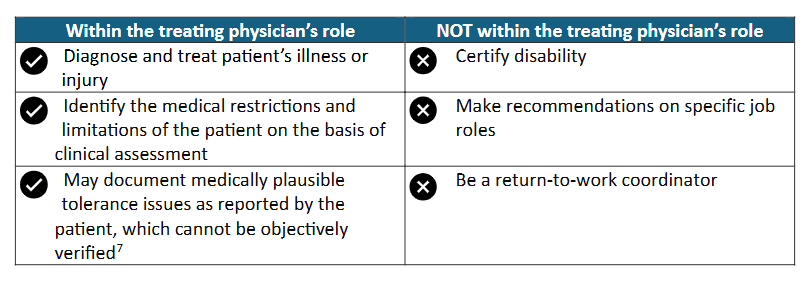
Getting better medical information
Scarcello recommends several practices for employers requesting medical information:
- Attach the job description to the medical form, so the provider understands what the role involves and how the employee may be limited or restricted.
- Ask targeted, specific questions tailored to the situation, focused on what the employee can and cannot do — not why.
- Ask how long restrictions are expected to last, which helps set the scope of the accommodation.
- Follow up if needed. There is no set limit on going back to a physician, she says; it depends on what's reasonable. If a form comes back incomplete, it's reasonable to send another with more directive questions.
"I'm a fan of direct, short, quick forms that physicians can respond to and that remove the potential for ambiguous responses," she says.
Overall, it’s about flexibility.
"There's no one-size-fits-all approach, and I think that is the most important piece about accommodation,” says Scarcello.